Episode 156: The Mosquito Bowl, WWII and Purdue’s Undefeated 1943 Football Team

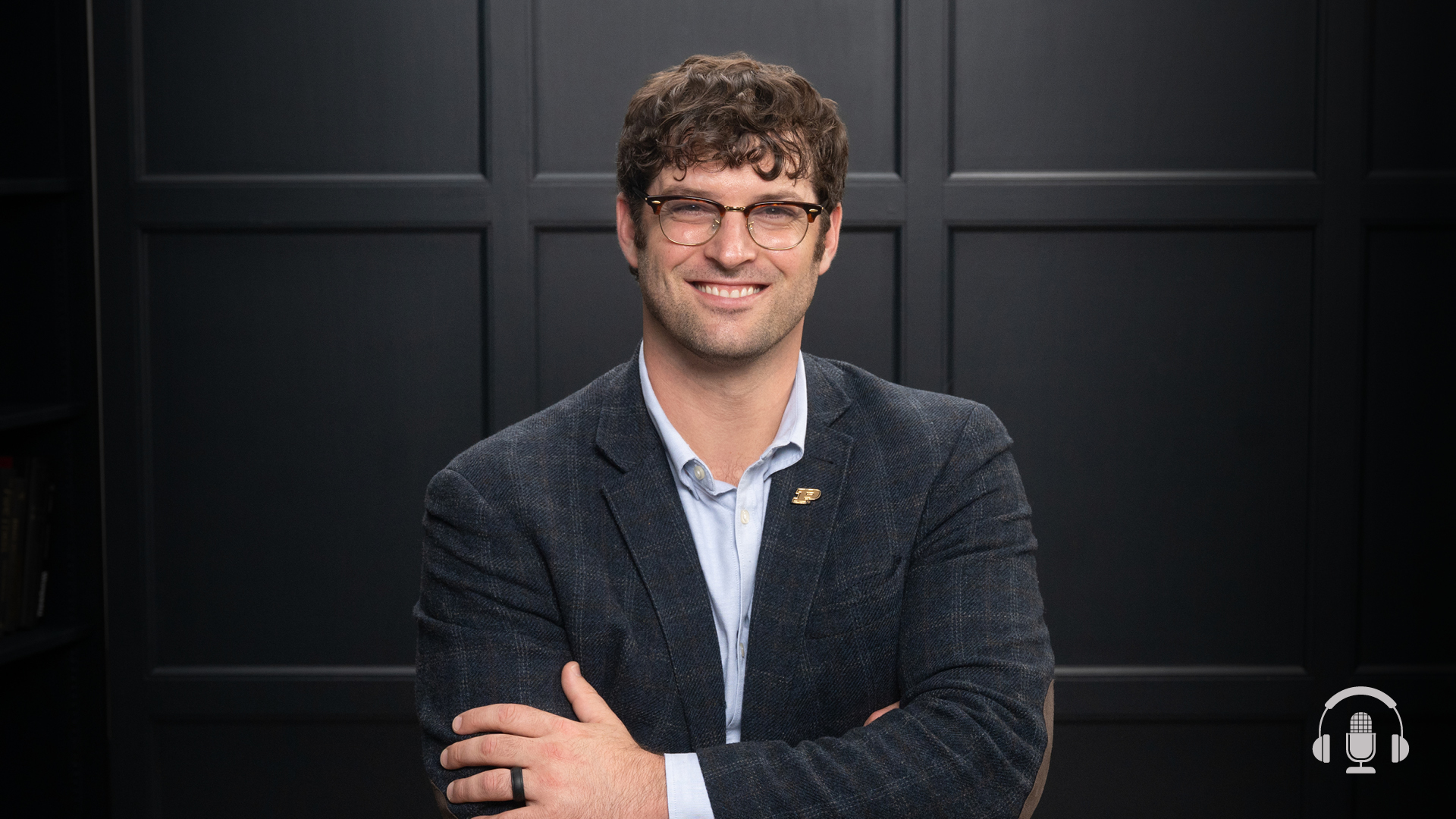
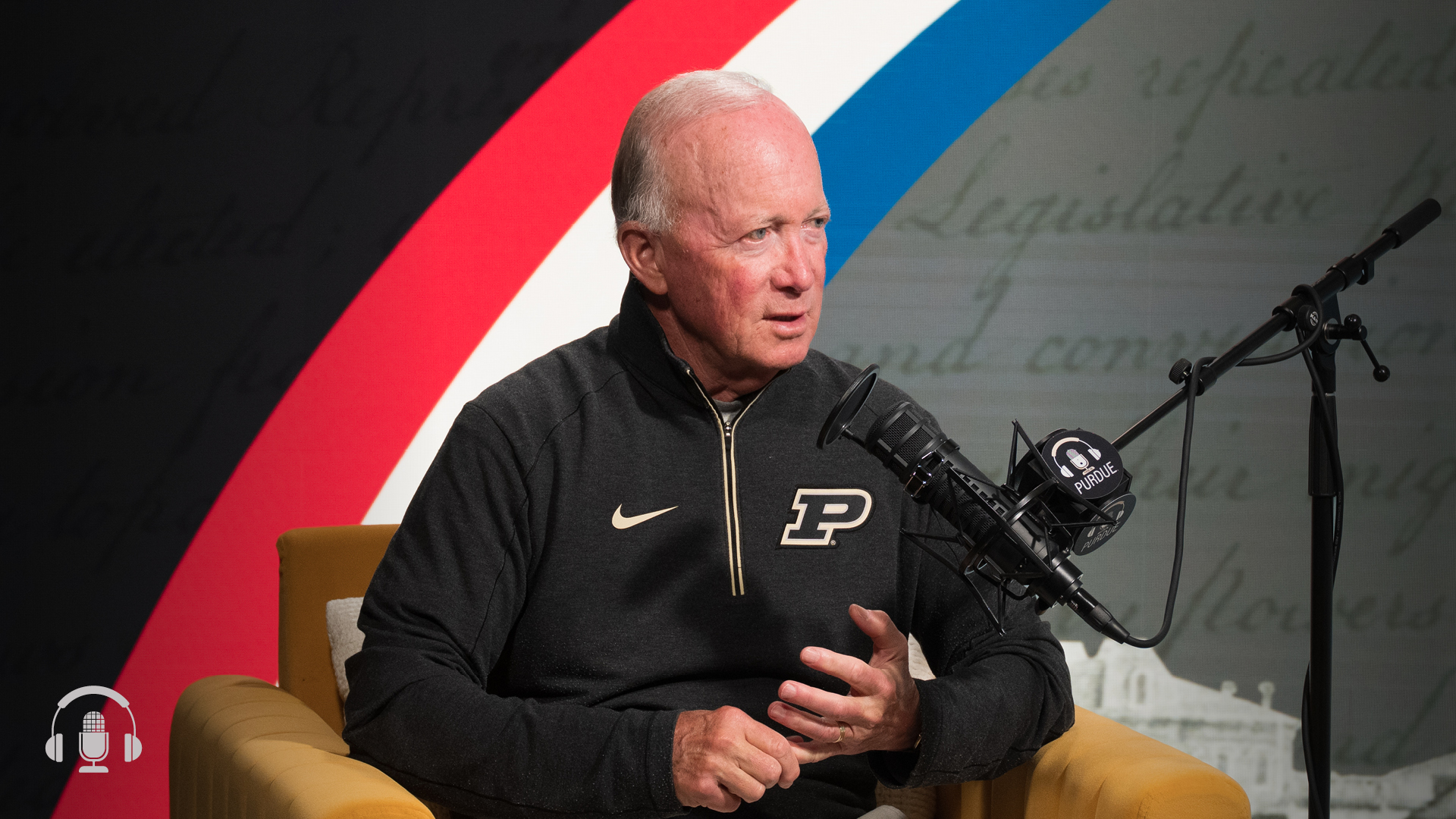
In this episode of “This Is Purdue,” we’re talking to Cory Palm (MA public relations and sport management ’08), director of broadcast services for Purdue Athletics and author of “Perfect Warriors: Touchdown Tony Butkovich and the 1943 Purdue Football Team.” As a proud Purdue alumnus with a decades-long broadcasting career, Cory is an expert in all things Big Ten athletics.
Today, he’s diving into “Perfect Warriors” and his documentary of the same name, which has aired on the Big Ten Network more than a dozen times. A focal point of both works is Tony Butkovich, a Boilermaker, All-American fullback and Marine who is depicted in a new film called “The Mosquito Bowl.” It’s an incredible story about the sacrifices that the Greatest Generation made during World War II. Cory provided key historical insights to director Peter Berg during the film’s preproduction process. The movie will be released on Netflix on Nov. 25.
In honor of Veterans Day, join us as we get an inside look at this major motion picture and discuss Purdue’s World War II contributions.
In this episode, you will:
- Learn more about Purdue’s undefeated 1943 football team, including some players’ unique position as students, star athletes and service members who were part of the V-12 Navy College Training Program — a World War II initiative that produced college-educated officers for the U.S. Navy and Marine Corps.
- Hear more about Purdue President Edward Elliott’s key role in the country’s World War II efforts, from advocating for the V-12 program to serving as chief of the Division of Professional and Technical Employment and Training within the War Manpower Commission.
- Discover more about Butkovich — the son of an Illinois coal miner who emigrated from Croatia — who set a Purdue single-season record with 16 rushing touchdowns in just seven games, a record he now shares with Boilermaker great Kory Sheets.
- Find out more about the Mosquito Bowl — the legendary pickup football game played on Guadalcanal island on Christmas Eve in 1944 — and how it was the last game Butkovich and other college football stars like him played just months before the Battle of Okinawa.
- Tune in for key takeaways about “The Mosquito Bowl” film, which is based on Pulitzer Prize-winning author Buzz Bissinger’s book of the same name, and what it was like for Cory to connect with prominent director Peter Berg during scripting and preproduction.
- Get insights into Purdue’s vital role during World War II as a land-grant institution, including its support of the GI Bill, which helped veterans adjust to civilian life and increased student enrollment.
- Hear more about Cory’s role at Purdue Athletics, including why he’s passionate about athletics storytelling and the premise for his new book, which covers the 1903 Purdue train wreck that killed 17 people, including 14 Boilermaker football players.
- Learn more about why the Mosquito Bowl still matters today, the enduring legacy of Purdue’s undefeated 1943 football team and how the sacrifices these men made were pivotal to the broader war effort.
You don’t want to miss this episode with a Boilermaker who’s uncovering Purdue Athletics’ unique military history — and helping bring these stories to global audiences!
- Watch our full video interview with Cory
- Learn more about Cory
- Learn more about the “Perfect Warriors” book
- Learn more about the “Perfect Warriors” documentary
- Read our story about Butkovich and the undefeated 1943 football team
- Learn more about Purdue Athletics
- Learn more about Purdue football
- Learn more about Peter Berg
- Watch “The Mosquito Bowl” film trailer
- Learn more about Buzz Bissinger
- Learn more about Buzz Bissinger’s “The Mosquito Bowl”
Podcast Transcript
CORY PALM: This is Cory Palm, and you’re listening to This is Purdue.
[MUSIC PLAYING]
KATE YOUNG: Welcome to This is Purdue, the university’s official award-winning podcast. I’m Kate Young, your host and a proud Purdue alumna. This is Purdue is all about sharing big ideas that spark broad interest and get people talking. We’re passionate about highlighting notable Boilermakers who are powering innovation and working together to solve today’s toughest challenges.
Tune in to each episode as we have engaging conversations with Purdue alumni, faculty, researchers, coaches, and more who are inspiring change through small steps every day across timely topics like sports, well-being, emerging tech, and life-changing research. Join us as we discover how these Boilermakers are taking their next giant leap.
CORY PALM: I’m sitting at home, and I get a random email from a guy named Peter Berg, who introduces himself as a movie director. And I’m reading this thinking, first of all, there’s no way this is real. I have to make sure this is real. But also, I know who you are. I’ve watched all of your movies. I’m a huge fan.
So he would call and break down the film on the phone. He’s like, what were some plays that worked for Purdue? What did the uniforms look like back then? Just everything from the Purdue angle that I could give him.
KATE YOUNG: In this episode of This is Purdue, we’re talking to Cory Palm, the director of broadcast services for Purdue Athletics, a Boilermaker alum, and author. In honor of Veterans Day, we’re having a special conversation about Purdue’s undefeated 1943 football team, which featured a collection of future Navy and Marine officers from across the country who came to Purdue to participate in the V-12 Navy College Training Program.
The goal of this World War II initiative was to produce college-educated officers for the US Navy and Marine Corps. See, Cory wrote the book Perfect Warriors, and one of the key players that he profiled, a Boilermaker Marine, an All-American fullback, Tony Butkovich, is now being featured in an upcoming film called The Mosquito Bowl, directed by Peter Berg. The
Movie is releasing on Netflix on November 25 and also centers around Tony, along with three other Marines preparing for the Allied invasion of Japan. It’s based on Buzz Bissinger’s bestselling nonfiction book of the same name. Peter is best known as the director of Friday Night Lights, the movie and the TV show, which was also based on the book Friday Night Lights– A Town, a team, and a Dream by Buzz. We’ll get more into their connection here soon.
And it gets even better. This is Purdue had the incredible opportunity to sit down with Peter for a virtual interview. We talk all about bringing The Mosquito Bowl story to life for millions to stream, how Ray Nicholson nailed his role as Touchdown Tony in the movie, and so much more. Be sure to check out that special episode on Monday, November 23. You will not want to miss it.
As for Cory, he says he’ll never forget the day Peter popped up in his inbox out of the blue to ask about his book. So let’s get to it. Here’s my conversation with Cory.
Cory, thank you for joining us on This is Purdue. We’re thrilled to have you.
CORY PALM: Glad to be here.
KATE YOUNG: So we are going to dig into an upcoming Netflix movie and your participation and help shaping this movie. It’s super exciting. So right now, you are the director of broadcast services for Purdue Athletics. You’re a Boilermaker alum, but you’re also an author.
So we’re going to dig into your book, Perfect Warriors. We’re going to talk a little bit more about how that played a key role in this Netflix movie, The Mosquito Bowl. But let’s jump in right away about how this team that you wrote about winded up at Purdue, this 1943 undefeated football team.
CORY PALM: Yeah, the perfect warriors, as it were. So it’s a really unique team in Purdue football history. It was a group of players about– well, about 90% of the team was from– they began their college careers at other schools, but at the outset of World War II, joined the Navy or the Marines and got shipped off to officer training, which there was a new program at the time, the V-12 Officer Training Program launched at campuses across the country.
And the Navy shipped these guys to different locations so they could get prepared in the classroom for war. They were able to also play football on the side, so it was a great collection of talent. A big group from the University of Illinois came over, including Tony Butkovich, who we’ll talk quite a bit about. But they got here and just became one of the best football– I would say the best football team in the country that year.
KATE YOUNG: Take us back to this era. What was it like at Purdue during this time? We were under President Edward Elliott’s leadership, the V-12 training program’s happening. What was it like back then at Purdue?
CORY PALM: Yeah, it was interesting. So President Elliott was near the end of his 20-ish year run. He was in his second decade at Purdue and really well connected. He had a lot of connections in Washington and was hooked in with the Roosevelt administration pretty good. So when the war broke out, he was really relied on by DC.
He joined the War Manpower Commission, had a leadership role in that, and that sort of led to training programs, the advent of a lot of college-based training for officers, which is what these programs became. As Purdue’s president, as an advocate for his university, he made sure that Purdue was involved in the Navy’s program and the Army’s similar training program the army had.
Campus enrollment at the time was about 7,000. Almost half of that, about 2,200 men, enlisted when the war broke out. The university could have fallen on dire times if they hadn’t been involved in these wartime programs. So it was a boon for President Elliott to make sure that Purdue was involved.
KATE YOUNG: This is a very unique time. They were training to be officers. Like you said, they’re students, and then they’re football players. What was it like for them based on your research back then?
CORY PALM: Yeah. So I ran across the daily schedule for these Marines. Reveille was at 5:45 every morning, and then they had calisthenics. And then they had a set time for breakfast and a four-hour block for classes. They had some physical training
That they had to do throughout the day, but their afternoons were free. And they had about 1 o’clock to 5 o’clock where they were able to have free time. And it just so happened that a large chunk of them went out for football. And so they were able to become Boilermakers instantly.
These guys didn’t get on campus until July 1 of that year, and they knew that a lot of them would be leaving before the end of the calendar year. So they just embraced it, joined the football squad. And some of them knew each other from the previous schools, and some of them had played against each other from some previous schools. So I’m sure that was an interesting mix. But life on campus– I can’t imagine how much different it was from one year to the next because of the war. Everything changed.
KATE YOUNG: This episode is going to be released around Veterans Day, and that ties into our whole conversation today. But how does the story of this team speak to the broader contributions of Purdue’s contributions to World War II?
CORY PALM: This story is just a microcosm, really, of everything that Purdue did academically. They flipped a lot of academic programs to be war-focused programs. The engineering aspect of Purdue has always been huge, but it became even bigger at the time.
The fact that Purdue had an airport on campus– about a decade old at that point, but that became a huge tool as well. They started turning out actually not pilots, but pilot trainers so that these guys could get their education in teaching how to become pilots. Because the army had just this gigantic need for pilots all of a sudden.
Everything, like I said, shifted at Purdue. It was fun researching for the book and for other projects, flipping through old issues of the Purdue Debris from the early ’40s. And just every single thing on campus was war focused because it had to be.
KATE YOUNG: The Mosquito Bowl movie is coming out on Netflix on November 25 and then select theaters before that. Hopefully, in Indiana, like we talked about. But that centers around this Tony Butkovich from Purdue. It’s directed by Peter Berg. I mean, these are big Hollywood names that we’re about to talk about here. What was it like assisting the team with the research, giving them access to video footage? Tell us about that process.
CORY PALM: It was one of the best professional experiences of my life. I’m sitting at home on a Easter Sunday two years ago, and I get a random email from a guy named Peter Berg, who introduces himself as a movie director. And I’m reading this thinking, first of all, there’s no way this is real. I have to make sure this is real. But also, I know who you are, dude. I’ve watched all of your movies.
An email led to an email conversation, which led to a text message. It was the day of the Purdue versus Tennessee Elite Eight game. So he was talking to me about basketball and advocating for going on the Final Four trip. Let me put you in touch with my bosses, and we’ll make sure this happens.
But that led to a phone call conversation, which was, a half-hour phone call. And just it snowballed from there. And I’ve been in touch with Pete Berg– he’s in my phone–
KATE YOUNG: No big deal.
CORY PALM: –for two years now. And he would call me out of the blue if he wanted to talk about something. He asked for some game film, which we happen to have, and I sent it to him. So he would call and break down the film on the phone.
He’s like, what were some plays that worked for Purdue? Can you diagram those for me and send them to me? And what did the uniforms look like back then? Can you get me some photos or some video, and just everything from the Purdue angle that I could give him, I’m all about, let’s make sure this looks good and is right. And I have no doubt in his hands it will.
KATE YOUNG: How did he come up with this idea? Did he share a little bit about that?
CORY PALM: He did. So there’s a book called The Mosquito Bowl written by Buzz Bissinger. He wrote Friday Night Lights back in the ’80s, which became the iconic TV show and movie. And him and Pete are second cousins. So they know each other. They’ve worked together quite a bit.
And when Buzz wrote The Mosquito Bowl, Pete probably knew at the time he wanted to turn it into a movie. So when he reached out to me, it was because he was researching. And on YouTube, he ran across the documentary that I’d made about the Perfect Warriors team, the ’43 squad. He just wanted to connect on that and pick my brain a little bit, and it went from there.
KATE YOUNG: Incredible. So let’s dive into Tony a little bit more. He was the son of Croatian immigrants. He was at the University of Illinois before he came over to Purdue. He broke all types of football records. So let’s dig into him and why he was a focal point in the documentary and the book.
CORY PALM: Sure. There were a lot of stars on that team. I think he was probably the brightest for Purdue in ’43, which is interesting because he wasn’t spectacular at Illinois. They had another running back that they featured quite a bit in 1942, and Tony didn’t do much for the Fighting Illini.
The first-generation college student, son of immigrants who were coal miners in Central Illinois, it was still a big deal for him to be at college. He was a three-sport athlete at the University of Illinois. He played baseball and wrestled as well, which was more common back in the ’40s, but still pretty fantastic. Probably could have been a pro baseball player. From everything I read, he was that good. He was drafted by the Cleveland Rams in the NFL after his year at Purdue.
But when he broke the Big Ten scoring record, which sort of became the focal point of the season, it was a no-brainer to make him the focal point of the book. The whole story of the season wrapped around that record and what it meant to not just him, but the entire team, as it turned out, was a great story to tell.
KATE YOUNG: And it’s so different, obviously, back then verse today. It seems hard to imagine. But how does that reality speak to the notion that this team back then was bigger than football itself?
CORY PALM: I think just the situation they were in. They knew they were here for a few months, and they were going to make the best of it. But they knew they were going on to something more important. The fact that a large chunk of them left during the season because the Marines shipped them out to basic training, it was just part of it. And they accepted it because that’s what they signed up for.
The head coach, Elmer Burnham, was just in his second year with Purdue, and he was a different character. He believed in the importance of sport, but he saw it within context of a larger part that it can play in a young man’s life. He didn’t take anything too seriously. He knew what he had in this team, and it was fun reading some of the accounts from the day.
They would go to practice some days and not practice football at all, really. They’d run around and have fun. But he knew they were prepared to play Iowa on Saturday or Ohio State or whoever. He knew that they were good enough to compete, and also that it was more important that they have a great experience and bonding together rather than getting one more rep of some silly hand-off.
KATE YOUNG: Yeah. Was there anything in your research that these players were– they had all these other obviously responsibilities. But was football for them kind of that chance to escape from reality?
CORY PALM: It really was, just a chance to do something that they’d always grown up doing– playing a game with their friends. And with everything else staring them in the face, they knew that. When I first started doing research on this, I was fortunate enough to be able to talk to a few members of the team who were still alive. And they reinforced that. They knew that what they were doing was the fun part, and they had serious life to live, for sure. But they didn’t let that slip past.
KATE YOUNG: So The Mosquito Bowl, named after the book, now the movie, it was a game that happened. So let’s dig into the game and its significance in history and Tony’s role in that game as well.
CORY PALM: Yeah, it was Christmas Eve, 1944 on Guadalcanal. At that point, the United States had possession of Guadalcanal, the island, for about a year and a half, and had used it as a forward staging area for what was to come next, and also a training ground for jungle warfare.
Tony and his unit got to the island in September. And by all accounts that I’ve read and documentaries I’ve watched, these guys were bored off their minds by December. They were tired of training. They were tired of living on the island and dealing with crabs and the rain and everything that you can imagine–
KATE YOUNG: The bugs, right?
CORY PALM: –bad conditions, the bugs. Yep, absolutely. It didn’t go unnoticed that there were a lot of great football players in these units. One thing led to another at a bar conversation and probably some bets involved I would imagine, knowing young men in their 20s. And it just became an event that everyone was in favor of because it was just a release. And a lot like the men who were on campus at Purdue, it became something fun for them to look forward to and then do.
There were a handful of All-Americans in this game, guys from Notre Dame and Purdue and schools across the country. But Tony was the star. He was the All-American fullback. He suited up for his unit and faced off against a couple players that are also main characters in the book, a couple players from Wisconsin and one from Brown University in Providence, Rhode Island. Those are the characters in The Mosquito Bowl book and then in the movie. But yeah, Tony was definitely one of the stars.
Different accounts from the time say the game ended in a tie, which nullified every bet for either side, of course. The things I read said that it was a scoreless tie. I can tell you with confidence that’s not how it will be portrayed in the movie, which is great. Some artistic license will most likely be taken there.
KATE YOUNG: What do you think this meant to those men?
CORY PALM: I can’t imagine the joy they must have felt. They didn’t have pads or helmets or any sort of gear, and they were playing on a coral rock, basically. So it started out as intended to be a touch football game. It didn’t last long.
KATE YOUNG: I bet. I bet.
CORY PALM: But the joy they must have had in playing, I can’t imagine. After what some of them had been through already, what some of them knew what was around the corner, to be able to get one more chance to play football had to mean the world to these guys.
KATE YOUNG: So sadly, 15 of the 65 players in the Mosquito Bowl were later killed, including Tony. And according to Buzz, he said this was the largest number of American athletes ever to die in a single battle. Many more were injured. So many soldiers perished. And when you hear numbers like that, what goes through your mind when you think about this game and then the sacrifice that occurred later?
CORY PALM: It’s heartbreak. Okinawa– I didn’t know much about the battle until I researched this book, and it was just one of the most gruesome battles, one of the bloodiest battles in the entire war from either theater. 250,000 people died from both sides in this two-month span. It’s terrible.
It was the final piece in the United States and the Allied forces hopping across the South Pacific. The next step, everyone knew, was the mainland of Japan, and that would have been the next invasion. The Japanese knew that, too. So they were fighting for Okinawa with everything they had. It just became this horrible bloody slog that took a lot of great men’s lives, including Tony’s.
KATE YOUNG: So jumping back to Purdue’s role during World War II, President Edward Elliott’s leadership. We talked a little bit about his involvement with then-President Roosevelt, the GI Bill. How did the GI Bill help support Purdue’s service members back then?
CORY PALM: Yeah, that’s fascinating. So Vice President R. B. Stewart, who Stewart Center, I guess is named after, he was one of the architects of the GI Bill. He served on several government commissions, too. So did Dean Potter from the engineering department.
The GI Bill– basically, I think you can give it credit for more than doubling Purdue’s enrollment in the post-war years. I said there were about 7,000 students in 1940. By 1948, it was almost 15,000 enrolled at Purdue and leveled out for a few years as the university figured out how to deal with twice the size of population, but then steadily grew from there.
And programs grew, and the need for faculty grows. And then it’s a domino effect, for sure. But you can’t overstate how important the GI Bill was for the university, I think, and for the men who came back, who had to figure out what to do with the rest of their lives. And college was a great option for a great many of them.
KATE YOUNG: And then with that context, why was Purdue’s role as that land-grant university so important?
CORY PALM: As a land grant institution, Purdue took it very seriously that there was a military component in the Morrill Act in the 1860s. So up until and leading into World War II, it was mandatory military training for first- and second-year students. Male students, naturally born citizens had to take military classes, which again made Purdue a unique place for the war effort.
It had an artillery ground and working cannon on campus and students who knew how to use that. So they were ready made soldiers. I think the engineering background, and like we talked about with the airport, there were so many things that Purdue offered in the way of supporting the military. It was such a natural fit.
KATE YOUNG: How did this 1943 football team serve as that example of that persistence, the grit, the duty, coming together for a common goal during this World War II era?
CORY PALM: These guys, they had a unified mission in mind. That can be said for so many of that generation. I think what makes these guys great is that they weren’t unique. They were part of a larger whole, and they all understood that. And maybe that’s a mindset that is unique, but maybe lost to many of us over the years. They’re a great example of how a disparate group can come together and achieve something, live in the moment, exist together in the moment, and achieve something great, even though they know that there’s a larger goal out there.
KATE YOUNG: Sure. Let’s dive into your background as a Boilermaker. What made you want to dig into this story? It was first a documentary, then you turned it into a book.
CORY PALM: So I was a graduate student working in the Strategic Communication Office for the Athletic Department, and I was doing some research on Kory Sheets, who was our star running back late in the Joe Tiller era– 2006, 2007. And I noticed that Kory Sheets was creeping up on some career touchdown records and some single-season touchdown records. And every time I looked at the media guide, I would see Leroy Keyes, who we all know, and Mike Alstott and Otis Armstrong and Tony Butkovich.
And I said, I know these guys. Who’s this guy? I’ve never heard of this character. And then the further I dug, oh, he played here for one season. Well, that’s weird. How come he only played here for one– OK, it was the early ’40s. I wonder if it was war related. And I kept looking and found his story. There’s some shorts written about him. Even back in the day, I was able to find those.
And it kind of went from there. I started putting this together. And the more I read about him, the more questions I had. OK, he was a member of the V-12 program. What was that? He came here from Illinois with a bunch of teammates. Who were they? And some of them were really prominent players in college football history, too. So it just kind of snowballed.
I wanted to tell these guys’ story because if I didn’t know it, then I’m sure a lot of other folks didn’t know it as well. So we’re here to tell stories, and I was able to figure this one out. I reached out to a couple of people on campus to see if there was any archival footage from that era.
And there was. I reached to a couple peers at other schools to see if they had game footage from that era, and they did. And I ended up with four or five game films from that year, and then some locator footage on campus of officers marching and doing all the things that soldiers do. It came together as a really fun documentary, and then it still lived on. I did a 30-minute documentary for Big Ten network, but there’s more to this story, and the only way I could tell the rest of it was putting together the book.
KATE YOUNG: What was your writing and research process like when it came to the book?
CORY PALM: It started with microfiche at the Tippecanoe County Public Library before everything was digital. Because I’m very old, Kate. I don’t know if you knew that. I found a lot of newspapers online, and I would go back and read stories from the Journal & Courier and the Indianapolis Star and the Purdue Exponent, anything I could put together. And then I would literally just report on the game.
Here’s what happened during the game. And here’s some reports from practice in the lead-up to that week against Marquette or against Ohio State. some fun stories– I won’t ruin them all. But the game at Ohio State, we actually played in Cleveland that year, in Cleveland Stadium, which I learned while researching that the Cleveland Indians had done spring training on campus at Purdue at the time.
KATE YOUNG: Wow.
CORY PALM: Because Major League Baseball had a World War II rule that they couldn’t go South for spring training. So they did spring training in Lambert Field House–
KATE YOUNG: Wow.
CORY PALM: –for a couple seasons. I know. Fantastic. And so that became an aspect of the book. And then we ended up back in their stadium for the game that fall against Ohio State. So really neat stuff like that, just little stones–
KATE YOUNG: Little nuggets–
CORY PALM: –yeah– you uncover, and it becomes a grander story.
KATE YOUNG: So your role with Purdue Athletics now, you play a huge part in the storytelling, like you just mentioned, helping students build hands-on experiences to work in the sports industry. What’s it like helping to share Purdue’s modern-day stories like this once you’ve already written a historic piece like that?
CORY PALM: Right, right. There’s great stories to tell. It’s the cool thing about college athletics is every team has 10 or 12 or 110 members, and each one of them has a unique story. Figuring those out and sharing those– finding the best way to share those has been a great challenge and a lot of fun.
I work more on the broadcast side now, so I work with undergrads who produce live games for the Big Ten+, the StudentU. And so I’m working with announcers and producers. And OK, what’s the story in this game? How can we tell– how do we make our viewers care about this Purdue versus Michigan soccer match-up? What matters, and how can we showcase that? And it’s just ever evolving.
KATE YOUNG: That’s amazing. We also hear you’re working on another book.
CORY PALM: I am.
KATE YOUNG: Tell us about this project now.
CORY PALM: It’s a sickness.
KATE YOUNG: [LAUGHS]
CORY PALM: This one– another story that I’ve read a little bit about. And it’s the same set of facts, no matter where you turn, is the 1903 Purdue train wreck. And Purdue was going to play Indiana in Indianapolis on Halloween of 1903. And some miscommunication on the train lines led to a horrific accident where the Purdue Special collided with some coal cars, and 14 members of the Purdue football team died in that wreck– a couple civilians as well. It just so happened that the team was in the first car, which was the one that took the brunt of the damage.
It was 120 years ago, so it’s tough to find a lot of sources. I’m approaching it as a historical fiction. So I’m trying to base as much of it in fact and reality as I can, while sort of filling in the blanks with fiction narrative.
KATE YOUNG: How interesting. I remember reading about that in the All-American Marching Band. One of their books had a little segment on that.
CORY PALM: Yeah, they were on the train as well. So, yeah.
KATE YOUNG: OK, wow. Well, when it comes to The Mosquito Bowl movie itself, how does it feel to you knowing that your contributions are going to be part of this big Netflix movie here very soon?
CORY PALM: It’s been surreal for the past year and a half. Pete invited me to the set to watch some of the filming, and it was the opportunity of a lifetime that I had to turn down because it was in Australia. And I’m like, dude, why couldn’t you film this in Florida? Come on.
So I regret a little bit not making that happen. But I would wake up randomly to text photos from the set that he would send me. So he understood and has been awesome throughout. The process has been really cool. It’s probably the coolest thing in my career. I’ve done a lot of cool stuff. So to be able to say that is really neat. I cannot wait to see the finished product.
KATE YOUNG: I was going to ask, have you had a sneak peek?
CORY PALM: I have not. He sent me the script when he was done with it.
KATE YOUNG: Oh, wow. So you had access to that.
CORY PALM: I had access to that, yeah, a little over a year ago. And it was fantastic. Like I said, he took some creative license, but that’s how Hollywood works. The extent of my inner workings, or side of the inner workings, I guess– I saw the script. I’ve seen some photos from set, but everything else I’m consuming along with everyone else.
KATE YOUNG: So you didn’t get a hand in which actors are playing which role?
CORY PALM: I did not. I didn’t. And I don’t think I could have picked any better if I had because I’ve heard Ray Nicholson is phenomenal as Tony. I’ve only seen Ray in, I think, one other thing. He’s a young man, but he comes through a great lineage. Obviously, his dad’s Jack Nicholson. So if he’s anything like the old man, it’ll be great.
Some of the other young stars my daughter’s more interested in them than I am. Bill Skarsgård is awesome. He’s another one that comes from a great lineage. I just know him as Pennywise from the It movies.
KATE YOUNG: Oh, he was the clown in It? Oh, wow.
CORY PALM: The cast is going to be phenomenal. I just can’t wait. I’m certain there was a lot of competition to get on this movie because Pete Berg launches careers, and he has been for decades. And hopefully he’ll do that again here.
KATE YOUNG: Well, in this era of streaming, you have access to millions and millions of people watching it.
CORY PALM: Yeah.
KATE YOUNG: It’s incredible.
CORY PALM: It is.
KATE YOUNG: So more than 80 years after the Mosquito Bowl, why does this story still matter?
CORY PALM: I think it matters– it’s important to keep it alive. I think it matters because it tells a piece of our institution. We’re here because we love Purdue. Purdue’s role in World War II was small, as everyone– individual institutions was, but it certainly played a role in the outcome. And to be able to recognize that and the men who made it happen– I love trying to get the word out on that. It’s the best of what we can be, I think, as a university working toward a greater goal, educating and helping young men and women achieve their dreams and achieve their potential. And that’s what this story is.
KATE YOUNG: How do you think that 1943 Purdue football team and members like Tony– how does their legacy endure today on campus?
CORY PALM: I think their legacy is more of an abstract just because their story is not super well known yet.
KATE YOUNG: Sure.
CORY PALM: Hopefully, this helps a little bit. But what they stood for and what they accomplished is what we all hope to accomplish in our time here and our time on Earth is to do an absolute good and to work together and to fulfill your destiny, I guess. That’s maybe a bit too lofty and flowery. But I think these guys knew what they were trying to accomplish, and they did so.
KATE YOUNG: Absolutely. Sports, and football, in particular, often directly reflects a country at any given time. What do you think the state of sports tells us about the US today?
CORY PALM: Hmm. That’s an interesting question because I completely agree with you, that sport can mirror where society is at. And I think right now the state of college athletics and athletics in general mirrors where we’re at as a society where maybe some of the team is lost in pursuit of the individual. And we see that with a lot of stories that come out of college athletics.
But I think that we’ll also recognize that the true greatness still comes when a team comes together. And so groups, sports teams that can figure out how to serve the individual while staying together as a team are the ones that will accomplish. And I think we see that in society as well.
KATE YOUNG: I love that. That was a great answer. Well, Cory, it’s been a total pleasure. Is there anything else I missed? Anything you want to say to promote the movie, your book? I know you can buy your book on Amazon.
CORY PALM: Yep, it’s available on Amazon. You can watch the Perfect Warriors documentary on YouTube. I’m glad that this story is getting a chance to be told. I hope everybody goes and sees the movie.
KATE YOUNG: Perfect timing in alignment with Veterans Day.
CORY PALM: Yes.
KATE YOUNG: And, of course, the movie releasing November 25. So it was so nice to talk to you. Thank you.
CORY PALM: You, too. Thank you.
KATE YOUNG: What an exciting time for Cory. Remember, you can stream the Mosquito Bowl movie on Netflix starting on Wednesday, November 25, right before Thanksgiving. And don’t forget to check out our special episode with Peter Berg later this month on YouTube or your favorite podcast platform. That one comes out. Monday, November 23.
This is Purdue is brought to you by Purdue Brand Studio. The podcast is hosted and produced by me, Kate Young. The creative team behind the show’s videography, design and writing and research includes Paul Zink, John Garcia, Jason Doty, Cheryl Glotzbach, Ashvini Malshe, John Underwood, and Dalani Young. Social media marketing is led by Maria Welch, and our project manager is Rain Gu.
Thanks for listening to This is Purdue. For more information on this episode, visit our website at purdue.edu/podcast. And head over to your favorite podcast app to subscribe today so you never miss an episode. You can also check out all of our podcast video content on our YouTube page– youtube.com/@thisispurdue. And as always, boiler up.
[MUSIC PLAYING]