Episode 151: Is TikTok Lying to You About Protein? The Truth About Nutrition Trends
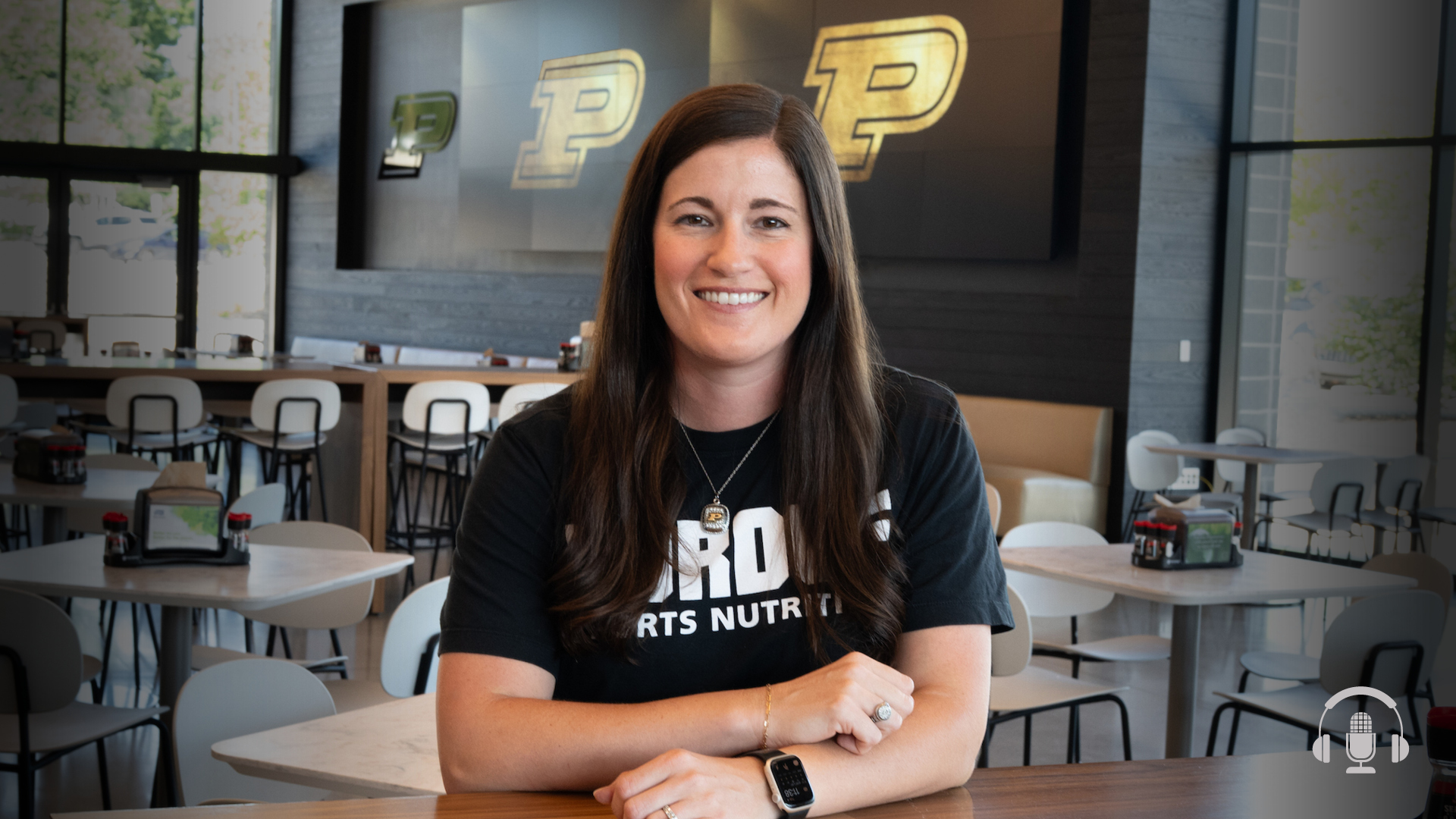
In this episode of “This Is Purdue,” we’re talking to Lauren Link (BS dietetics/health, fitness and nutrition ’11, MS health and kinesiology ’19), assistant athletics director of sports nutrition for Purdue Athletics.
As a registered dietitian, Lauren and her team manage the menu planning, nutrition education and food service for 18 varsity teams at Purdue, including basketball, football, volleyball and soccer. She’s also a proud graduate of Purdue’s College of Health and Human Sciences and a former collegiate athlete herself.
The nutrition expert sits down with host Kate Young to debunk the myths — and explain the realities — behind the recent health crazes dominating our social media feeds.
In this episode, you will:
- Learn more about what’s fueling viral nutrition trends on TikTok, including the protein craze and “fibermaxxing,” and why we should be cautious about who we get our health information from.
- Hear how doctors, dietitians and nutritionists can use social media to combat health and nutrition misinformation.
- Discover more about the national rise in the use of GLP-1s and how it’s impacting the protein industry and the overall population.
- Get the facts about the U.S. supplement industry and how to be more informed the next time you’re buying vitamins or supplements.
- See what Lauren has to say about the types (and amounts) of food the average adult needs to consume daily to stay physically and mentally well — without breaking the bank.
- Dive deeper into how AI is changing the health, nutrition and fitness space and Lauren’s expert tips for using AI for your weekly shopping and meal planning.
- Find out about Lauren’s vital nutrition coaching work with Purdue’s student-athletes and how she helps them perform at an elite level and center their well-being.
- Hear more about Lauren’s Boilermaker journey, including her time as a Purdue soccer player, and why she’s passionate about helping students successfully transition into life after elite sports.
You don’t want to miss this fascinating episode with a Purdue alumna who’s empowering Boilermaker athletes in their health and nutrition journeys!
- Watch the full video interview
- Learn more about Lauren Link
- Learn more about Purdue Athletics
- Learn more about the Gelov Family Purdue Athlete Dining facilty
- Learn more about student-athlete development at Purdue
- Learn more about Purdue’s dietetics/nutrition, fitness and health major
- Learn more about Purdue’s kinesiology major
- Learn more about Purdue’s Department of Nutrition Science
- Learn more about Purdue’s Department of Health and Kinesiology
- Learn more about Purdue’s College of Health and Human Sciences
- Learn more about Lauren’s two health and nutrition-related books
Podcast Transcript
This is Lauren Link, and you’re listening to This Is Purdue.
Welcome to This Is Purdue, the university’s official award winning podcast. I’m Kate Young, your host and a proud Purdue alumna. This Is Purdue is all about sharing big ideas that spark broad interest and get people talking. We’re passionate about highlighting notable Boilermakers who are powering innovation and working together to solve today’s toughest challenges.
Tune in to each episode as we have engaging conversations with Purdue alumni, faculty, researchers, coaches, and more, who are inspiring change through small steps every day across timely topics like sports, well-being, emerging tech, and life changing research. Join us as we discover how these Boilermakers are taking their next giant leap.
I saw someone once pose the question like, well, why are all these dietitians, doctors, scientists trying to be influencers? And the reason is these influencers are trying to be doctors, dietitians, scientists. So I do feel like it’s important to combat the misinformation online.
In this episode of This Is Purdue, we’re talking to Lauren Link. Lauren is the assistant AD of sports nutrition for Purdue Athletics and a proud Boilermaker alumna. Lauren and her team of dietitians manage the nutrition, menu planning, and food service for 18 varsity teams here at Purdue, including basketball, football, volleyball, and soccer.
Now, if you have any type of social media account or read any newspapers or magazines, you’ve probably come across some type of recipe that claims to be high protein. And honestly, cottage cheese is everywhere now, including in recipes it had no business being in five or 10 years ago. Pasta sauces, scrambled eggs, dips, and even brownies.
The protein craze is here and Lauren is going to break it all down for us. How much protein does an average adult actually need? And what about the latest social media nutrition trend fiber maxing? We’ll dig into all of this and more in today’s episode. Plus, we’ll discuss easy and affordable ways that you can prioritize nutrition day-to-day, and why nutrition is vital for enhancing both physical and mental health.
Lauren is also a registered dietician and former collegiate athlete, herself a Big Ten Championship winning athlete at that. So she’s the perfect person to dive into the realities and myths behind the recent health trends on your TikTok and Instagram feeds. So let’s get to it. Here’s my conversation with Lauren.
Lauren, thank you so much for joining us on This Is Purdue, the official university podcast.
Thanks for having me.
We’re so excited to dive into today’s topic. It’s all over our social media feeds. We’re going to talk about nutrition. You are the assistant AD of sports nutrition for Purdue Athletics.
You’re also a registered dietician. You’re also a former collegiate athlete yourself. You played soccer at Purdue. So there’s no one better to get into everything that’s dominating our social media feeds lately.
No, I’m excited to talk about it.
So let’s kick things off. There’s so many things, all the emphasis on protein. There’s now fiber maxing. As a nutrition expert, what do you make of the rise of all of these nutrition trends on social media?
I think it’s nothing new that there’s a new trend every other day. I think it will probably be that way for the foreseeable future. But I think really when people ask, why are these new trends emerging? The answer really boils down to money.
It doesn’t sell product to say nutrition is a little bit boring, you should really just eat a balanced diet and hydrate and all these boring things. Really boils down to what can we sell? And I encourage people to think through that lens a lot when you see somebody pushing, whether it’s a product, a book, whatever it might be. Think through the lens of like, are they trying to sell me something? And if so, that changes the narrative a little bit.
Do you think there’s increased interest in the accessibility of nutrition and health content through social media? Are you seeing that Gen Z students are really interested in that, or has it always been that way?
I think it’s fair to say that probably this generation is more interested in nutrition, and maybe just health in general than certainly my generation was in college. I wish I would have been more interested in nutrition in hindsight, but I think definitely they are more exposed to things at an earlier age. We know they’re exposed to just everything, content wise all the time. Yes. I think it’s fair to say they’re more interested in nutrition and health than previous generations, and they’re exposed to a lot of different things, whether they’re good, bad, or otherwise.
As a registered dietician and actual nutrition expert, how does it make you feel when people are coming out of the woodwork on social media and claiming to be experts?
And unfortunate part is that’s where a lot of people get their nutrition information is not from an expert, but from an influencer online. Susan, next to them at the office, their cousin Eddie at the family party. Who knows?
But I saw someone once pose the question, well, why are all these dietitians, doctors, scientists trying to be influencers? And the reason is these influencers are trying to be doctors, dietitians, scientists. So I do feel like it’s important to combat the misinformation online.
But the hardest part, from my perspective, is that a lot of those people get followers and get attention because they use fear mongering tactics, they use big headlines and cherry pick data. And that’s a challenge for practitioners because the reality is that, like I said, it’s boring, some of the best information or the best advice. So yeah, it’s a problem and I don’t think it’s going away anytime soon unfortunately.
You talked about people selling you stuff and influencers pushing things. Do we actually need the protein powders that they’re selling, or can we get our nutrition from real food, eggs, chicken, et cetera?
I mean, definitely. Do we need it? No, overwhelmingly. Probably, no.
I do think it’s worth pointing out that there are some helpful uses for things that are fortified with protein. Maybe it’s convenience, self-stability, something that you can put in your backpack, or you can pack in the car for a ride. There are certainly good uses of some things that are protein fortified, especially in my world where I work with college students who are busy and they’re running around and they’re elite level athletes who need more protein.
So there are uses. I mean, the protein is out of control from a product standpoint. Everything’s got protein added. And the reality for the layperson, for most average adults is that if you eat dairy, if you eat meat, you’re probably doing just fine.
I more often try to tell people that I’m less worried about the overall amount that you’re getting and more concerned that you maybe spread it out throughout the day. A lot of people back load it into dinner. So most people, again, if you’re eating dairy, if you’re eating meat, you’re probably doing OK. And that would be another use case where if you’re vegan or if you are averse to eating dairy, that might be a good use of a protein fortified product. But overall, it’s definitely out of control.
How many grams of protein do adults actually need to be eating on a daily basis?
The recommendation is somewhere around 1 to 1.5 grams per kilogram. An easy way to think about it would be if you took your weight in pounds, that would be the absolute most you would need in my opinion. So 150 pounds person would need no more than 150 grams of protein a day. That would be like quite high really. That might be appropriate for an athlete or someone maybe who’s sick or recovering from something.
But the lay adult who’s casually working out or not working out, if you took your weight in pounds and divided that by 2, that’s probably a totally fair estimate. Yeah, that 1 to 1.5 grams per kilogram is a pretty good range for most adults.
Good to know. So the other thing that’s in the news a lot is GLP-1s. And recent data from Gallup News shows that 11% of adult Americans are using GLP-1 medications for weight loss, a steep rise from 3% reported in 2024.
And obviously, these medications help people that truly need them. But there’s also that risk of losing muscle mass due to the vast amount of weight that you’re losing. So how do you think that growing popularity of these GLP-1s is driving some of these nutrition and health trends?
I mean, I think it’s definitely driving some of them. The protein rise is probably a big one. And in fact, in our world, again, where I’m using a lot of whey protein products, it’s actually driving the price up. It’s driving the availability down because so many people are trying to get more protein in their diet in a way that’s not filling them up.
I mean, it’s definitely driving some of the trends. And I could probably get on a whole tangent about that, but I think I would just concisely say I agree with the standpoint. It can be a really helpful tool for a lot of people. But I also would not want people to misuse that tool or take it too far, and definitely be cautious of the muscle loss.
Depending on your age, it can be really hard to get muscle mass back. And so someone who’s older, I would be pretty concerned about them losing too much muscle and the ability to get it back. So it’s a balance.
Another thing that is popping up on a lot of people’s social media feeds, a lot of people are using them or you’re seeing them a lot more are supplements. How do you feel about those? What’s your opinion on using those?
I have so many opinions, but to keep it short and sweet, I think what people don’t realize is that if it has a supplement facts label, and that would be as opposed to a nutrition facts label, that’s going to be a food. A drug facts label is going to be a medication. Both of those are overseen by the FDA and regulated by the FDA.
If it has a supplement facts label, so you turn your product around, it says supplement facts. It’ll say right there on the label, this has not been reviewed by the FDA, but most people don’t necessarily notice or think about that disclaimer. And it is a totally, wildly unregulated industry that’s worth probably a trillion, maybe trillions of dollars.
And there’s been a study done pretty recently. It’s probably my favorite recent study about this where they went in, they took like 60-ish supplements off the shelves. So these are in big brand stores, took them off the shelves, tested them to say, does what’s on the label match what’s in the product? 90% did not. So 90% were inaccurately labeled.
So then the question was posed, OK, how much is actually in the product? 40% of that 90% had zero detectable amount of the ingredient listed. So that would be like you went to the store to buy a magnesium product, and there was zero detectable magnesium in it.
The other 60% of the 90% had anywhere from 0.02% of the listed amount, all the way up to 334%. And both of those are concerning for other reasons or for differing reasons. So it is just a total Wild West of an industry. So I really urge people to use caution.
When it comes to supplements, we look for third party testing. You will not find me recommending and definitely not providing a supplement that has not been third party tested. So that’s my quick nutshell on it. I think people just have no idea, and they see them constantly on their social media feeds in the stores. And the reality is, if it says supplement facts, you just have to use a lot of caution.
And best case scenario, it’s a waste of your money. Worst case, it’s detrimental to your health potentially.
Exactly, yes.
So, similar to the protein craze, we now have the fiber craze as well. What amount of fiber do adults actually need to stay physically and mentally healthy?
Women need about 25 grams. Men, I think it’s about 32 to 35, somewhere in that ballpark. And for what it’s worth, I don’t know that I support fiber maxing. That’s probably a bit extreme, and people might regret that from GI symptom perspective.
But I like it better than the protein, if I’m being honest, because most people do not get enough fiber in their diet. Americans resoundingly don’t get enough fiber in their diet, and that’s because where does fiber come from? Fruits and vegetables, whole grains, beans, legumes, things that we just probably don’t eat enough of.
So I don’t hate that we’re focusing on fiber. In fact, we’re not getting enough in our diet, and it has a lot of benefits. I mean, it’s really good for gut health. It’s really good for cardiac health, actually. There’s a lot of really good things about fiber.
So absolutely, we need it. Let’s get some. We don’t need to go crazy though like anything.
What are some other things that we should focus on when it comes to the adult diet? We talked about protein, we talked about fiber, obviously, fruits and vegetables. What else?
Honestly, I’ve alluded to it, but like most professionals in our space will tell you, the answers are kind of boring. I really promote eating regularly. So eating every three to four hours for most people is very helpful. I talk about this with our athletes all the time.
A balanced plate is 100% what I support for any person, for an athlete, for a lay adult who’s only mildly active. Of course, now what that plate exactly entails is going to change, but my goal would be that people look down at their plate and they have some kind of carbohydrate, they have some kind of protein, and they have a fruit or a vegetable. That’s a really good start for most people.
And then within that framework, if you can get some variety, we just talked about the fiber piece, absolutely. If we can get more whole foods, that’s a great goal. Fruits, vegetables, whole grains, legumes, all of those kinds of things.
But I think for most people, if they’re starting at ground zero and they know very little, if you look down at your plate and you have a carbohydrate, a protein, a fruit, or a veggie, that’s a pretty good start. And then, of course, the other boring advice, make sure you’re drinking plenty of water, be active, get plenty of sleep. Again, it doesn’t sell books. So that’s probably my baseline advice.
Sure. And I feel like in the old days, it was carbs are scary.
Totally.
Why are carbs important?
So they are our main energy source. And, of course, again, everything I do day-to-day is with athletes, so I’m really pressing that we need carbohydrate. But it’s true for the average person too.
Our brain prefers to solely operate on glucose. Glucose is a carbohydrate at its most simple form. So it’s fair to say, though, do Americans probably eat more carbs than they need? Yeah, probably. A lot of people do.
So what I would say is back to that plate and the balanced plate aspect, it’s a piece of our plate. It’s not our whole plate, and that’s often I think, where Americans maybe go a little bit awry is that maybe we have a whole plate of pasta. And then I also have some breadsticks on the side.
The carbohydrate itself is not the problem. Pasta, bread, all these things that have gotten this really bad, scary reputation, those are not the problem. If we eat in excess, that could be a problem. If we cover the carbohydrate in a really cheesy, creamy, high calorie sauce or high fat sauce, then it starts to tip the scales, maybe towards unnecessary intake or whatever. But that, I think is probably the biggest thing that people misunderstand is that it has really been villainized and we need carbohydrate, but we need it in moderation, just like anything else.
Sure. Or if you’re eating that every night, that’s when it becomes the problem. So we talked about GLP-1s and the protein craze driving the prices of things. And I’ve seen on fast food menus there’s special GLP-1 menus now at Smoothie King or wherever. What is some type of advice for people who want to eat well and also want something affordable? There’s that bad rap that eating healthy can be expensive.
Yeah, and it’s fair because it can be depending on how you approach it. I think anytime you’re eating out, you’re going to see higher prices. It’s more or less attainable depending on your situation.
But I think the best case is that we’re doing more cooking at home, we’re grocery shopping, we’re prepping our meals at home. There’s a lot of really healthy foods that are totally attainable. Protein wise, eggs are a great, cheap protein.
Buying like frozen protein, your chicken or whatever, buying it frozen, buying on sale and freezing. Beans, legumes, we mentioned. Those are super cheap options.
On the carbohydrate side, I mean, most carbs are actually quite affordable, pasta, rice, those sorts of things. And then fruits and veggies really can add up in a cart. Thinking about buying in-season, buying on sale, trying not to overdo it.
I think a lot of people maybe get in a mode where they’re like, I’m going to eat healthy and I’m going to go get my healthy groceries. And then they’re like loading up their cart and then half of it goes bad in the fridge. So being realistic, I usually encourage people pick a couple things you’re going to make that week. Pick a handful, 2, 3, 4, maybe fruits or veggies, but we don’t need to go crazy. That might be my first line of advice is if we can eat at home and control what’s going in our cart, what’s going on our plate, I think that’s a really good start.
Is there anything to be said about frozen veggies versus fresh veggies, and same with fruit?
They’re all great. So it’s fair to acknowledge that fresh is best. It’s going to have the most nutrients. But I think a lot of people look at canned or frozen as, oh, that’s not as good or that’s not good for me.
Frozen is actually quite comparable to fresh. It’s often been, especially vegetables, maybe like steamed quickly than frozen. It really retains a lot of the same nutrient value.
And fruit, I mean, it’s like practically the same canned. It’s fair to say, yeah, it’s lost maybe a little bit in the processing. It’s had some things added to preserve, whether that’s salt or sugar. But is it still a fruit or vegetable? Yes, it’s still absolutely is a positive addition to a diet.
So I think, yeah, if we can do fresh, cool. Sometimes of the year or depending on budget, that might not be realistic. And if that’s the case, then absolutely include fresh, frozen, even dried, canned. The whole gambit is helpful.
So AI is another hot topic obviously. And now it’s becoming a huge part of the health and wellness space. You have the Fitbit, you have Oura Ring. People are tracking calories macros through MyFitnessPal.
I know AI isn’t always 100% accurate. But what tips do you have as a dietician as far as using AI to meal plan or track calories, et cetera?
I think there’s definitely probably some helpful use cases. I think one that comes to mind that I’ve seen done that I think could be pretty cool for people is helping manage that grocery list creation, managing chronological use if you will like with what’s in your fridge. I hope that people could use it to learn to do some of that themselves.
I think generally I feel that way about AI of like, let’s not rely solely on that. Use it as a tool, but also use your brain. I think that could be a pretty cool use is like, I’ve got X, Y, and Z in my fridge and pantry, what could I make with this?
Or I’d like to make XYZ recipes. What would my grocery list look like? I think some of that stuff could absolutely be helpful to people. Those are probably maybe the easiest low hanging fruit uses that I have seen personally used.
Or even just meal prepping. I’ve had some athletes where we used AI to make like a guide for them, something that they could do at home. I’m going to prep five days worth of meals. How would I scale this recipe? Things like that I think could be helpful.
Do you ever see with your athletes them obsessing over how many steps they get or tracking their food?
Yes. We live a really delicate balance in our world. When you’re talking elite level athletes, it’s fair to say that we want them to be tuned in to what they’re eating. And of course, they’re tracking all kinds of things anymore.
We’ve got Oura Rings, we’ve got WHOOP Bands, we’ve got Apple Watches in the mix. We’ve got all these things which are helpful, but we do have to balance that world of, how can we use this to help but not to the detriment where we’re obsessing? So on our end, we try to be really cautious of and mindful of, how can we use this?
But if we ever feel like it’s getting to where they’re obsessing about it, then we would probably pull back. We might restrict some of the data they can see or different things like that. Because, yeah, you want it to be a helpful tool, but it can absolutely slide into detriment.
Let’s talk about your day-to-day. So you manage the nutrition for Purdue volleyball, soccer, basketball. What is it like working with these student athletes? How do you plan their meals? Sometimes you’re traveling with the teams, tell us what that’s like.
Yeah, I think one of the things I’ve always loved about my job is that every day is different. So it really depends on what time of year we’re in, what sports obviously you work with. At one point I worked with all 18 sports when it was just me as the first full time. Now we have eight like I mentioned. So we have been really able to divide and conquer, if you will.
But day-to-day is going to be a mix of all things. So we do a lot of one-on-one consultations. So that’s like sitting with the athlete across the desk, talking about you name it, anything regarding nutrition.
We do a lot of team education, so that could be really casual. Often it is really casual, quickly after a lift or before a practice starts. Sometimes it’s a little more formal. We’re sitting in the team room with slides behind us.
So we do a lot of team education, we do body composition testing. So we do that three times a year on our athletes. We have a DEXA machine on site. So we manage that data.
What else do we do? All kinds of things supplements. Anything supplement wise, we are running point on that. So might be distributing or managing that operation.
Food service is quite prevalent in our world. So we have fueling stations, we oversee those areas. We have a dining hall these days, which we’re quite lucky to have. And so we’re doing the menu planning on that, we’re up and around that space a lot, working with our athletes up there. Those are probably some of the big ones.
So I think, again, it totally depends. Traveling, tomorrow I leave with soccer, so we’ll be on the road all day tomorrow. And that tends to be more hands-on nutrition, if you will. So making sure our heavy sweaters are hydrating appropriately, making sure that pregame and postgame recovery are happening, helping with meals. So there’s a lot of moving parts.
Right now, though, we’re in post-summer craziness with preseasons starting, camp is starting, so it is all hands-on deck. A lot of hands-on nutrition food service type activities.
So the performance athletics dining facility at Purdue is really first class. And you talked about the meals, the different fuel stations, the different technology. How does that set Purdue apart from other Big Ten universities?
Yeah, we’re super lucky. We’re going into our third year of being in the dining hall. And we are really lucky not only to have the space, but our administration has really leaned in and said like, yep, this is going to be an advantage for us.
So we do three meals a day, Monday through Friday for all of our athletes, which is huge, and it’s quite competitive in the Big Ten and even the Power Four. So that’s a big recruiting bonus for us and a performance bonus. So we really lean into that space.
Again, the space itself is a huge tool, but then we work really closely with the culinary team. Actually, one of the eight dietitians that I’ve mentioned is performance culinary RD. So her whole job revolves around the dining hall and making sure that our recipes are accurate, that we have education up, that we’re incorporating performance cooking techniques. I’m quite thankful that we have that facility. And like I said, and the support to really use it how we can.
Give us an example of a meal there.
I always point out, when I walk through the building with recruits, that you will always be able to find a lean carbohydrate, a lean protein, lots of fruits and veggies. So that is a goal. But you’ll also find lots of fun foods too.
We’re asking our athletes to eat there 15 times a week and just like you and I like, we would not want to eat chicken, broccoli, and rice every meal. So we try to have a variety of things available that can meet that need for the athlete who’s like, I’m locked in right now. I’m in the pinnacle of my season and I really want to be lean and focused on that.
But you’re also going to see pizza, you’re going to see wing Wednesday, you’re going to see Taco Tuesday. We try to incorporate fun foods as well. So you can find practically anything up there.
And Lauren is going to give us a tour of PAD. So stay tuned to our podcast YouTube channel. So we’re excited about that.
And I read an article that you were talking about, obviously, a volleyball player is going to eat differently than a football player. So briefly, tell us about how you guys differentiate between different athletes when it comes to athlete performance and what you feed them and how you fuel them.
One of the biggest challenges with a space like our dining hall is that you’re trying to meet the needs of not only 18 different teams who are all in different seasons, but you’re also trying to meet the needs of the person who, like I said, maybe is really needing to lock in. It might be the wrestler who’s trying to get his weight down for weigh-ins this weekend. And you also have the football player who needs to eat 7,000 calories to keep his weight up.
So it is a hard balance. We have a lot of international student athletes. So we try to incorporate different menu items that they might recognize. So when people think about menuing, it’s a whole thing to try to menu for our needs.
But to your question, I think some of it comes down to coaching. So that’s why we try to be up there and it’s helping that athlete. You’re walking the line with them and saying, hey, remember we’ve got this coming up. So let’s maybe tone that down or increase this.
For the athlete who’s really trying to get a ton of calories in, we try to have things additional that they can add. So it might be toppings, cheese, sauces. We have lots of smoothie options available. We try to have ways that they can layer on calories if they need to or get it from beverages, things like that. Or we have ways that we can try to keep it really lean if that’s the goal too.
So I’d love to learn more about your journey to Purdue athletics. You went to Purdue, you played soccer at Purdue, you were part of the 2007 Big Ten Championship winning team. That’s awesome. So what initially drove your passion for nutrition and health in that space?
I think my family was one part of it. Just seeing family members struggle with weight or nutrition, that drove some curiosity of how could this help impact people’s health? And then when I got to Purdue, I was lucky that I chose dietetics off the bat, and especially being an athlete, that really tied together, how could this help me perform?
So I think it was just natural. I got lucky in the sense that I started in it and loved it. But that combination of how can nutrition help our health? How can it help our performance? That was like a natural progression then to being interested in sports nutrition.
And how did you come back and start working for Purdue athletics?
I mean, honestly, sometimes the stars align a little bit. When I finished my dietetic internship, I had always wanted to do sports nutrition, but at the time there was very few people doing what I do now full time. I always tell people there were single digit people working full time in collegiate athletics as a dietician when I was in school. Now we have eight at Purdue. So just to illustrate how much it’s grown.
So I wanted to do it, but I didn’t figure there would be many jobs. So I went into clinical nutrition first. I did that for about a year. And at that time, Purdue had two part time dietitians that were working in the athletic department. One of them left.
I had obviously connections with Purdue. So I was calling like, who are you going to hire for that part time? And luckily, I had some inroads with the other dietician. She was my mentor, still a friend, mentor, and she still teaches on campus, Rachel Clark.
So I reached out to Rachel and was like, hey, I could be there tomorrow. And so I got that part time position and was able– in the first probably six-ish months, we were really pushing for full time. And so then in 2014, I was our first full time. So we transitioned to that to be our first full time and then it’s grown from there.
And as a former student athlete yourself, that transition between being a college athlete and transitioning to the real world, you’re an expert at that. And I know that’s really important to you. So you started a transitional program called BLAST or Boiler Life After SporT. Tell us a little bit about that program.
The BLAST program was started by myself and Cathy Wright-Eger at the time. And I will say a lot of it has since been absorbed into our athlete development programming because now we have a whole department that does that, which is awesome.
So the program was founded on four pillars, I will call them, nutrition and fitness being obviously the one I’m passionate about, financial literacy, which is a big piece of what our athletes maybe struggle with, identity and mental health and professional development. So that was our goal with that. And like I said, a lot of those now are happening via other methods.
So the actual BLAST program has seeped into different things, but we still do some of that nutrition and fitness stuff as well. So every year we’ve got a seminar or I’ll call it a workshop, maybe for our juniors and seniors on how we can transition out of sport when it comes to nutrition and fitness. We try to do some different exposure activities, try a workout that’s not related to your sport out in the community. And so things like that are some of those things that we still do in that space that we’re from the BLAST program originally.
And then, like I said, a lot of those financial literacy, all our teams are doing a ton with that and more professional development. They’re doing a ton with that, even identity, mental health. We have now three full time psychologists on staff. So a lot of it has grown into it’s baked in now. But that was how we started.
We’re talking about mental health and that’s the perfect transition. Why is nutrition aimed at enhancing both physical and mental health of these student athletes? Why is that vital?
I think really it just comes down to the holistic nature of it. I mean, they’re a whole person, and sometimes it gets really focused on, you’re an athlete and we’re trying to perform and we’re trying to win, which is totally the case. But they can’t perform if they’re not well.
And so I think we talk about that a lot in our space is this almost pyramid approach, if you will. You have to have the foundation. And in our world, the foundation is they have to be healthy and they have to be well before we can start focusing then on performance. I can’t get you to perform better if we’re not well, whether that’s you’re sick all the time or you’re struggling with something mentally or what have you. I think it’s important to look at the whole picture.
It’s early August. Any athletics predictions as we head into the school year?
I think everyone is excited about all of our fall sports. I think we’ll surprise some people. In some, volleyball, their level is so high, their ceiling is high, but the floor is really high too. So yeah, I mean, I think we’re all excited. I think it’s going to be a good fall in West Lafayette.
Thank you, Lauren.
Thanks for having me.
That was such an incredible conversation. And it’s clear Lauren is very passionate about what she does here at Purdue. Remember, you can check out Lauren’s tour of the Performance Athletics Dining facility on our podcast YouTube page by heading over to youtube.com/@thisispurdue and be sure to click that Subscribe button while you’re over there.
This Is Purdue is brought to you by Purdue brand studio. The podcast is hosted and produced by me, Kate Young. The creative team behind the shows videography, design, and writing and research includes Thad Boone, John Garcia, Cheryl Glotzbach, Ashvini Malshe, John Underwood, and Delaney Young. Social media marketing is led by Maria Welch and our project manager is Rain Gu.
Thanks for listening to This Is Purdue. For more information on this episode, visit our website at Purdue.edu/podcast, and head over to your favorite podcast app to subscribe today so you never miss an episode. You can also check out all of our podcast video content on our YouTube page at youtube.com/@thisispurdue. And as always, boiler up.