Episode 150: Hall of Fame Quarterback Drew Brees on Leadership and Life Beyond the NFL
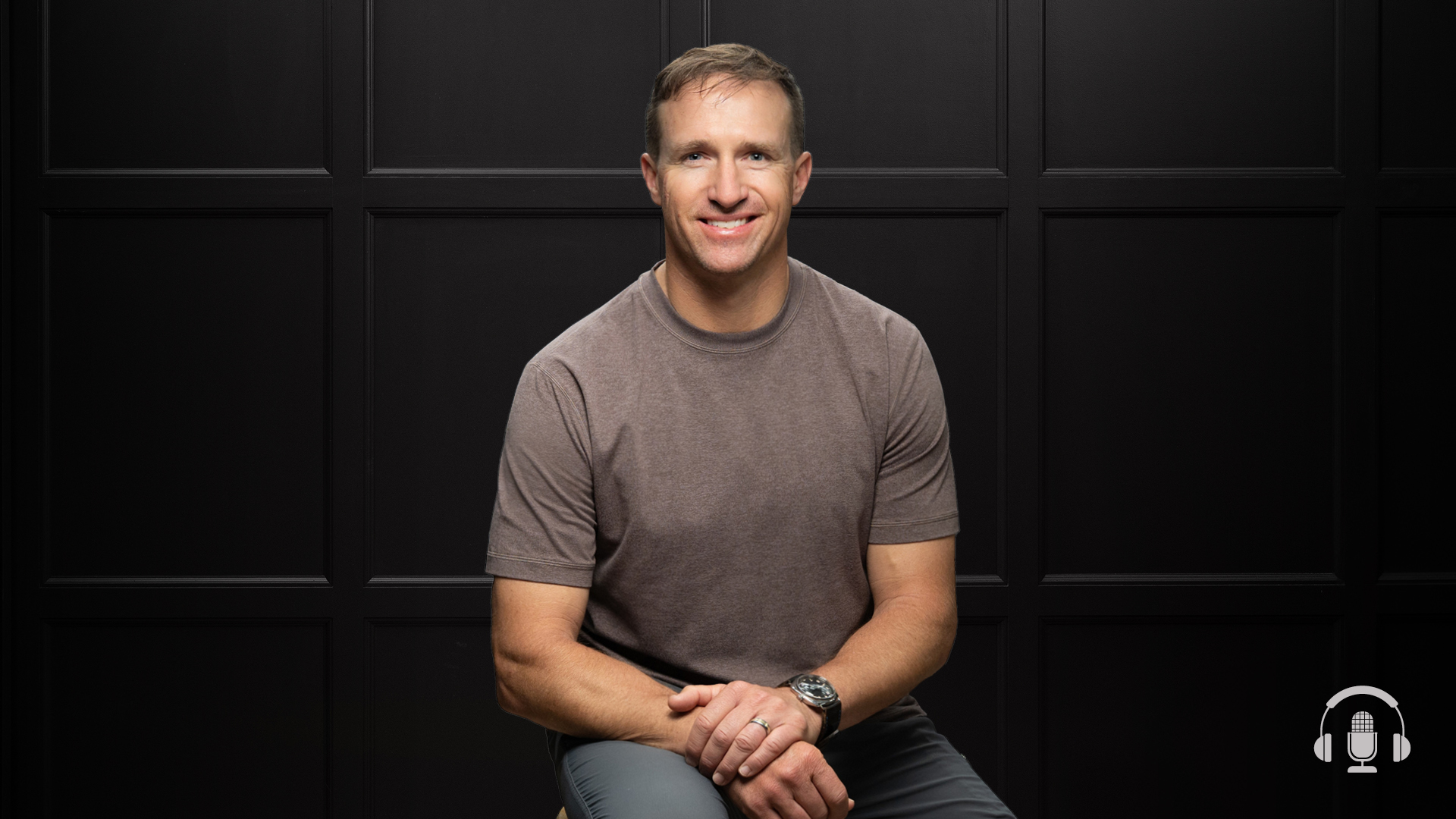
In this episode of “This Is Purdue,” we’re talking to record-setting quarterback Drew Brees (BS industrial management ’01, HDR business ’26), who on Aug. 8 will be inducted into the Pro Football Hall of Fame.
As a Super Bowl MVP, it’s safe to say Drew’s reputation precedes him. But what comes next for this entrepreneur and philanthropist? The Boilermaker legend sits down for a fascinating interview to discuss leadership, legacy and life after his 20-year career in professional football.
In this episode, you will:
- Hear Drew reminisce about his journey from growing up in Austin, Texas, to becoming an award-winning and record-breaking quarterback at Purdue
- Dive deeper into the lessons he learned from Purdue coach Joe Tiller and the strong network he built as a Boilermaker, as well as how they prepared him to succeed in the NFL and beyond
- Learn more about Drew’s life-changing tenure with the New Orleans Saints, including his love of the city and “Who Dat Nation,” and how their strength during and after Hurricane Katrina inspired him
- Find out more about what it meant for Drew to receive an honorary doctorate in business from Purdue at the Spring 2026 Commencement
- Discover why he and his wife, Brittany (BS organizational leadership and supervision ’00), are passionate about giving back to their alma mater and why the university’s continued growth excites them
- Get the details about Drew’s induction into the Pro Football Hall of Fame Class of 2026 and what it meant to get a knock on the door from fellow NFL icon Dan Fouts
- Learn more about his next chapter, like his work with the Brees Dream Foundation, entrepreneurial endeavors and role as an NFL game analyst for Fox Sports
- Hear more about Drew’s mentorship of his kids — who are also budding athletes — and why he’s motivated to shape younger generations in this new phase of life
You don’t want to miss this episode with an NFL powerhouse and celebrated Boilermaker who’s guiding the next generation of athletes and leaders!
- Watch the full video interview on YouTube
- Learn more about Drew Brees
- Learn more about Drew’s induction into the Pro Football Hall of Fame Class of 2026
- Learn more about his impact at Purdue
- Learn more about the Cradle of Quarterbacks
- Learn more about the New Orleans Saints
- Learn more about the Brees Dream Foundation
- Learn more about Drew’s partnership with Jimmy John’s
Podcast Transcript
This is Drew Brees, and you are listening to This Is Purdue.
Welcome to This is Purdue, the university’s official award-winning podcast. I’m Kate Young, your host and a proud Purdue alumna. This is Purdue is all about sharing big ideas that spark broad interest and get people talking. We’re passionate about highlighting notable Boilermakers who are powering innovation and working together to solve today’s toughest challenges.
Tune in to each episode as we have engaging conversations with Purdue alumni, faculty, researchers, coaches, and more who are inspiring change through small steps every day across timely topics like sports, well-being, emerging tech, and life changing research. Join us as we discover how these Boilermakers are taking their next giant leap.
I feel like I was given this platform for a reason. It was to be able to make our mark, leave things better than we found it, and to make it better for the next generation. Look, if we all take that mindset, then we will always see constant improvement. And you’re going to be equipping the next generation to do great things.
In this episode of This is Purdue, we’re talking to Drew Brees. That’s right, the Drew Brees. Former boilermaker quarterback, Super Bowl MVP, NFL legend, philanthropist, entrepreneur, and now Pro Football Hall of Famer. Our podcast team had the chance to sit down with Drew when he was back on campus receiving his honorary doctor of business from the Mitch Daniels School of Business during the spring 2026 commencement in May.
In this episode, you’ll hear about Drew’s experience as a Boilermaker, how he was first recruited by Purdue, how he met his wife, Brittany, and why they continued to give back to their beloved alma mater. Drew shares his take on the current landscape of NIL and the importance of persistence, loyalty, and culture in college sports. He also shares the adversity he’s faced as an athlete and the leadership lessons he’s learned along the way.
Plus, he discusses what’s next for him after a 20-year career in professional football and his hopes for the future of Purdue. So let’s get to it. Here’s my conversation with Drew. Drew, thank you so much for joining us on This is Purdue. I said, it’s like a morning talk show, bright and early for us.
Yeah, and I’ve got my real coffee in the coffee mug here, so–
I love it.
–I’m ready to go.
[LAUGHS]
Yeah.
Well, we’ve been prepping for this interview a lot differently, because we’ve been wanting to have you on the show for the past five years. You’re just so beloved here. And I just want to know, and I think all of our listeners and viewers want to know, what’s it like to come back to campus?
I always love coming back to campus so much. First off, it feels like home. Even though being a Texas kid and never thinking that I’d leave the state of Texas, every second I’m on campus, there’s just so many great memories from every part of it. Even as it continues to evolve and grow, I mean, even now just driving down the street, I’m sitting there looking at the new nursing and pharmacy building, of course, the Mitch Daniels School of Business building going to be ready fall of 27. It’s fun to see things continue to grow and evolve and continue to get better and better. But I would expect nothing less from Purdue. That’s what we’ve always prided ourselves on, continuing to do things that make this one of the greatest institutions in the country.
Walk us through a typical day when you’re back on campus. Like, what are you taking your family to go see, go do, go eat?
Yeah. Well, it was funny. We got in last night, and we have our two middle sons with us. And first thing we did was basically [LAUGHS] drive down Northwestern, of course. And you’re looking at the football offices, and you’re seeing Mackey Arena, and you make your way around to Harry’s chocolate shop. And when the kids say, hey, mom, dad, what did you guys used to do there?
[LAUGHTER]
No. But just past there is actually where Brittany and I met for the first time, was just walking down the street. So that was pretty funny. We got to rehash that story, going to our favorite Jimmy John’s. The kids are very familiar with Jimmy John’s.
Yes.
Yeah. So we got a couple number nines, Italian nightclubs, and then just kept driving around campus. Drove by the Sigma Chi house, some great memories there as the Sigma Chi. And honestly, it seems like every corner that you turn, there’s a story to tell the kids. And they’re sitting on the edge of their seat. They love it.
I love that. So let’s dig into how you and Brittany met. We love a good love story on the podcast, so tell us the details.
Oh, boy. Well, technically, the first time we met was the winter of 1999. And there was about 10 feet of snowbank on the side of the street and in parking lots. I think we just got a lot of snow that winter. And it was actually my 19th birthday. So I was with a bunch of guys on the football team, and we were getting kind of rowdy. But we were literally in the parking lot. I think we were wrestling in the snow banks.
And I just remember seeing this girl walk across the parking lot. It was the 1010 apartment. It was at 1010 Washington. A bunch of the guys stayed there, and a bunch of students stayed there. And so it was almost like a block party. Everybody’s just walking around free flowing, and I see it from across the parking lot. I just remember looking at her and saying, I’m going to marry that girl. And everybody was like, you’re an idiot.
And so I went up, and I talked to her. And I don’t even remember what I said, but I think I made a fool of myself. And so it was funny because that was the first time I’d ever seen her anywhere on campus. And then I literally saw her every week after that throughout the entire spring semester. And I would see her from a distance and be like, how do I redeem myself? Because I think I made a complete fool of myself.
And so finally, it was that summer. We were all back for summer school, and we bumped into each other on the street, I think, in front of what used to be, where else, or the boiler room or in that corridor, and just started talking again. And I think I convinced her to give me a second chance.
And the rest is history.
And the rest is history. That’s right.
What was it like to be a student in the late ’90s, early 2000? No cell phones. A lot different back then, right?
Yeah. I think all of us can reference the era pre-cell phone was quite a bit different. You actually had to make plans as to where you were going to meet people. It was fun. I started off in Wiley Hall as a freshman, and then it was Hilltop apartments. We drove by those as well yesterday as sophomores. And then as juniors, we actually went across the river, and we were in downtown, Lafayette. We had a cool apartment there.
And then I was over in that, what, Peppermill apartments as a senior. So lived a couple different places. And quite honestly, I feel like everybody on the team had their different spots that we would always congregate. And so you feel like you just made your way all around campus and even on the outskirts. It was so much fun. I think some of my greatest memories were just walking through campus, especially in the fall. It was football season, so there was an energy, there was an excitement. The leaves were changing color. The bell tower is ringing, and you just felt like something great was happening.
So those quintessential college memories.
Absolutely.
You talked a little bit about how Purdue was changing, and you’re showing your kids that. But what ways do you think Purdue’s remain the same?
It really still feels very much just like a small college town where everyone around Lafayette and West Lafayette supports Purdue University. And whatever’s happening here, they’re engaged with. And I think that’s something that you really appreciate. Purdue doesn’t feel like a big school. I mean, we are. We’ve got a lot of students, both undergrad and graduate and international students. And so it’s very diverse in that way. But you don’t feel like it’s overwhelming, and you also feel so supported.
And I think you always feel like things are happening here that are always in the best interest of the University, of the students to continue to push Purdue forward, to continue to advance the degrees that we’re all seeking to achieve. And then what I’ve found, too, is, in life after Purdue is that the Purdue network is strong. Everywhere I go, I meet Purdue people, in all different sectors, in all different industries, in tons of positions of leadership, which is also really encouraging because really feel like Purdue is developing the next generation of leaders.
I love that, you’ve stayed so involved with the University since you’ve graduated. You’ve come back, you’ve come to this podcast. We so appreciate it. But what inspires you and Brittany to continue to give back to your alma mater?
We love it here so much, and I think we know that our most formative years were spent here. And that Purdue developed our character, and, I think, made us appreciate so many things. And so we always want to give back to the University that gave so much to us. And look, I think it’s all of our responsibilities to leave it better than when we found it and to want to continue to advance it forward and make it better for the future generations so that hopefully, they feel the same way. And that’s how you continue to make progress. So we will always give back to Purdue University.
This year’s May commencement ceremony represents that pinnacle of your connection between Purdue and you as an alum. What’s it like for you to be back here and recognized with that honorary doctorate in business from the Mitch Daniels School of Business?
Yeah. It was very unexpected. President Mung Chiang called me up and said, we would like to bestow this honor upon you. And you’re kind of speechless for a while. You’re like, wow, this is absolutely incredible. Especially Mitch Daniels had such an impact on this University. And obviously, he’s now the namesake of the School of Business. Back when I graduated, it was the Krannert School of Business.
And I think it just continues to show the evolution and how we as a University continue to want to push things forward, recognize those who have made such significant contributions, like former President Daniels. And honestly, I’m just honored and humbled. Never thought that this would be something that would be bestowed upon me, but it’s an incredible honor.
So getting into the football side, you’re the first This is Purdue guest that was also on New Heights. We can–
Oh, there we go. OK.
I prepped for this interview by watching you on that. How enjoyable. But you’re arguably Purdue’s most famous athlete. But you were just coming from a small town in Texas, and Coach Tiller recruited you. What did you think the first time you arrived at Purdue in this small town in Indiana?
Well, it was pretty funny. Being a Texas kid, you grow up with, I think, probably a narrow view of the world. The state of Texas is a big state. It’s bigger than most countries’ economies. And there was a ton of schools down there, too. That was the old Southwest Conference days. So growing up there in the ’80s and ’90s, it was all about University of Texas at Texas A&M. Both my parents went to Texas A&M, so I wanted to be an Aggie, hands down.
But I grew up in Austin, literally six blocks away from University of Texas campus. So we would walk to UT home football games, buy the cheap Bleacher seats, and I watched some epic games in the ’90s. And so you’re around that atmosphere. And then the other schools in Texas, Rice, Houston, SMU, Baylor, TCU, Texas Tech, I mean, the list goes on. Massive state, tons of institutions in the state of Texas.
So I think in my mind, especially as your friends begin to start talking about colleges, you’re just, where am I going in the state of Texas? But I wanted to play sports. I wanted to play football. I wanted to play baseball. I was very athletic. And all of a sudden, you start realizing, well, nobody in the state of Texas is recruiting me.
[LAUGHTER]
And I’ll never forget the day at practice, which was December 22, 1996, where two coaches show up to our football practice as we’re getting ready for the state championship game, and it’s Purdue and Kentucky.
Oh.
And I remember our offensive coordinator coming over to me and tapped me on the shoulder and saying, those two schools are here to see you. And it was like, wow. And it was funny because when I first heard Purdue, I thought Ivy League, because it had such a great academic reputation. So I mean that as a great compliment, but I can’t say that I knew that it was in the state of Indiana, part of the Big Ten.
But very quickly, I learned about the strong tradition around the cradle of quarterbacks. Certainly, it reinforced its strong academic reputation. But then it’s like, OK, I need to schedule a visit and check this place out. And so I come up here mid-December of 1990– no, sorry, mid-January of 1997. So Joe Tiller had just gotten the job, and he told me, he said, we were going to try to recruit you at Wyoming, but we didn’t think we’d have a chance at you, even though they had a strong Texas base when it came to recruiting. And he was actually surprised to see that I wasn’t getting recruited. And he said, all right, but I think we can get you at Purdue. And so he started recruiting me, brings me up mid-January of ’97.
And I’m telling you, there was so much snow on the ground. All I’d heard was Purdue’s this beautiful campus, beautiful red brick buildings, John Purdue, you know. And I could not see the buildings, because there was so much snow. It was like blizzard conditions. And it’s funny, because we drove by the Pike house, and that was like the first college party that I went to. I mean, I remember Nick Zitelli was my host. And we go to this party there and I’m like, wow, this is what college is like?
It was fun on one hand. And then the other hand, it was like, I’ve never seen this much snow. [LAUGHS]
And cold.
And I’ve never been exposed to this. Am I really going to do this? But truly, it was– I loved Coach Tiller. I loved the offense, spread offense. I love the feeling that we could do something the Big Ten that had never been done before and take this program from truly worst to first, as far as the way that we were being perceived. We were the last place recruiting class in the Big Ten that year. There was only about 12 of us that were recruited that year. I think maybe six of us hung on, and that’s a very tight group, as you can imagine, that group that stuck. And we were able to leave here as Big Ten champions, and more importantly, with incredible degrees and a connection to this University that will last forever.
Yeah. Did you ever think about leaving when you weren’t the starting quarterback, or why did you think Purdue was the right fit? Why did you stay?
See, it’s funny that you asked that question because we are in this era now with an island transfer portal that the natural feeling is that when you don’t get what you want, you can just up and leave. And that is the antithesis of what sports and especially college athletics is about. It’s about character and leadership development. So no, never in my mind did I ever think that leaving was an option. I am here to get a degree, first and foremost.
And if I ever see the field, then great. I’m going to work my tail off. I’m going to do whatever the team needs me to be. I’m going to play the role that they need me to play, because your job on a team is to be the greatest teammate that you can be. And so, look, when I showed up here, there was seven quarterbacks. Did I think that I was going to play? No. But I also knew, you just take it one day at a time, and do whatever they ask you to do, and continue to improve. And it’s constant skill development, and it’s just constant improvement. There’s going to be plenty of days that you don’t get what you want.
And maybe it’s because I face some disappointment in high school with injuries and different things, and so maybe I was a little ahead of the game just in regards to having to have overcome some adversity already. So I was programmed a little bit that way. There would be more in college. There was going to be plenty in the NFL. But to me, that’s the greatest thing about athletics, is you learn how to be a great teammate. You learn how to overcome adversity that comes in different ways. Failure, disappointment, not getting what you want, injury, you name it.
I knew I was going to be here for four years, even when the opportunity came around to potentially leave early to go to the NFL. There was talk about that going into my junior year. To me, that was never an option. I said, first off, when we got here as freshmen, we said we were going to leave as Big Ten champs. We haven’t done that yet, so let’s go do that. And secondly, I want to make sure I get my degree.
You’re probably especially proud then of Coach Painter and the–
Absolutely.
–team that he’s built and the loyal seniors we had.
There’s nothing worse in college athletics than looking at a team and basically saying like, that team, all five of those starters were bought. They weren’t here the year before. We went out and just assembled a bunch of mercenaries to go in, and they just happened to be wearing a Jersey that had a university’s name on it. But you see that happening now everywhere.
First off, how do you build team and culture that way? And in some cases, maybe guys just look at it as, I’m going to go get paid to play somewhere, and then I’m going to jump to the NBA. Basketball is a little different, just because they can leave earlier than football. But I think what Coach Painter has built here is incredible because he has truly built it on the foundation of team development, culture development, skill development, character development, leadership development.
And I think guys appreciate that. Guys appreciate that. When they have a chance to be a part of that, it doesn’t mean there’s not going to be tough moments. There’s going to be plenty of tough moments, plenty of moments where you’re not getting what you want. If you talk to me long enough, that’s going to be a constant theme. Because I feel like my story, my career was a lot of instances of not getting what I wanted. My vision was, I was staying in the state of Texas. I knew nothing outside of the state of Texas, right?
Yeah.
But I did not get that opportunity, so I had to go seek that elsewhere. And Purdue opened up their arms to me to embrace me to be able to do that. And so I walk away from here with an incredible education, winning a Big Ten Championship, being formed in so many different ways. I go down to the San Diego Chargers, I get benched three times. Did I want that to happen? No. And then I have a major shoulder injury that I thought was going to end my career. Did I want that? No.
New Orleans was the last place I ever thought I’d land. And then 15 years there was the most unbelievable experience of our life. And so all these instances, at the time you’re going through it, you’re saying, man, this is terrible. This isn’t the way I planned it. But God’s plan isn’t your plan. And it’s what forms you and molds you into who you were meant to be. And you become so thankful for it.
But it’s also how– not only does it form you, but it forms the team. And you have a chance to imprint on them. You have a chance to impact them in a really positive way. And so then when it comes down to the real, tough moments, there’s a level of trust, between teammates. Hey, we’ve been here a long time together. We’ve stuck it out together. And I think that’s why you see the sustained success that our basketball program has had. A lot of that’s because of the atmosphere and the culture that Coach Painter has created. And then the players come in, and they buy into that, and they reinforce that, and they leave their mark on it.
Absolutely. Speaking of forming a team, Coach Tiller is just as beloved among Purdue fans as you are. What types of things did you learn from him that you took into your NFL career?
[LAUGHS] It’s funny. Coach Tiller would always say, we operate by the Golden rule. He who has the gold makes all the rules, and that’s me.
[LAUGHTER]
No. He would say that. But he had a good way to work in humor into his leadership techniques. I would say this. You woke up every day feeling like you had to prove it to coach Tiller. And maybe that’s just because of the environment that he stepped into in 1997. You have him turn a program around that hasn’t seen a winning season in 10 plus years and make sure everybody buys in, and that meant that not everybody was going to stay.
That 1997, call it offseason, winter conditioning through spring ball, was very difficult. I think a lot of guys recognized that this wasn’t for them. But I mean, again, you have to set the tone everywhere I’ve been where it’s– Sean Payton did this in 2006 with the New Orleans Saints. He came in and recognized, hey, there’s some stuff that we need to clean up. And maybe there’s some guys that aren’t going to be a part of this because they haven’t fully bought in, and they’re not necessarily setting the right example. And if you’re not going to buy in, then we’ll show you the door. There’s somewhere else for you. It’s not going to be here.
And so I know that that’s what happened with Coach Tiller. It happened during that training camp that year. But man, I tell you what, when we started that 1997 season, we felt like we had something. And you’re looking around the room, and every guy that’s there, you know he’s earned the right to be there, and he’s earned the respect of his teammates. And look, that starts from the top down. And so Tiller certainly made you feel like each and every day, you had to prove yourself to him. You had to prove yourself to your teammates. And I think that’s what helps create an edge.
That team, you all won the Big Ten Championship. You wound up playing in the Rose Bowl. You talked, a lot of you all were there since you were freshmen, and you stayed all four years. What are some of your favorite memories from that season with that 2000 team?
I don’t know if this has ever been done since that 2000 season, but our fans rushed the field three times in one season. You only play six or seven home games. You tell me half of them, they rushed the field, because it was just that level of mayhem in and around the game. The first one was Michigan. So Michigan comes to town. They were undefeated, I think 6 and 0. We were 3 and 2, and they were ranked fifth in the country.
And I don’t know if you remember that game, but they had four possessions in the first half. We had three. And you go into halftime, we were losing 28. I remember walking at halftime– and look, like, man, you had built this game up so much, it was such a meaningful game. Because you felt if we’re going to win the Big Ten, we have to beat Michigan.
And they got the ball four times, and they scored four touchdowns. So I just remember thinking to myself, OK. I was like, well, if they’re going to score a touchdown every time they get the ball, then we’re not going to have a chance. I said, but we just have to be so on point with everything that we do offensively. I mean, we had a touchdown, a field goal, and a punt. And 10 points, I felt OK about that. We’d scored two out of three possessions. But we’re down 28-10.
And that’s when you just look at everybody and say, poise, composure, one series at a time. Defense just get a stop, offense, we have to score every time we touch the ball. And that’s not pressure. That’s just our responsibility. And we just chipped our way back, chipped our way back, and then we go down, and Travis Dorsch kicks the field goal. And then we rush the field, and I think Tim Stratton loses his helmet on the field somewhere, or a fan grabs it.
And the next thing you know, the goalposts are coming down, and they’re walking them to the Wabash, and– no, I mean, that was a wild game. And then, of course, the Ohio State game, the finish to that game with the Seth Morales touchdown, and then fans rushed the field again, and the goalposts come down. And then, of course, we beat IU to officially win the Big Ten Championship a couple weeks later, and then we’re on our way to the Rose Bowl.
And I’ll never forget that image with the roses in our mouth. I remember seeing that when I was a freshman with Charles Woodson when Michigan in 1997 went and won a national championship. But him having the rose in his mouth, I said, that’s the picture I want. And sure enough, we all got that picture.
And now anytime you Google you, that’s one of the first pictures that comes up.
That’s right.
[LAUGHS] So your NFL career, outside of Boilermaker circles, you had this wonderful career with the New Orleans Saints. You also played for the Chargers. But really, you’re known for playing with the Saints. You had that incredible Super Bowl victory in 2009. And really, it was so special for the city of New Orleans because they were just starting to recover from Hurricane Katrina when you started in 2006. How do you feel about your role within the Saints and how the city was rebirthing at that time and recovering from an event like that?
Yeah. Hard to believe, but that just 20 years ago now that we were all brought to New Orleans. I mean, truly, it was this offseason, this time 20 years ago, that all of us were arriving there for the first time, and really just trying to get our feet under us, understand the gravity of what had happened there, and understand that we were going to be a part of something that was so much greater than just football.
And I think that that’s what made it unique. Is that at the time, we all had our own things that we were dealing with. I’m coming off a major shoulder injury. I remember one of my great friends on the team was a guy named Scott Fujita, who was a linebacker who was drafted by the Chiefs, then he went to the Cowboys, then he came to us and so many other guys who had similar stories to that where it was like, how they ended up in New Orleans is just a crazy sequence of events. And yet, they were the right person at the right time. And then collectively together, it became a really, really special group.
And Sean Payton had so much to do with that, identifying those guys, knowing that it was going to take a special type of person and player to embrace the responsibility within the community that was beyond just the game of football. And look, we recognize that the best thing we could do is win games, because that just lifts everyone’s spirit. And there is such a diehard fan base down there, the Who Dat Nation, that I think everybody has come to know and love and embrace, and probably feel like they’re a part of.
I think that 2006 season– and all started with the reopening of the dome September 25, 2006. The Superdome, obviously, sustained a ton of damage during Katrina. It became a symbol of refuge for so many people, because so many people ended up using that building as a place of safety for a long time. And so it needed significant repairs. And all of a sudden, here’s the reopening of the dome, Monday Night Football, September 25, 2006.
And I think that’s when literally everybody, not just in the building, but outside the building watching that game on television, there was something that resonated with them about what the city was overcoming. There was a piece of that that, I think, lived inside of everybody and felt like we became America’s team after that where everybody’s– they were rooting for us.
And so I think we felt that energy and tried to carry that with us on our way to the NFC Championship that year. And then a couple years later, we go and win a Super Bowl. And the culmination of just so many ups and downs during those four years as we were trying to come together as a team, but also find our place in the community and where we can make the biggest impact. And I’m proud to say that here we are 20 years later, and New Orleans has come back stronger than ever. It’s an incredible place, not just to visit, but to live, to raise a family, to grow a business. And we’re proud of that.
So you recently were inducted or you’re going to be inducted into the Hall of Fame, you just found out recently. What was it like to get that knock on the door and be able to celebrate with your family?
Yeah. It’s incredible. And another one of those things that you don’t start off thinking about when you enter the league, and even towards the end of my career. I mean, I remember going to events, and people would introduce me as future Hall of Famer. And it’s just like, it just doesn’t even register. I’m just still trying to play. I’m still trying to get better. I’m still trying to be a great teammate. I’m still trying to win championships. Your mind doesn’t even go there.
And even upon retirement, it maybe just feels so far away or just unfathomable. The people you look at with the gold jackets are just the legends, the legends of the game. And all of a sudden, for one of them to knock on your door with the gold jacket on. It happened to be Dan Fouts, who was one of the first guys that I met when I was drafted to the San Diego Chargers, that was really meaningful.
And my family totally set me up, too. That’s become actually a great tradition with the Hall of Fame. Is they call it The Knocks. It’s always a Hall of Famer who’s coming to tell you that you’ve been inducted into the Hall of Fame and are selected. And it was funny because it was my birthday, and my oldest son and I share a birthday. So that weekend, we had made all about him. I’d rather not count the years for me now.
[LAUGHTER]
But my daughter had come up to me and said, hey, dad, I want to take you out to eat for your birthday. And so my heart’s melting. I’m like, absolutely, sweetheart, let’s do it. She had 5 o’clock. So I’m waiting downstairs at 5 o’clock, and my wife’s ready, my daughter’s ready, and the boys are messing around. So I’m like, boys, let’s go. Rylan said 5 o’clock, let’s go to eat. And they’re still messing around.
Well, little did I know, Britt had told him, hey, stall, stall, because I think the camera crew and the whole setup was running a little bit late. And I’m like, boys, 5 o’clock. Time to go. You’re being disrespectful. And so then I’m getting fired up. And then all of a sudden, there’s a knock at the door. And I’m like, who’s at the door? We’re trying to leave. And then there’s Dan Fouts. And it’s like, oh, you guys got me.
Oh, that is so special. And now you’re going to be a legend with the gold jacket.
Yeah, I get the gold jacket. Tried it on. It fits pretty nice.
[LAUGHTER]
And it’s Purdue colors.
I love that too. So when we talk about entrepreneurship and philanthropy, you gave a shout out to Jimmy John’s earlier. How have all of these experiences at Purdue– you had your industrial management degree. You were a member of Sigma Chi fraternity. How did those experiences prepare you for life after football as a business owner and entrepreneur?
Yeah, in so many ways. I’ve always had that bug, that entrepreneurial bug, always loved business. When it came to Purdue, obviously, Purdue, known so much for engineering and management and among so many other things. I knew I wanted to be in the School of Management, but I wanted to incorporate engineering in some way. And so that’s how the industrial management degree came about. I actually started off with an industrial engineering minor. And I did it for two years, and I was taking all those engineering classes. I was like, you know what, I don’t think I’m an engineer.
[LAUGHTER]
But I’m definitely a business guy. And so I switched to manufacturing and then just started taking a bunch of history and political science classes as well, was just fascinated with that. But really, really proud of the management degree. And look, as much as it was maybe a pipe dream to play in the NFL or to play professional sports, I really came here with the idea that I’m going to leave after four years. I’m going to contribute as best I can on the football field. But I’m getting my degree, and I’m going into the business world and do something great.
Just happened to play football for a really long time, and so maybe it just delayed the business part of it. But nonetheless, I was still thinking about it throughout my career, because football’s going to end at some point. You want to have a solid foundation, solid base for maybe what you can build, that you could transition to. And so Jimmy John’s became one of our first forays into business back in 2011.
I’ll never forget. I’m literally sitting in the State Street Jimmy John’s, which it’s a new location now. It used to be down the way a little bit. But I’m sitting in that location in 2011– and first off, when I got drafted to the San Diego Chargers, I go to San Diego, and there’s no Jimmy John’s. I mean, I was eating Jimmy John’s three days a week when I was here at Purdue. You order it to the dorm at Wylie Hall at 3:00 AM, and some dude comes rolling up on a bike and hands you number 9. And you’re like, this is the greatest thing ever.
But you go to San Diego, no Jimmy John’s. Go to New Orleans, no Jimmy John’s. So the only time I get Jimmy John’s is coming back to the Midwest, come back to Purdue. And if I was here and I ate nine meals, I was eating Jimmy John’s for seven of them. So taking a bite of that number 9 saying, all right, that’s it. I can no longer go back home to where I’m living and not have Jimmy John’s.
So I call up a former teammate, Carl Buergler, who was a walk on quarterback who was now the VP of operations for Jimmy John’s corporate in Champaign, Illinois. I’m like, Carl, what do I need to do to bring Jimmy John’s in New Orleans? He said, we just opened up the territory. Are you serious? I said, yes. So there we go. That was–
[LAUGHTER]
–basically me signing on as a Jimmy John’s franchisee. And it was actually a great first business experience, because you think about what franchising is at its core, and it’s, we’re taking a proven business model, we’re taking a game plan, so to speak, and we’re putting it in the hands of a young, hungry entrepreneur who wants to be their own business owner and be in control of their financial future. And you operate the game plan, and you’ll see success. You work hard, you’ll see success. And we’ll help you and support you every step of the way.
And I think that’s what’s really helped me really enjoy franchising. And so we built out the market for Jimmy John’s in New Orleans. And then since then, it’s resulted in being on the franchisor side of a lot of other brands. And so, yes, that’s taken up a lot of time. I’ve had the chance to sit on a few bank boards, which has been an incredible experience, very educational.
I think what I’ve realized is, especially post-football, is surrounding yourself with as many smart people as you can that you can learn from, that you can glean from. I mean, I’m a lifelong learner. I’m so curious. I love to learn about different industries and different businesses and honestly find the similarities between them all. I love to listen to podcasts where entrepreneurs are talking about how they started and all their struggles and the defining moments. And you find so many commonalities and parallels between people’s journeys. And so much of it is persistence and perseverance, and you learn great leadership lessons through that. Certainly, the basis of, I think, my love for business and the opportunities that I would have after football started here at Purdue.
I love it. You and Brittany are always giving back to Purdue. You founded the Brees Dream Foundation, which supports cancer patients and children and families in need. What inspires you to help people in that way?
I feel like I was given this platform for a reason. It was to be able to make our mark, leave things better than we found it, and to make it better for the next generation. Look, if we all take that mindset, then we will always see constant improvement. Despite the craziness that seems to be happening in our world at all times, I think if you always take the mindset that you want to be a great member of the community, use the skill set, use the gifts that you’ve been given for good, you’re constantly going to see improvement, and you’re going to be equipping the next generation to do great things.
I do want to talk to you about your career in broadcasting, because you’re a great talker. But what has it been like to be on TV? You’re so passionate about football. How has it been sharing your football knowledge with the casual audience? Has that been a little bit tough or do you love it?
No, I love it. I love broadcasting. Look, I think what I realized is, you play 20 years of professional football, I mean, football becomes so ingrained in you. And certainly, what I’ve recognized over the last five years in leaving the game is that I still have such a love and passion for the game. And what is the best way for me to convey that and release that?
I coach my kids, which is such a joy. I’ll have three boys in high school next year, so I’ll have a senior, sophomore, freshman all playing football. They play multisport, and my daughter’s a gymnast. I tell my daughter I’m like, sweetheart, I will support you whatever I can. I can’t teach you anything about gymnastics. I know nothing about the beam. She is awesome. It’s the greatest joy in my life to watch her compete.
But I get to coach high school football. I get to coach my boys. I basically look at it as, I get to steal two extra hours a day with them, which is awesome. But also teach their friends. All their friends, I’ve coached since first grade. And so I walk around campus, and I’m not Mr. Brees. I’m Coach Drew. I love that. But the broadcasting, you truly prepare for a game as if you’re playing it, and I think that’s what I love.
It’s one of the things I miss about playing the game, is just truly the weekly grind of going in on Monday and you’re like, OK, how are we going to attack these guys? And you just sit there, and you make your way through the film. And you begin to start identifying things, and you build your game plan, and then you go out and practice it, and you work through all the mistakes, and you refine. And then you get to game day, and then you just feel so confident and invincible.
It’s the same preparation for with broadcasting, just sitting there as if I’m going to attack that offense, that defense. I know that coordinator. I know what his tendencies are. I know the skill set of this quarterback. I know where the matchups are. And you begin to build your own game plan. And then you have your production meetings, and you can confirm that as you talk to coaches and the players on each side.
But then once you get to game day, you’re really reacting to what’s happening in front of you. But you want it to be an easy listen, and you want it to be entertaining. You mentioned the casual fan. Most people who are watching, they’re casual fans. They have their loyalties to their teams, but they just want it to be an easy listen. They want it to be fun. And hopefully you can give them three or four things that they wouldn’t have otherwise known. A fun fact about one of those players that once you dug in, you were able to find that you think is really relevant to what’s happening, or can build a connection between the fan and the player. You see that every week.
And then I think the most exciting thing for me is the situational football aspect. When you get to two-minute drives or when you get to key third downs or red zone possessions, and you can really just put yourself in the moment, I mean, that’s what continues to fuel the fire. I do. I love the game, and I love to convey that through broadcasting.
You mentioned your kids. Are they interested in Purdue? Is the senior looking at playing football in college?
Yeah. My oldest son, Baylen, who is going to be a senior, a big lacrosse player. In fact, today he’s playing in the Division I Lacrosse Championship in–
Oh my god.
–southern California, which is awesome. I’m excited for him and his team. And then my middle son, Bowen, is probably more of a football player. And then my younger son, Callan, is more of a basketball player. And my daughter’s a gymnast at this point. So even though they’re all multi-sport, they play football, basketball, lacrosse, gymnastics. Rylan does basketball as well. They have that sport that they’re honing in on a bit. And so certainly, Purdue is in the mix.
It’s funny though because I think part of the access to information nowadays with kids is, they know so much about so many different players and sports, and there are multiple fantasy leagues, and this and that. And so it’s crazy that there are loyalties are all over the place. And look, I mean, all our kids were born in New Orleans, Louisiana, so they love LSU Tigers. Right?
OK.
I mean, that’s in the culture as well. Is if you’re a Saints fan, you’re a Tigers fan, and vice versa.
That’s a great gymnast program.
Absolutely, yeah. So we’ll see how it plays out.
No shortage of athletes in the family.
Yeah. They love it.
So what’s next for Drew Brees?
Oh, all kinds of stuff. I’m 47, coaching the kids, broadcasting, all the business stuff on the franchising side. I love youth sports. I’m a partner at a couple of youth sports organizations that are two of the largest in the country, unrivaled sports and pioneer sports. I think continuing to foster the next generation of athletes and leaders is something that I am really passionate about. This window of time with my kids is so much fun, so much fun, watching them continue to grow and develop and find their path. And then you as a parent just want to support them every step of the way. I love what’s happening here at Purdue. Being a part of all these things makes life a lot of fun.
What excites you about the future of Purdue?
Oh, man. Again, every time I come to campus, I see something new. I see something under construction. I see some improvement. I want to spend more time here. I want to spend as much time as I can. It’s tough when you live in Southern California, and you’re doing all this stuff in the fall with broadcasting and coaching. We make it out as much as we can. Yeah. I mean, I love not just the memories here, but I love what’s going to happen in the future.
OK. We’re going to end with a rapid fire segment. So just the first thing that pops into your head, OK?
Yeah.
Last Purdue teammate you texted or called.
Oh, well, it would have been Ben Smith and Jason Loerzel. We’re on a group text. Those were my college roommates, so we talk all the time.
A hype song that reminds you of your Purdue football days.
Oh, that’s good. OK. I’m going to give a shout out to– the irony here is that this was a New Orleans rapper, Master P.
Oh.
Master P, we used to play that. So this was like Willie Fells, Lee Johnson. It was a bunch of the Florida guys that had control of the stereo system during stretch at practice.
OK.
So we would always listen to Master P. So there’s a shout out. That’s a shout out to Willie Fells and Lee Johnson. Those are the two linebacker leaders of the team back when we were freshmen and sophomores. Love those guys, man. And they’re doing great too. But that’s a song that definitely reminds me of the Purdue days. No limit soldiers.
Favorite Purdue tradition.
Favorite Purdue tradition. Oh, wow. I’ve yet to actually be a part of this. What do we do with the basketball team?
Oh, the sandstorm dance.
Yeah, the sandstorm dance. I have not been a part of it, but I’ve seen it all over the place.
You got to learn that.
I know.
We got to do a video of that.
Awesome.
All right.
For sure.
Favorite campus study spot back in the day.
Yeah, good question. The Hovde Water Fountain is probably where I spent the most time, just because it was kind of close to engineering mall and business school, and so I felt like I was walking through it all the time.
Did you have a signature go to meal at the dining courts that you liked?
Well, Cary Quad had the best food at the time. So we would always find ways to get to Cary Quad. Yeah so I remember a lot of meals there. It’s like meeting up with guys on the team or classmates or whatever to get the good stuff.
Did Coach Tiller have a favorite catch phrase or saying?
Well, I said one of them– he who has all the gold makes all the rules. Yeah, probably that one. It was more so just the look, that look he would give you with the bushy mustache.
[LAUGHS]
You knew if he was upset with you.
OK. All right. The look. Most memorable Purdue football win as a player.
Oh.
You talked about three big ones.
Yeah.
[LAUGHS]
But I’m actually going to go– I’m going to go prior to that when we were sophomores and we played at Michigan State. And Michigan State had just beat Ohio State, who was number one in the country. So this was 1998. And so we go to Michigan State, and they were a really good team. This was like Plaxico Burress and Robert Smith. They had some other guys. I mean, they were really talented team, and they just beat number one Ohio State.
And so then we play them at their place, and I think we’re down 13 points. And we go down, and we score two consecutive touchdown drives. Blocked punt on one of them. I just remember that last touchdown, and it was like the first real big comeback I felt like I’d been a part of in college. And so it was like a defining moment of how good we could be as a team. And I think for me personally, that was a big moment.
Later on that year, we go down to the Alamo Bowl, and we beat K-state. And similar deal where we were actually in control of that whole game, and they come roaring back. They were fourth in the country. And honestly, they should have been playing for a national championship. They were really, really good. And then we go on a two-minute drive. Ike Jones catches the little inside fade. I think just some of those comebacks just was like preparing us, making us recognize what was possible for us as a team.
And so I go back to those years saying that that’s really what positioned us and built the foundation for what we were able to accomplish later.
What about a memorable Boilermaker athletics game, any sport that you’ve attended as a spectator?
Yeah. Watching our women’s basketball team win a national championship.
Yes.
I guess it was ’98, ’99–
Yes.
–season. That was awesome.
We’ve had some of them on the podcast. Stephanie White.
Was that Ukari Figgs, Stephanie White-McCarty. That group of girls was awesome.
Oh, they talked about that you were there, I think–
I was there all the time. I love watching them play.
And you greeted them when they came home. I think you were part of the group in the–
Yeah.
That’s so cool.
That was awesome.
First thing you bought after signing your NFL contract. That was probably a house.
[LAUGHS]
Yeah. Nothing crazy. There wasn’t anything crazy. I’d say this. My wife and I love to travel, and we tried to do a lot of that prior to kids. So prior to having our first son, Baylon, in 2009, I think South Africa was a bucket list trip, going on a Safari and driving the Garden Route and diving with great white sharks and basically doing all the crazy stuff before you– skydiving–
Oh my gosh.
–bungee jumping, doing all the crazy stuff before you have kids and responsibilities.
I love it. Awesome. OK, last one. Craziest place someone said “Boiler Up” to you.
Oh, there you go. Well, I definitely have this with the Who Dats, the Who Dat Nation, all the New Orleans fans. Here’s one. So have you ever heard of the tulip fields in outside of Amsterdam?
Yeah.
So there’s the tulips, I think, bloom there for a month out of the year. I think it’s literally this time. It’s like April, May. And so my wife and I went there for that because we were actually going to a wedding of a Purdue teammate’s sister in Paris. And so we started in Amsterdam, and then we took the train to Paris. But we go to the tulip fields. I remember walking through them and somebody yelling, Boiler Up!
Oh my gosh.
And you just never know where you’re going–
You never know where you’re going to meet the Boilermakers. They’re everywhere. Yeah.
Incredible. Well, Drew, we can’t thank you enough. It was a pleasure talking to you, and congrats on all your successes and your new doctorate.
Yeah, thank you. I told my family I have to call me doctor here for at least six months.
Dr. Brees, absolutely.
That’s right.
Thank you so much.
Thank you.
Congratulations to Dr. Drew Brees, and thanks so much for joining us on This is Purdue. If you’d like to watch our full video interview in our Podcast Studio, plus some extra bonus videos featuring Drew, head over to our podcast YouTube page, youtube.com/@thisispurdue. And click that Subscribe button while you’re over there. This is Purdue is brought to you by Purdue Brand Studio.
The podcast is hosted and produced by me, Kate Young. The creative team behind the shows videography, design, and writing and research includes Thad Boone, John Garcia, Cheryl Glotzbach, Ashvini Mulshe, John Underwood, and Dalani Young. Social media marketing is led by Maria Welch, and our project manager is Rain Gu. Thanks for listening to This is Purdue. For more information on this episode, visit our website at Purdue.edu/podcast. And head over to your favorite podcast app to subscribe today so you never miss an episode. You can also check out all of our podcast video content on our YouTube page, youtube.com/@thisispurdue. And as always, Boiler Up!