Exploring Mars from Purdue to the National Air and Space Museum
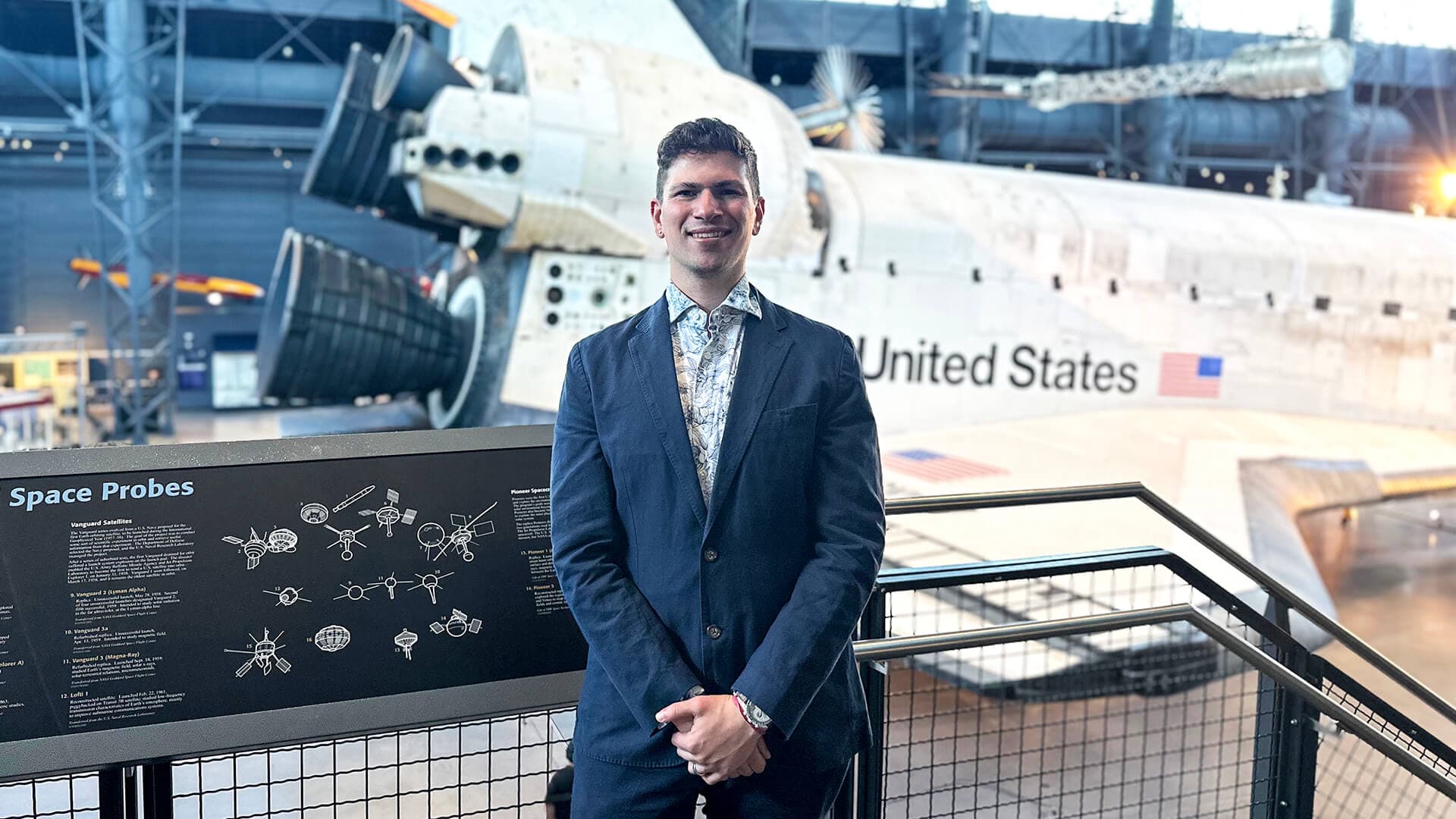
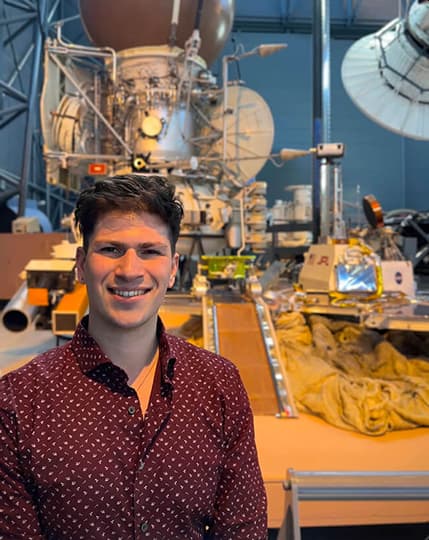
James Haber, a postdoctoral research fellow at the Smithsonian’s National Air and Space Museum, explores some of the universe’s biggest questions, like if life exists on other planets. (Photo courtesy of James Haber)
Alumni like James Haber are embedded in America’s most storied institutions, including the Smithsonian
James Haber didn’t become a planetary scientist by accident. It’s something he’s dreamed of since third grade — thanks to an interest in space exploration that his father encouraged.
From the family’s home on Long Island, it wasn’t easy to get a patch of night sky without light pollution, but the Habers made it happen.
“We would go out to golf courses, which are the darkest spots you can find in the suburbs of New York City,” Haber says. “Sneaking onto putting greens at night to look at the stars helped expand my passion for the cosmos. It’s what led me to Purdue.”
Today, as a postdoctoral research fellow at the Smithsonian’s National Air and Space Museum, Haber (PhD planetary science ’23) explores some of the universe’s biggest questions, like if life exists on other planets.
He does this work at an American institution whose founding mission matches that of his alma mater.
Honoring America’s 250th anniversary provides an opportunity to recognize our national progress and impactful alumni. Purdue was founded in 1869 as a land-grant university with a mission to make education accessible for all. The Smithsonian, which began in 1846, was funded by James Smithson, who said it would be “an establishment for the increase and diffusion of knowledge.”
That common thread — the drive to impart knowledge — stitches together achievements that are centuries in the making. It weaves leading organizations like Purdue and the Smithsonian into the historical tapestry of the United States.
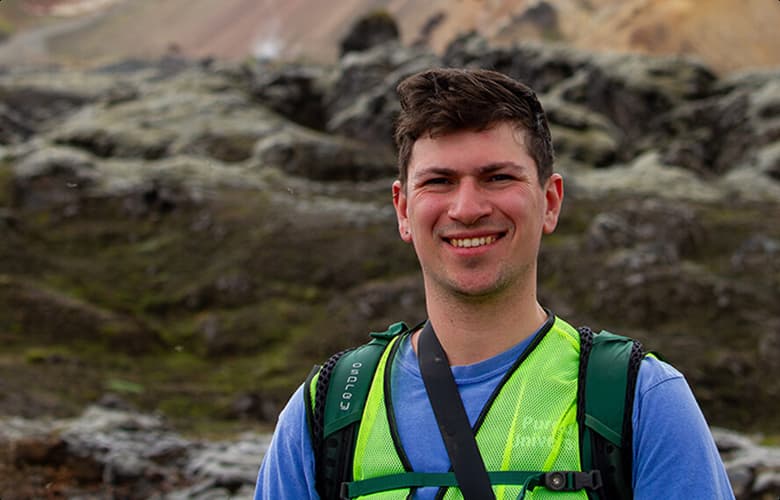
Sneaking onto putting greens at night to look at the stars helped expand my passion for the cosmos. It’s what led me to Purdue.
James Haber
PhD planetary science ’23
Growing as a researcher at Purdue
As an undergraduate, Haber studied physics, mechanical engineering and astronomy at Cornell University. While searching for graduate programs, he looked at Purdue’s Department of Earth, Atmospheric, and Planetary Science (EAPS), where the planetary science division was a fraction of its current size.
Other schools may have had bigger or more established programs, but the chance to work with an incredible advisor and do intriguing fieldwork made it easy to choose Purdue.
When Haber met his advisor, Briony Horgan, he felt a kinship. Horgan had also been a student at Cornell and was originally from a physics background. Add in her experience with multiple Mars missions and it’s an ideal mentorship.
Fieldwork was a gamechanger in Haber’s graduate student experience.
“When we look at pictures of Mars, we have a sense of what’s there, but in order to really know what’s going on, I think it’s important to see things closely,” Haber says.
“There’s this sort of universality of physics and chemistry: The same processes that alter rocks on Mars also alter rocks on Earth,” he says. “The tactile experience of walking around as if you were a rover, picking up rocks and using tools to better understand what you have, enhances everything.”
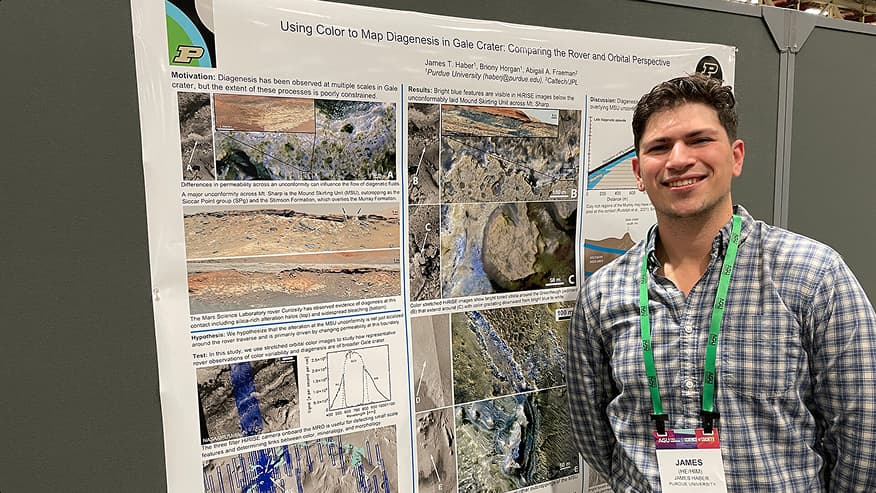
Members of the department took a trip that Haber still treasures.
“It was incredible to see Arizona and Utah with my cohort,” he says. “Getting to go to the Meteor Crater with professor Jay Melosh, who had so much influence on the world’s understanding of impact craters, is something I could never forget.”
In West Lafayette, he found a space legacy unlike any other, as well as other Purdue-specific perks, like professor Andy Freed’s Geosciences in the Cinema class. Seeing reminders of alumni’s roles in space exploration was inspiring — most days, Haber walked by a photo of NASA astronaut and fellow EAPS alum Andrew Feustel and recognized the impact of the university’s space legacy.
Recently, Haber conducted fieldwork in Iceland for the Smithsonian with a couple of colleagues who also went to Purdue. Horgan let them use some of her instruments, including a handheld spectrometer gun that looks like something out of “Star Trek.”
“Briony is a very kind and compassionate person to work with,” Haber says. “She helped me then and continues to make my role better even now.”
Being among our nation’s biggest discoveries
As “an establishment for the increase and diffusion of knowledge,” the Smithsonian hosts so much more than only the public-facing exhibits. Hundreds of researchers work within the organization’s 21 museums, 14 education and research centers, and the National Zoo.
Within the National Air and Space Museum, the Center for Earth and Planetary Studies uses data from orbiting satellites, human and robotic space missions, and field studies to expand humankind’s understanding of what’s beyond our atmosphere.
Haber is part of the team of planetary scientists looking at images and datasets from different planets across our solar system. Though the group is small, there are researchers who have been there for decades and dealt with the very first Mars rover missions. It’s a collaborative environment.
As he studies rocks on Mars, Haber compares them to rocks on Earth and tries to figure out what they’re made of and how they indicate the presence of ancient liquid water on Mars.
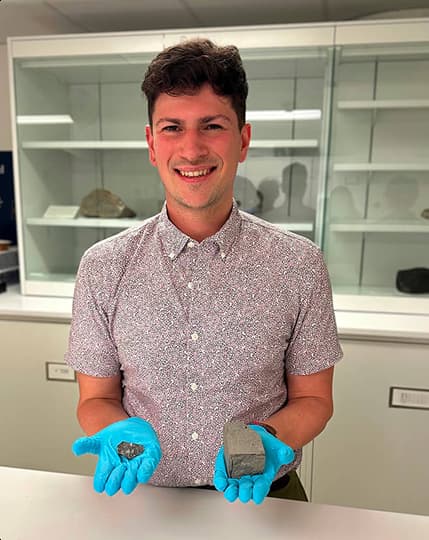
“My research raises a series of questions,” he says. “Where was the water flowing? Could it have been habitable? What life could have survived or even thrived there?”
Colleagues and friends work in the outer solar system, where missions like the Europa Clipper (on its way to Jupiter) are scouting the edges of what we know. Haber says he looks forward to wherever his career may lead, whether it means continuing to work with Mars or focusing on the outer solar system instead.
“Even in day-to-day work, I think about deep time and the vastness of the cosmos,” he says. “When I look at things that are billions of years old, it’s a reminder that we’re all a part of something much bigger than ourselves.”