Meet the Boilermakers behind Purdue Pete’s cutting-edge look
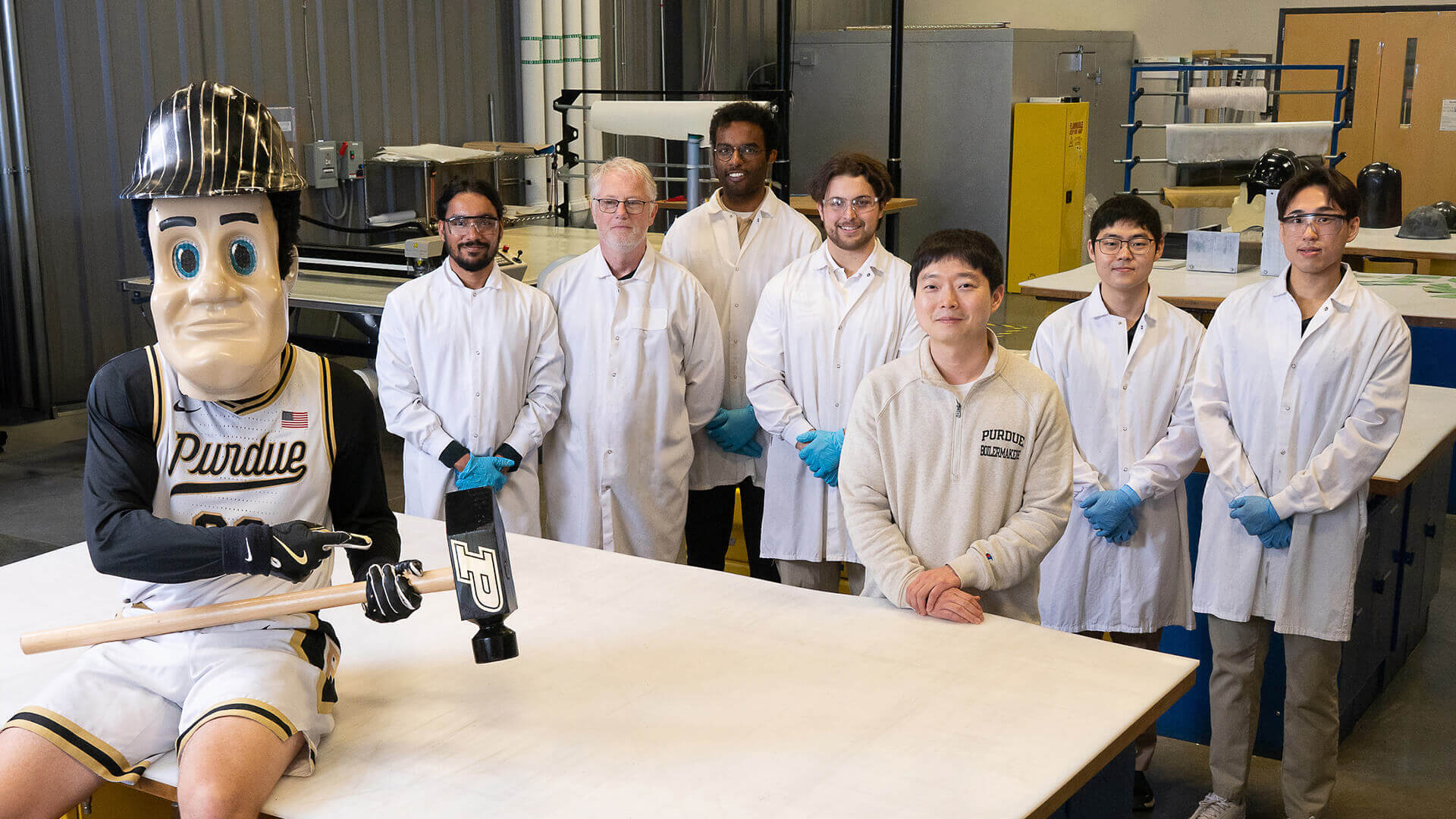
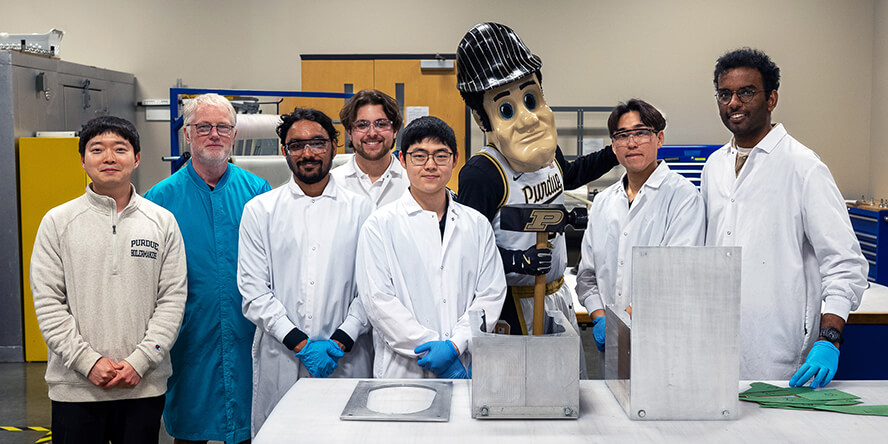
Purdue Pete’s lightweight, carbon-fiber head is the result of the innovative work of assistant professor Garam Kim (third from right) and his colleagues at Purdue’s Raisbeck Advanced Composites Laboratory in the Composites Manufacturing & Simulation Center. (Purdue University photo/John Underwood)
Where else but Purdue would researchers use aerospace-grade materials to make a sports mascot’s head?
What’s more Purdue than having a mascot whose head is constructed from the same materials as a rocket or a space shuttle?
Such is the case with Purdue Pete, the Boilermaker athletics mascot whose head is unique for several reasons. For one thing, it’s made on the Purdue campus — not outsourced to an external vendor — with contributions from current Boilermaker students. But the bigger difference is the carbon-fiber material that separates Pete’s incredibly lightweight and durable head from the costumes of his mascot compadres.
“Most of the mascots out there are made out of cotton or fabric, something like that,” says Garam Kim, an assistant professor in the School of Aviation and Transportation Technology who has helped make Pete’s head for the last 12 years. “Purdue Pete is definitely unique. We make it out of aerospace-grade composites — the same material as we’d make a Boeing 787.”
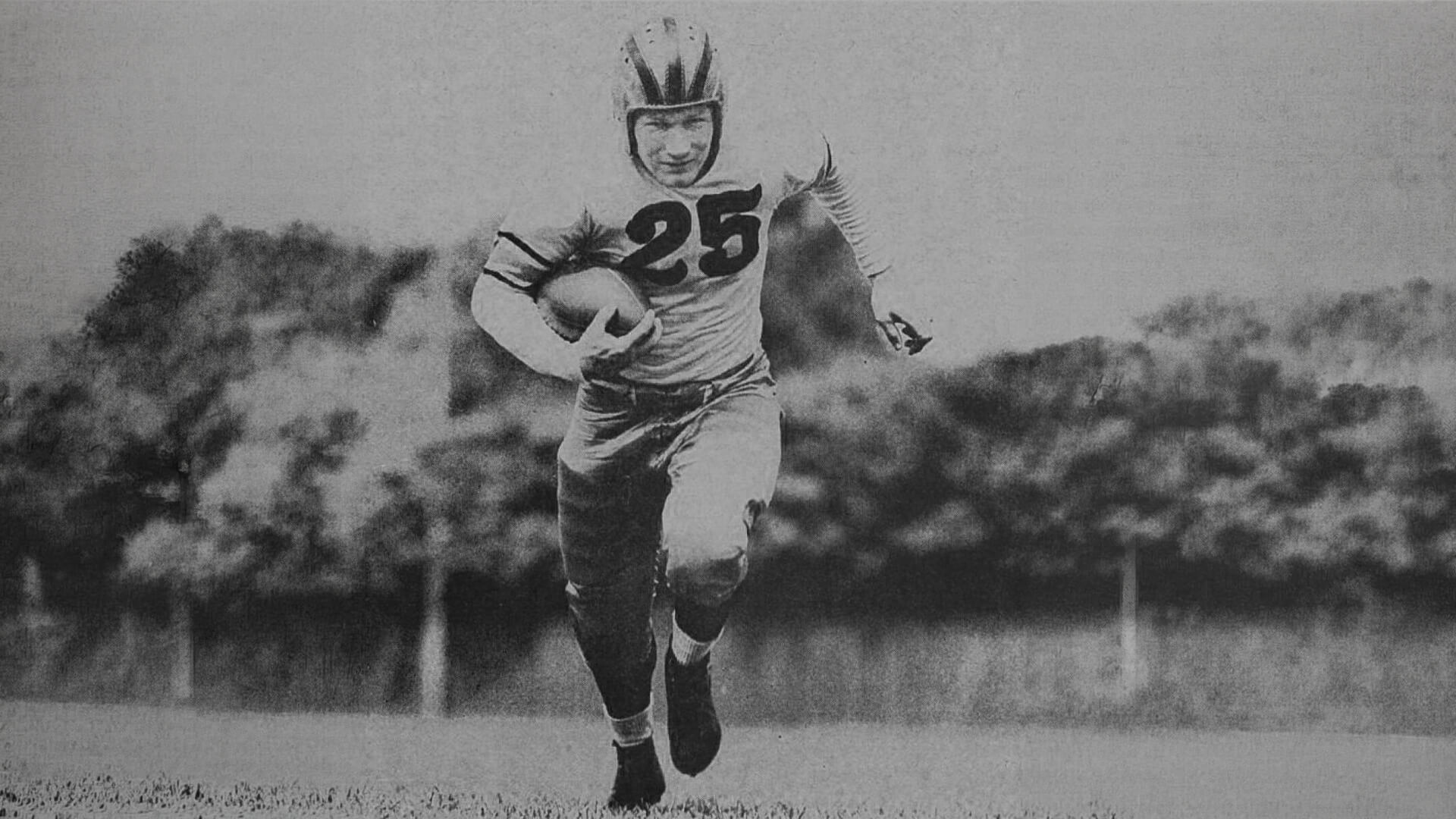
That represents a massive upgrade from the primitive getup that Boilermaker student Larry Brumbaugh wore when Purdue Pete debuted at the Sept. 28, 1956, pep rally before the Purdue-Missouri football game. Back then, the outfit featured foam rubber padding, long black pants, a sweater adorned with a block P and football shoulder pads, with Pete’s papier-mâché head attached using chicken wire.
Kim estimates that ensuing iterations of Purdue Pete’s head weighed around 40 pounds. Today, it weighs less than 2 pounds — thanks in part to advancements Kim and his colleagues have made at Purdue’s Raisbeck Advanced Composites Laboratory in the Composites Manufacturing & Simulation Center, where Pete’s head is one of many products created using the latest materials technologies.
“What we learned and what we found and what we developed with this technology, we directly applied to making the mascot. That’s how the mascot technology gets developed,” Kim says. “We have continuously worked to optimize the material system and manufacturing process for Purdue Pete and continue refining the design as new technologies become available.”
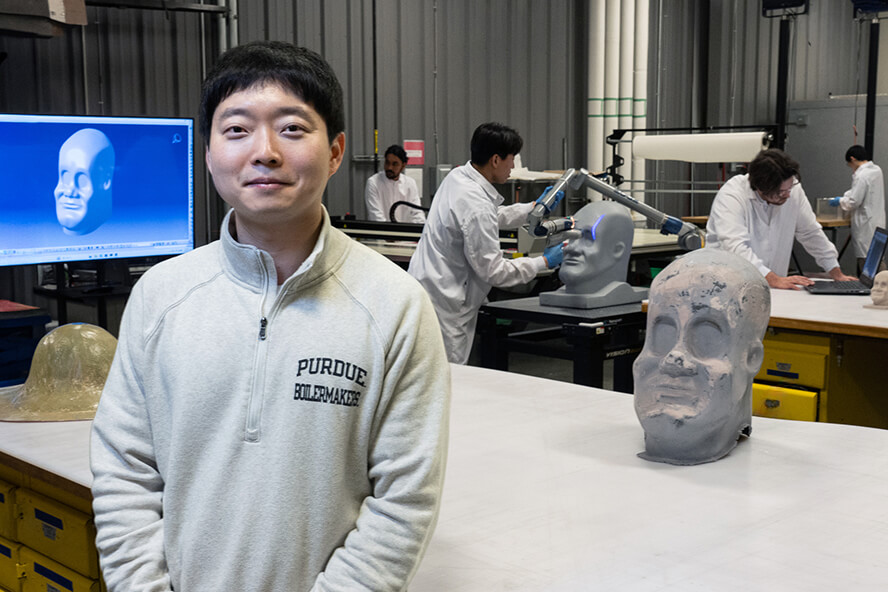
Purdue Pete is definitely unique. We make (his head) out of aerospace-grade composites — the same material as we’d make a Boeing 787.
Garam Kim
Assistant professor in the School of Aviation and Transportation Technology
Taking pride in Pete
Believe it or not, the guy who makes Purdue Pete’s head has never attended a Boilermaker sporting event.
And yet it would be difficult to find anyone who cares more about Purdue Pete than Kim (BS aeronautical engineering technology ’15, MS aviation and aerospace management ’17, PhD technology ’21), a triple Boilermaker who first started working on the mascot head as an undergraduate student in the Purdue Polytechnic Institute.
“I received an email from my advisor, Dr. Ronald Sterkenburg, asking if I was interested in working in the composite lab. It sounded like a good opportunity, so I got involved at the lab at that time — and one of the jobs was making Purdue Pete,” Kim says. “I’m not very into sports, but I just made it because it was my job. But after I made it over and over and started to learn about the history and studied the manufacturing method, I started to have affection for Purdue Pete. And now I think it’s the best mascot in the U.S. It’s very fascinating, and I’m very proud of what we’re making and how we make it.”
Sucheol Woo (BS aeronautical engineering technology ’25) learned about the Pete project in similar fashion — and he takes similar pride in the work after joining Kim in 2024 as an undergraduate research assistant.
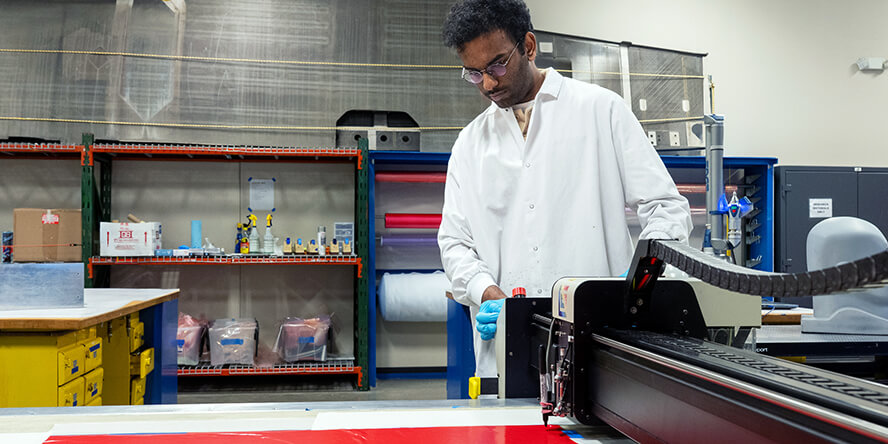
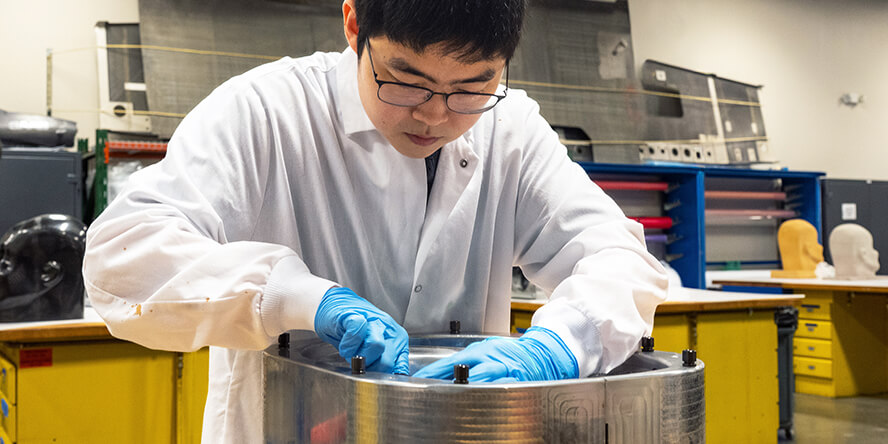
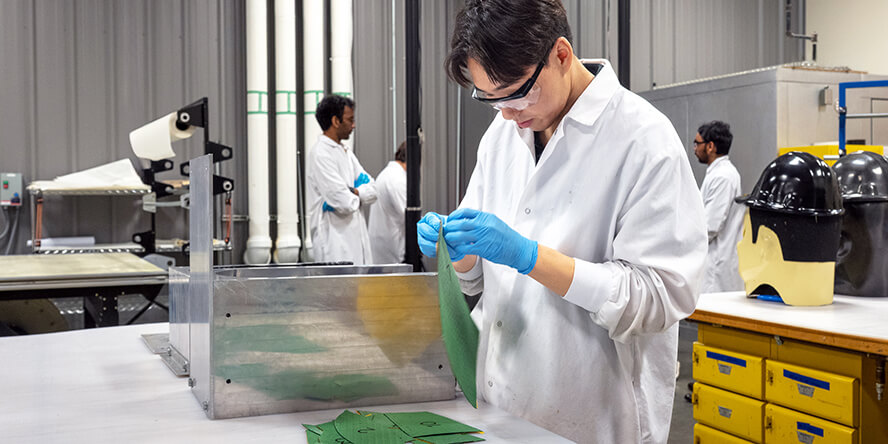
“Honestly, every part of the work is enjoyable,” says Woo, who is pursuing a master’s degree in aviation and aerospace management. “Cutting the plies to fit the shape and laying them onto the mold piece by piece, then watching all those small parts come together into one giant Purdue Pete gives me a sense of pride. It feels like I am contributing to my school not just academically, but also in an obvious and meaningful way.”
Working on such projects in the composites lab was also a fun way to build essential hands-on skills in his chosen field. After making Purdue Pete heads, Woo says it was a breeze to pass the composites course he took as part of his aeronautical engineering technology curriculum.
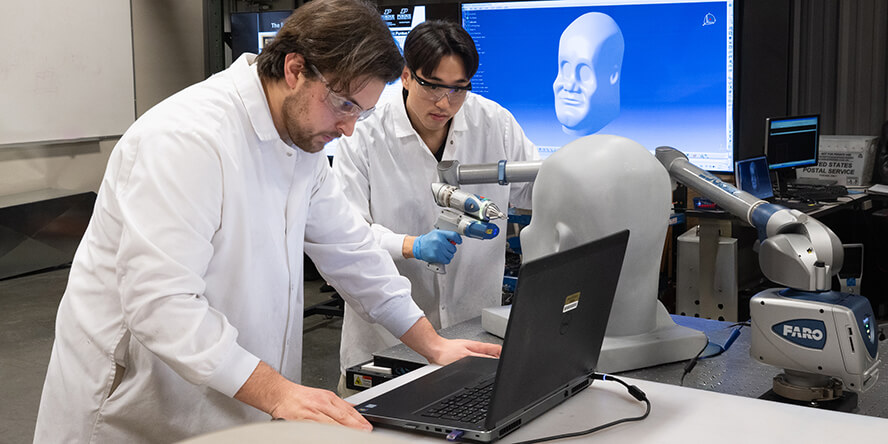
“It felt like one of the easiest classes for me because I already had so much hands-on experience,” he says. “Through designing the new Pete head, I’ve also gained valuable skills in CAD (computer-aided design), CNC (computer numerical control) machining, 3D printing and 3D scanning. This project has given me a strong foundation for the research I am doing now and the career I hope to pursue in the future.”
The next iteration
Speaking of new (and not yet seen) Purdue Pete heads, the project also gives students like Woo an opportunity to innovate.
By transitioning from the heavier materials previously used to make the head, Kim and his predecessors have helped make it an increasingly wearer-friendly getup.
“It really wasn’t that bad. It was like wearing a bicycle helmet that was extra heavy,” says Bo Pratt (BA elementary education ’07), a former Purdue Pete (2005-07) who estimates that the head’s weight had decreased to about five pounds by the time he served as mascot. “The biggest thing, in the sense of being uncomfortable to wear, is it was hot because you’d get no airflow at all. Football is kind of rough sometimes if it’s a really sunny, warm day. And there were a couple summer events where if the sun was beating down, it got really hot in there.
“I always had to wear a sweatband because you can’t wipe sweat from getting in your eyes,” Pratt says. “Otherwise, my eyes would be burning all the time, because even when you’re at a basketball game or at volleyball, it’s still warm enough that you’re going to have sweat running down your forehead.”
Through reverse engineering and digital assembly techniques, Kim and company have set out to add breathability to future iterations of Purdue Pete’s head. Instead of using expandable adhesive foam, customized to fit each individual wearer and hold the head in place, the researchers plan to introduce new designs that will fasten the external carbon-fiber shell to a detachable bicycle helmet worn internally, improving the ventilation inside the head and allowing the wearer to switch to a fresh, clean helmet as necessary.
“They sweat a lot, and that sweat will soak into the helmet, so it would be much better if they could change helmets when needed. That’s why we are working on new designs to replace the adhesive foam,” Woo says. “With these designs, we can reduce the overall weight, make the helmet replaceable, and also integrate a vent system inside to make it more breathable and comfortable to wear.”
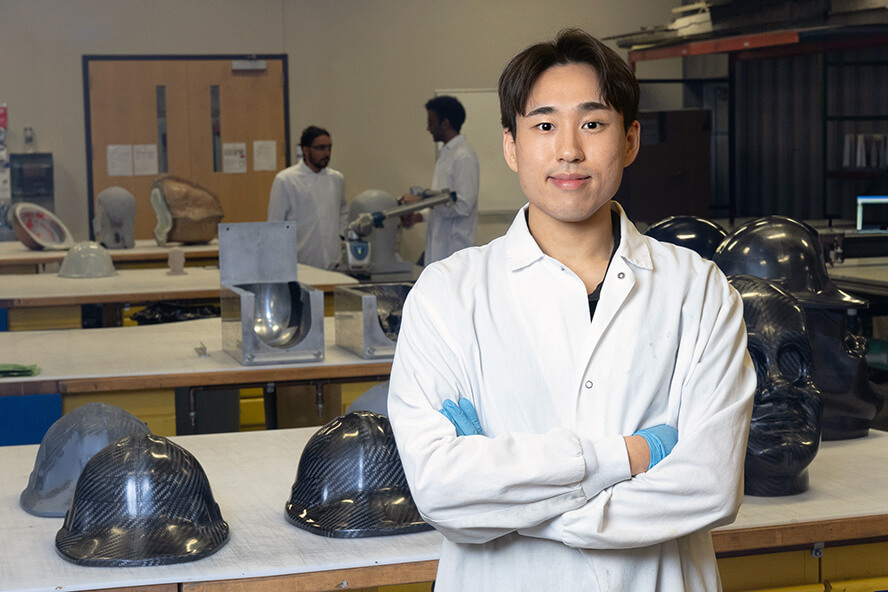
Watching all those small parts come together into one giant Purdue Pete gives me a sense of pride. It feels like I am contributing to my school not just academically, but also in an obvious and meaningful way.
Sucheol Woo
BS aeronautical engineering technology ’25 and graduate research assistant
Improvements like these have influenced Purdue Pete’s evolution ever since the mascot project landed on the aviation technology department’s doorstep in 1989.
The upgrades have made wearing the head less physically demanding for the handful of Boilermaker students who represent their university each year at countless campus and community events. And while most who see Pete at an event don’t realize it, the cutting-edge methods used to create the mascot’s head are also a perfect example of the technological innovation that takes place each day at the university Pete represents.
“We’re not using something totally different from what we study,” Kim says. “We actually use the same material and technology we use for research, and we adapt it to the mascot manufacturing.
“I have so much affection for it, and I’m very proud of Purdue Pete,” Kim says. “I think it delivers the message to the world that Purdue is passionate, strong and tough. There’s no reason not to love Purdue Pete.”