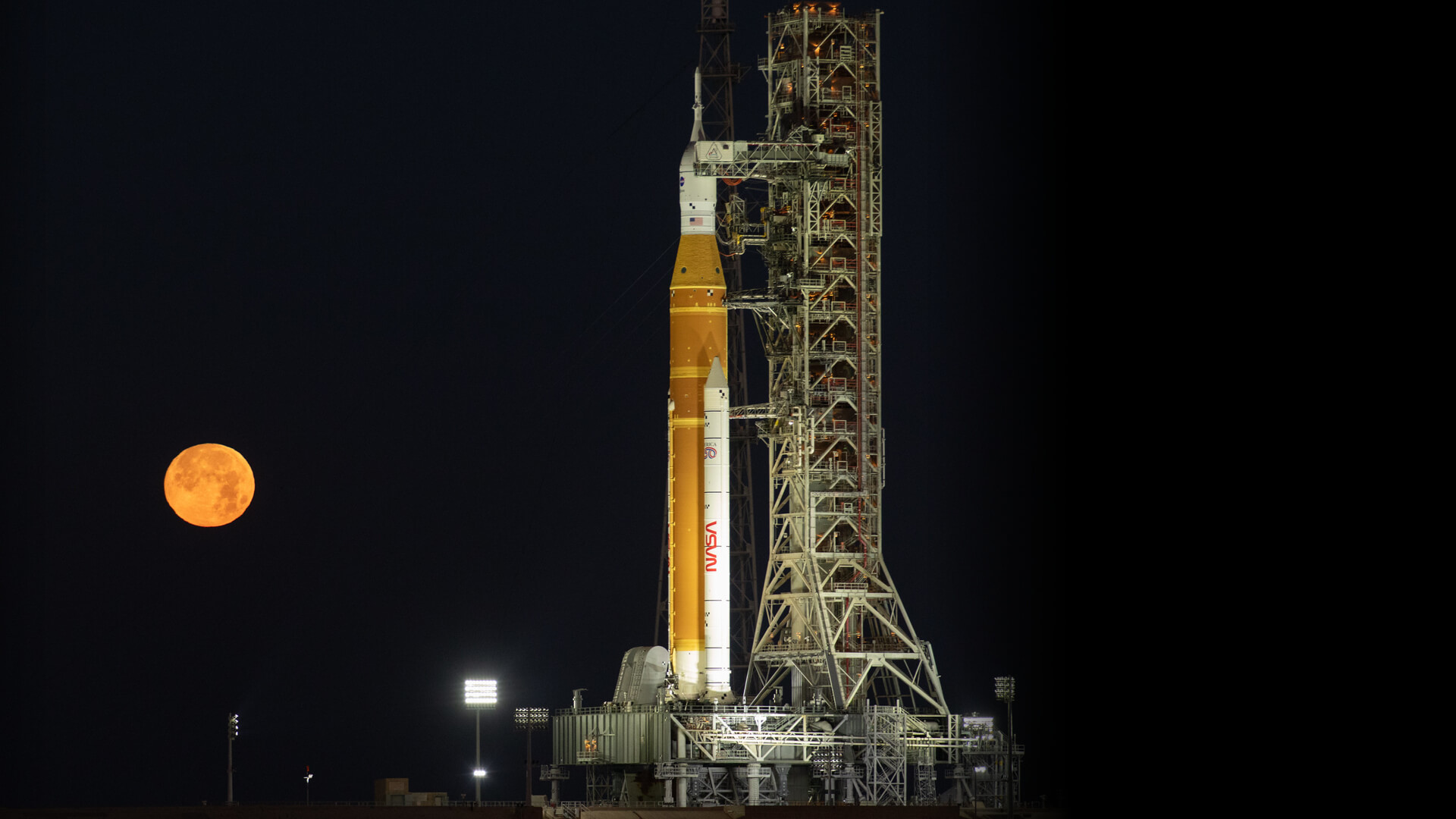
When gravity disappears
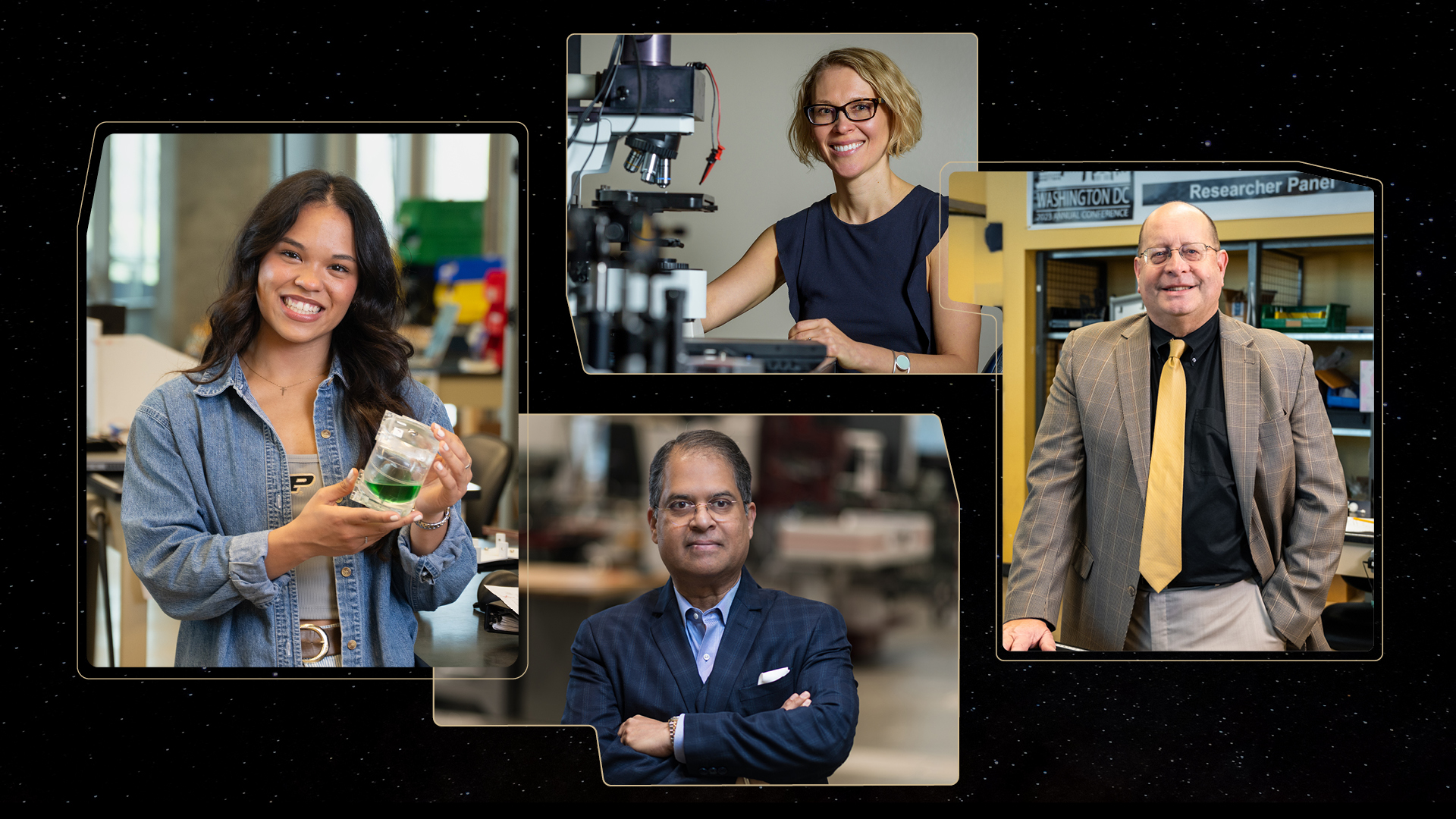
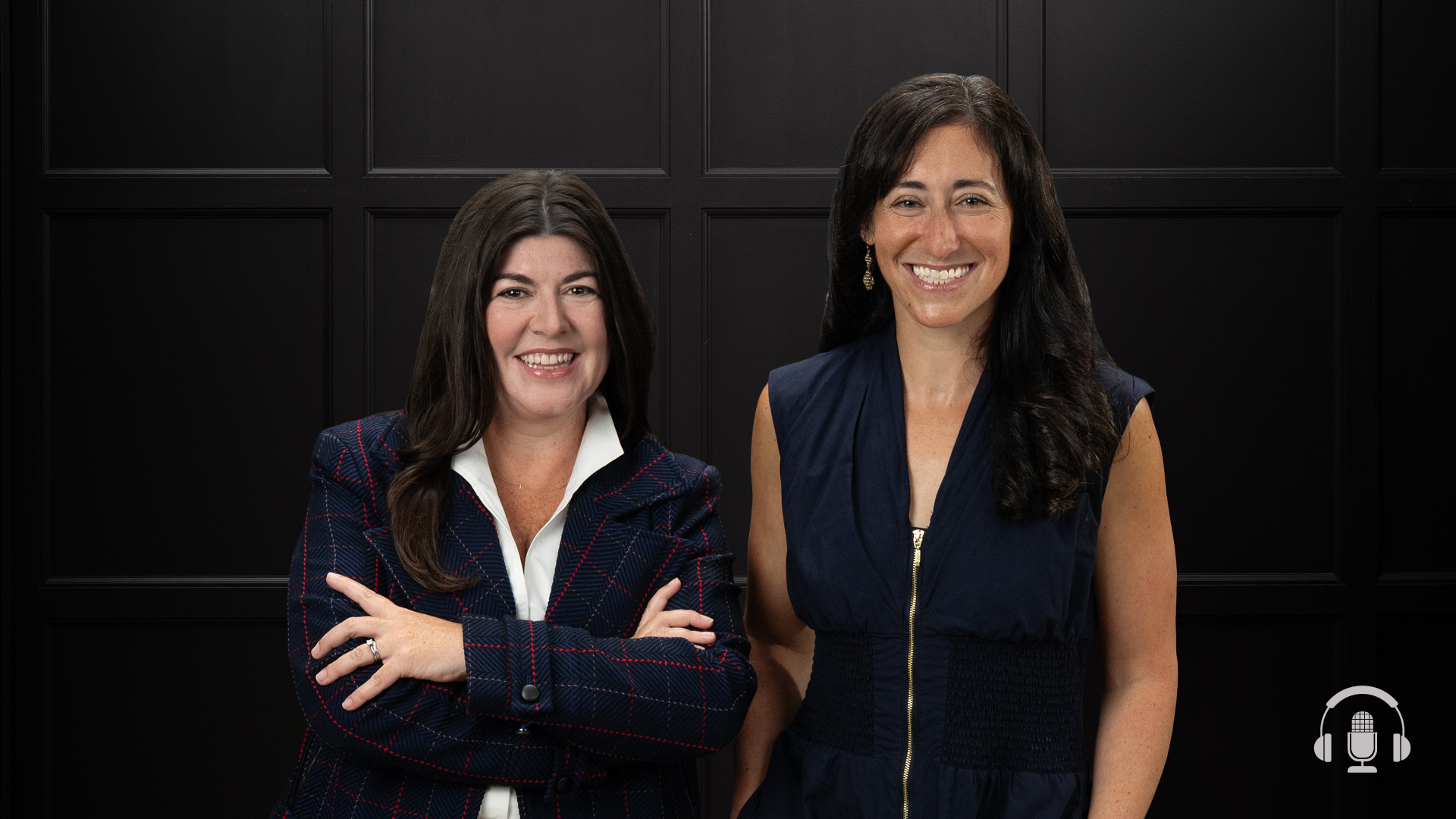
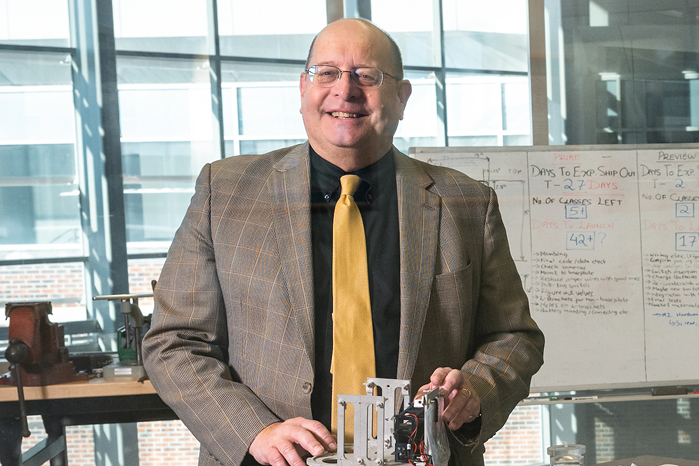
The thrill is real: Abigail Mizzi, graduate student in aeronautics and astronautics; Alexandra Boltasseva, the Ron and Dotty Garvin Tonjes Distinguished Professor of Electrical and Computer Engineering; Ajay Malshe, the R. Eugene and Susie E. Goodson Distinguished Professor of Mechanical Engineering; and Steven Collicott, professor of aeronautics and astronautics, prepare groundbreaking research for the 2027 Purdue 1 mission into space.
On a flight into space, Purdue researchers will test forces that could determine how we find our way, build and survive in space
A drop of liquid released in space doesn’t fall. It hovers, clings and stretches into shapes that defy earthbound expectations. And for engineers, that drop resists prediction.
In 2027, Purdue researchers will follow that bead of liquid aboard a Virgin Galactic spacecraft and into microgravity, chasing answers that could determine how spacecraft navigate, how manufacturing for the supply chain can be accomplished in space, and how humans can survive and function there.
The Purdue 1 mission is a first: a university-led, research-focused suborbital flight with an all-Boilermaker crew. In a few minutes of weightlessness, experiments that span quantum physics, manufacturing and fluid dynamics will test whether the systems that humanity will need in space can be made efficient, reliable and operationally resilient.
The research is critical if space is to one day become a place where humans live and work. All of the systems we take for granted on Earth have to work in an environment where gravity, the consistent assumption behind nearly all existing engineering, no longer dominates.
Navigation without GPS: Wayfinding in deep space
On Earth, navigation is invisible. Satellites beam signals, and a blue dot appears on our phones or vehicle screens to reassure us that the technology knows where we are and how to get where we’re going.
In deep space, that system collapses.
“When you go to Mars, you won’t have a GPS signal,” says Shengwang Du, the Scifres Family Professor of Electrical and Computer Engineering and a professor of physics and astronomy. “You have to rely on new technology.”
That technology — quantum positioning, navigation and timing, or Q-PNT — is at the center of one of Purdue 1’s experiments.
Du is working to reveal how laser-cooled atoms behave in microgravity along with colleagues Alexandra Boltasseva, the Ron and Dotty Garvin Tonjes Distinguished Professor of Electrical and Computer Engineering; Vladimir Shalaev, the Bob and Anne Burnett Distinguished Professor of Electrical and Computer Engineering; and Joseph Lukens, associate professor of electrical and computer engineering, in collaboration with the company Infleqtion.
When intensely cold, atoms can become remarkably precise. That’s the idea behind the researchers’ experiment to understand how atoms behave when gravity nearly disappears.
Using laser light, the team will cool atoms to microkelvin temperatures — just a millionth of a degree above absolute zero (minus 459.67 degrees F). That’s colder than deep space. At these temperature extremes, atoms barely move. And when motion nearly stops, precision takes over.
“Even a tiny error makes a huge difference,” Du says.
On Earth, atoms jitter and drift, like a metronome knocked slightly offbeat. But at near absolute zero, their motion becomes steady and predictable.
That rhythm becomes a kind of internal clock. By measuring its consistency with extreme accuracy, researchers can track motion and position from within the system itself, without satellites.
That precision could be the future of navigation everywhere.
Today’s global positioning systems are vulnerable in ways that quantum technology would not be. Satellites are susceptible to outages, interference and attack. Q-PNT points to a different future for both outer space and Earth: navigation that doesn’t depend on satellites. In the long term on Earth, that could mean more reliable timing and positioning for cars, airplanes, ships, financial systems and power grids.
Quantum systems that can operate without GPS would be more resilient and harder to disrupt and hack. Spacecraft traveling to the moon, Mars or beyond could navigate independently, without relying on signals from Earth.
Still, navigation is only one of many challenges. To live and work in space, humans will need an entire infrastructure, from guidance systems to orbital manufacturing, capable of producing semiconductors and metals in orbit.
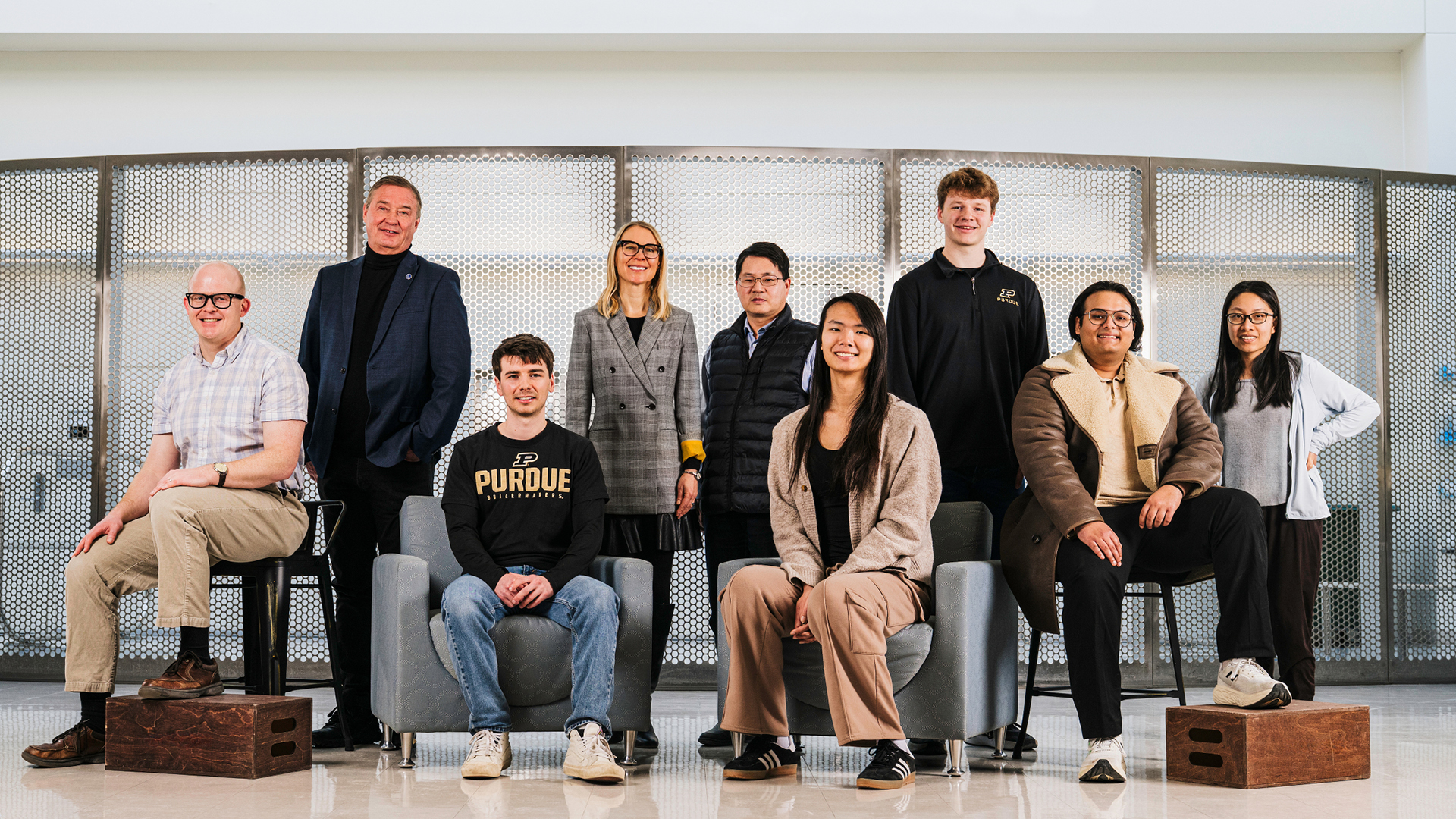
Manufacturing off Earth: Building what you need, when and where you need it
If navigation answers where you are and where you’re headed, manufacturing answers what you can do once you get there.
Ajay Malshe and his team’s experiment addresses a constraint as old as spaceflight itself: that every component, every replacement part, every system must be carried into space from Earth. That model isn’t sustainable on a large scale as we move away from individual space missions to operating in space.
“We are in what you would call Space 2.0,” says Malshe, the R. Eugene and Susie E. Goodson Distinguished Professor of Mechanical Engineering and co-pioneer of the concept “factories in space,” alongside his son, Harsha Malshe, co-founder and chief technology officer of Arkwright Space. “If human habitation, human presence, human operation is going to go to space, the electronics, the semiconductors, chips, quantum and the digits all have to go to space.”
Malshe’s PRISM team — Purdue Research in Space Manufacturing — has designed its Purdue 1 experiment as a compact, autonomous micro-lab for understanding the science and engineering intrinsic to the in-space manufacturing of electronics and semiconductors. Inside it, researchers will test whether the earliest building blocks of manufacturing can happen in orbit under conditions that are fundamentally different from those on Earth.
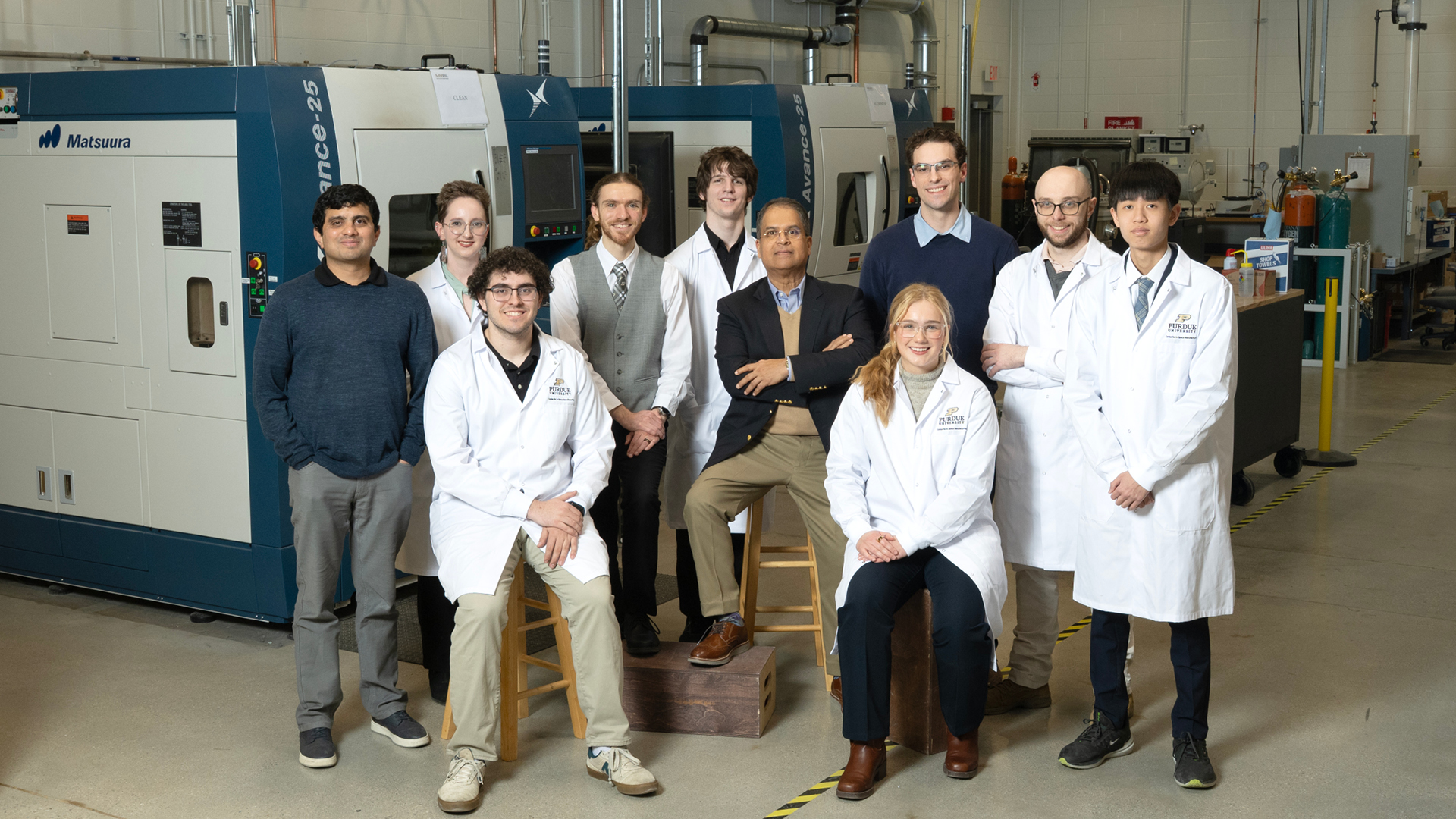
The work builds on years of research from Purdue’s Center for In-Space Manufacturing, where engineers, students and industry partners rethink how production happens without gravity.
Instead of relying on large, energy-intensive systems like furnaces, the experiment uses a far more targeted approach. A diode laser module — drawing less than 50 watts of power — delivers controlled, localized energy to ultrathin layers of silicon and metal.
The goal is to gently reshape their internal atomic structure and study performance without the standard constraints of bulky scale or the energy demands of traditional manufacturing.
Beginning with the liquid phase, the experiment also will observe how materials change phases in microgravity and how digital tools can guide manufacturing processes with minimal human intervention. Together, these elements point toward a system that can operate at the point of need with increasing autonomy — a necessity when distance and delay make real-time control from Earth impractical.
At its core, the work asks a simple question: Can critical components be made, repaired and adapted when they’re needed and at the rate they’re needed?
In space, that capability defines resilience. It determines whether a mission can continue when something breaks, whether systems can evolve in place and whether infrastructure can scale beyond one-off missions into sustained operations.
When liquids refuse to behave: The hidden problem of spaceflight
On Earth, liquids are obedient. They settle at the bottom of a container. They pour. They drain. In space, they do none of those things.
“On Earth, liquids just go downhill,” says Steven Collicott, professor of aeronautics and astronautics, who will go up in the Purdue 1 spacecraft to conduct his fluid-dynamic experiment. “That’s all due to gravity. Without gravity, other things draw where the liquid wants to go.”
Those other things include surface tension and capillary forces, which dominate in microgravity. They determine where fuel collects in a tank, whether water reaches a plant’s roots and whether life-support systems function as intended.
Every spacecraft depends on liquids for fuel, drinking water for astronauts, coolants for electronics and fluids for medical systems.
And yet, as Collicott notes, engineers have designed those systems on Earth, guided by intuition that does not apply in space.
Purdue 1 carries two experiments designed to close that gap.
Controlling liquids when gravity no longer does
Collicott’s experiment focuses on a deceptively simple question: How do liquids spread across surfaces in microgravity?
On Earth, gravity dominates fluid behavior. In space, liquids cling, wick and move in ways that are difficult to predict and even harder to model.
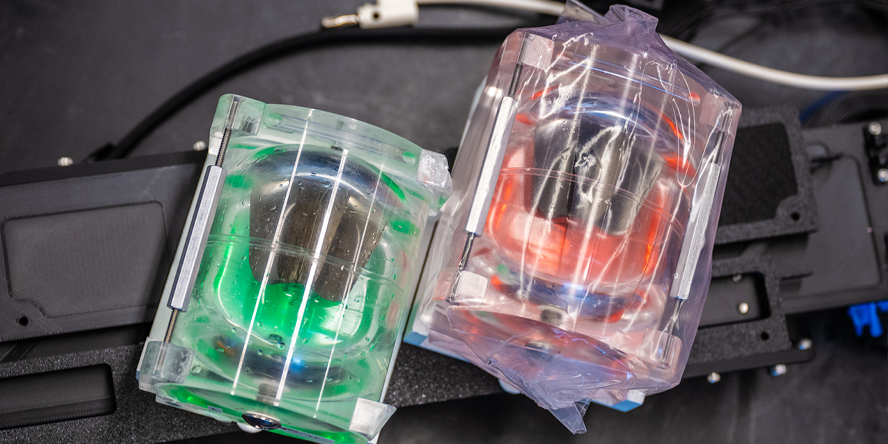
Collicott’s test uses adjustable plates to observe how liquids advance along surfaces under different conditions. The goal is to build models that can predict space-based fluid behavior reliably.
The lack of those models has had tangible negative consequences. Spacecraft must carry extra fuel, add redundancies and accept inefficiencies. Collicott’s work will pave the way toward spacecraft and space systems that are lighter, cheaper and more precise.
“If you don’t have a good knowledge of how to handle and separate liquids and gases,” Collicott says, “you’re just wasting precious fuel.”
In extreme cases, misunderstanding fluid behavior can lead to failure: overheating tanks, losing propulsion or compromising life-support systems.
The experiment will collect rare, sustained, high-quality data in true microgravity, gathered not by automated systems, but by a researcher adapting in real time.
That human presence matters. “You put the brain power up there,” Collicott says, adding that the power to adjust conditions maximizes what can be learned.
When motion complicates everything
Collicott’s work will study liquids at rest. Abigail Mizzi’s will examine them put in motion.
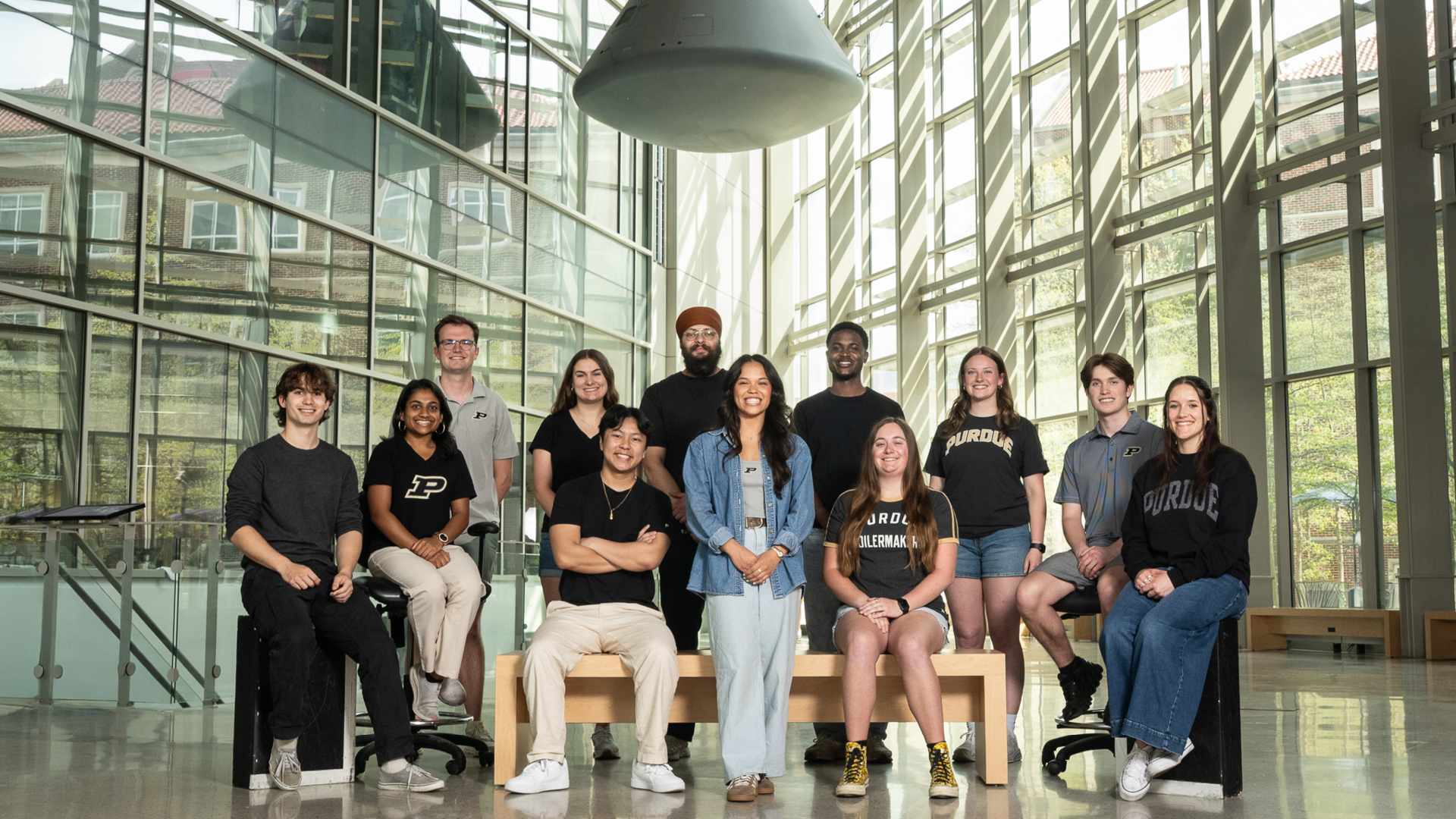
Mizzi, a graduate student in aeronautics and astronautics, will join Collicott aboard the Purdue 1 spacecraft. She is leading teams of undergraduate researchers in preparing the experiment designed to learn about rotational slosh — how liquids that are set into motion behave without gravity to slow them down or stabilize them.
On Earth, a shaken cup of coffee quickly settles. In space, it does not. “How long does it take for it to stop moving?” Mizzi asks. “There’s no gravity to make it stop.”
That question carries enormous implications because moving fluids can shift a spacecraft’s center of mass, affect stability and navigation, and complicate fuel delivery.
Mizzi’s team is building an experiment that will induce motion by rotating and disturbing liquid systems, then measure how they behave.
The goal is to develop and improve models used to simulate spacecraft systems. Current simulations contain uncertainty, forcing engineers to compensate with extra fuel, weight and cost.
“We can’t fly humans to space based on assumptions,” Mizzi says. “We need data.”
That data will inform propellant systems, life-support systems in spacesuits and water delivery for plants.
Even something as simple as watering crops in space depends on knowing where the liquid is and whether it can be moved where it’s needed.
A team effort from the ground up
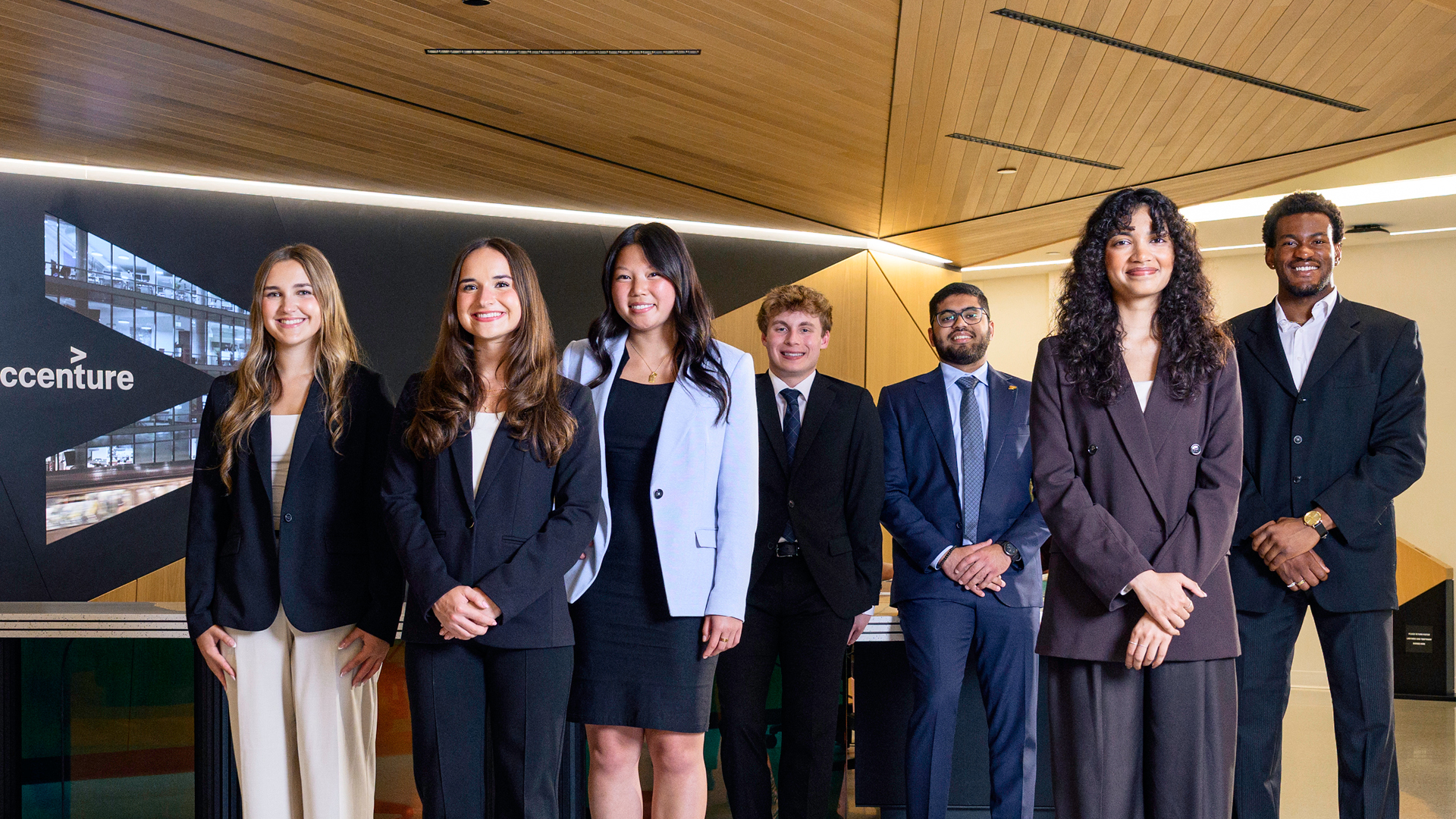
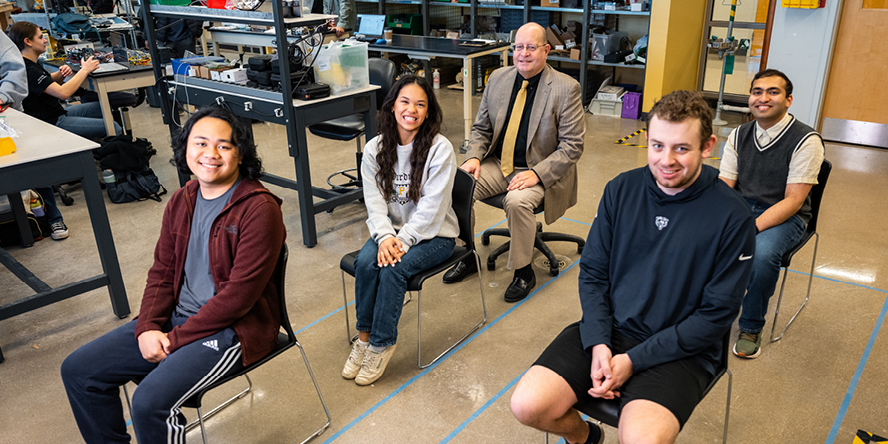
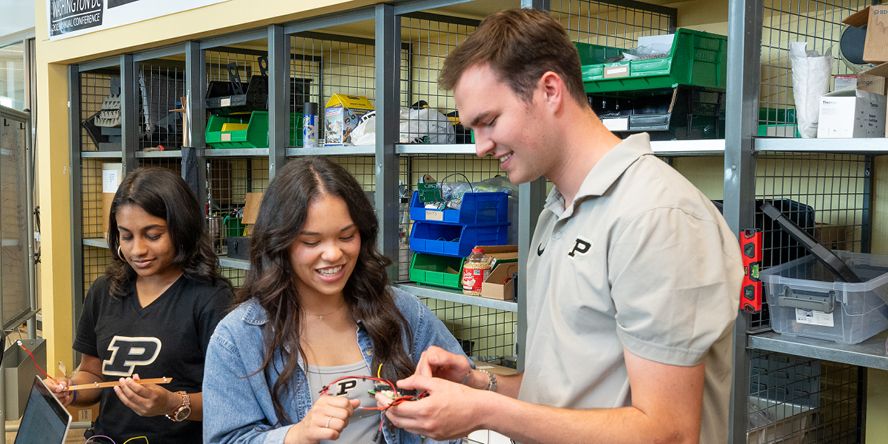
The rotational slosh experiment is also a study in how space research is built — not by individual researchers, but by teams learning in real time. Mizzi’s team is filled with Purdue undergraduates who are getting real-world research experience they will likely never forget.
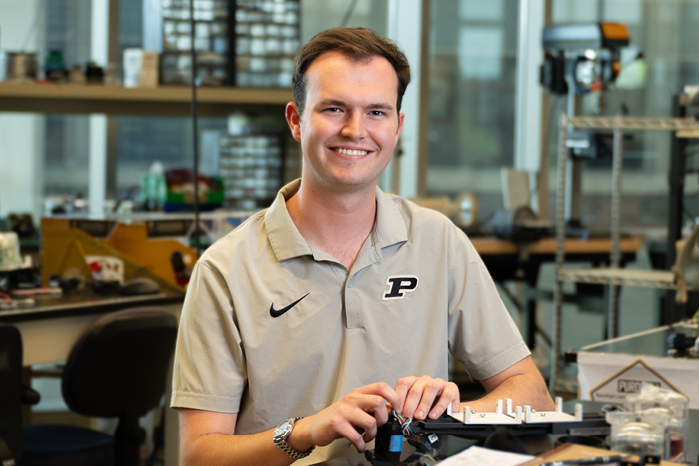
Owen Fix, who received his bachelor’s degree in aeronautics and astronautics in May, is among them. He describes the project as the kind of engineering he used to envision but rarely encountered in the classroom.
“It’s kind of what I always imagined engineering would be like,” he says, referring to his experience with Purdue’s signature hands-on, iterative learning tied to real-world outcomes.
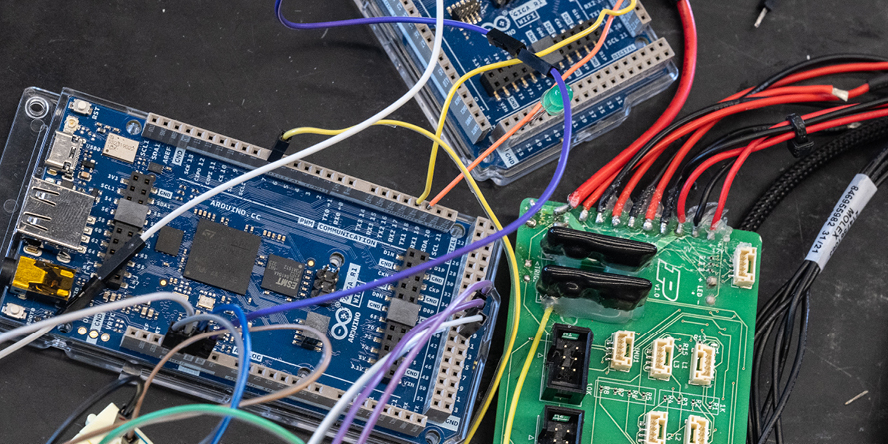
His role among several undergraduate researchers on Mizzi’s team is focused on motors and control electronics. It has involved trial, error and the occasional failure in the form of burned components, unexpected results and lessons learned.
Failures in this process are not flaws; they are inherent to learning. And for Fix, they can also be exciting.
“I’ve made a lot of mistakes in it,” he says. “But that’s kind of part of the fun of doing something that actually matters.”
For Mizzi, leading the project means managing not just technical challenges, but people. She trains students every semester as seniors graduate and new students join her team. Documenting the work done and progress made while maintaining continuity in a changing team is an ongoing challenge.
Mizzi takes it all in stride. She understands that space research is not an individual pursuit. “It takes so many people to collaborate and work together to make something massive happen,” she says.
Minutes that matter
The Purdue 1 mission will provide only minutes of microgravity — minutes that will be choreographed down to the second. Each of the research projects, whether automated or human-run, must activate, capture data and, if needed, receive real-time adjustments.
Preparation includes simulation, rehearsal and even centrifuge training to replicate the forces of launch. Researchers must be ready to act immediately, without hesitation.
“Plan, prepare, practice,” Collicott says. Because in space, there are no second takes.
Moments for momentum
Each of the Purdue 1 experiments addresses a different piece of a much larger puzzle.
A fifth experiment to be overseen by Beth Moses, astronaut and associate professor of engineering practice, will test wearable technology.
Individually, they are incremental. Together, they point toward a future where space systems are not just functional, but reliable enough to support sustained human presence.
Opening space to more than astronauts
The Purdue 1 mission is also part of a broader shift that extends beyond technology.
Malshe calls it the “democratization of space,” a move from a domain once limited to a few astronauts to one that includes universities, industry and government. He says that this is as it should be. “As a land-grant university, we engage our citizens.”
Partnerships with NASA, the U.S. Space Force, Northrop Grumman and companies like Infleqtion help move ideas from lab to orbit.
Shalaev sees that collaboration as essential: “The fact that we’re doing this with industry is very important,” he says, “because it could speed up this new technology. This will help to bring the work we do closer to real technological application in the field of quantum.”
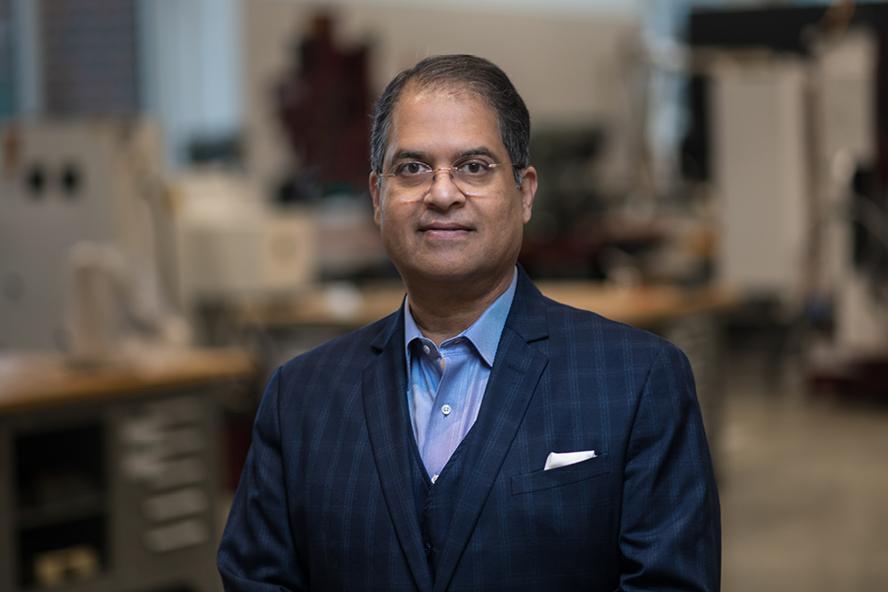
We are in what you would call Space 2.0. If human habitation, human presence, human operation is going to go to space, the electronics, the semiconductor, the quantum all have to go to space.
Ajay Malshe
The R. Eugene and Susie E. Goodson Distinguished Professor of Mechanical Engineering
Boltasseva points out that what follows is competition, momentum and progress. “I think there will be a race to get things into space and test them, and that is great because competition drives technology and fundamental discoveries forward,” she says.
She also sees something less tangible but in her view just as important: a chance to spark curiosity.
“I think we are in an important stage right now because quantum for many people is still something mysterious,” she says. “Educating people about quantum technologies at large and their emerging future impact on many aspects of life, technology and science is very important.”
Purdue’s next chapter in space
Purdue’s legacy of astronauts, missions and milestones in space is well known.
Purdue 1 represents a different kind of first — ownership. Purdue is designing and operating its own research in human spaceflight.
In many ways, it represents a return to the university’s land-grant roots of applied research, real-world problem-solving and practical outcomes. Only now, the field extends beyond Earth.
When the spacecraft arcs above the planet in 2027, the experiments will last just minutes. But the questions they ask and the answers they yield will endure. Before humans can live in space, they must first understand it. And to gain that understanding, even a drop of liquid matters.