Minecraft meets the hellbender
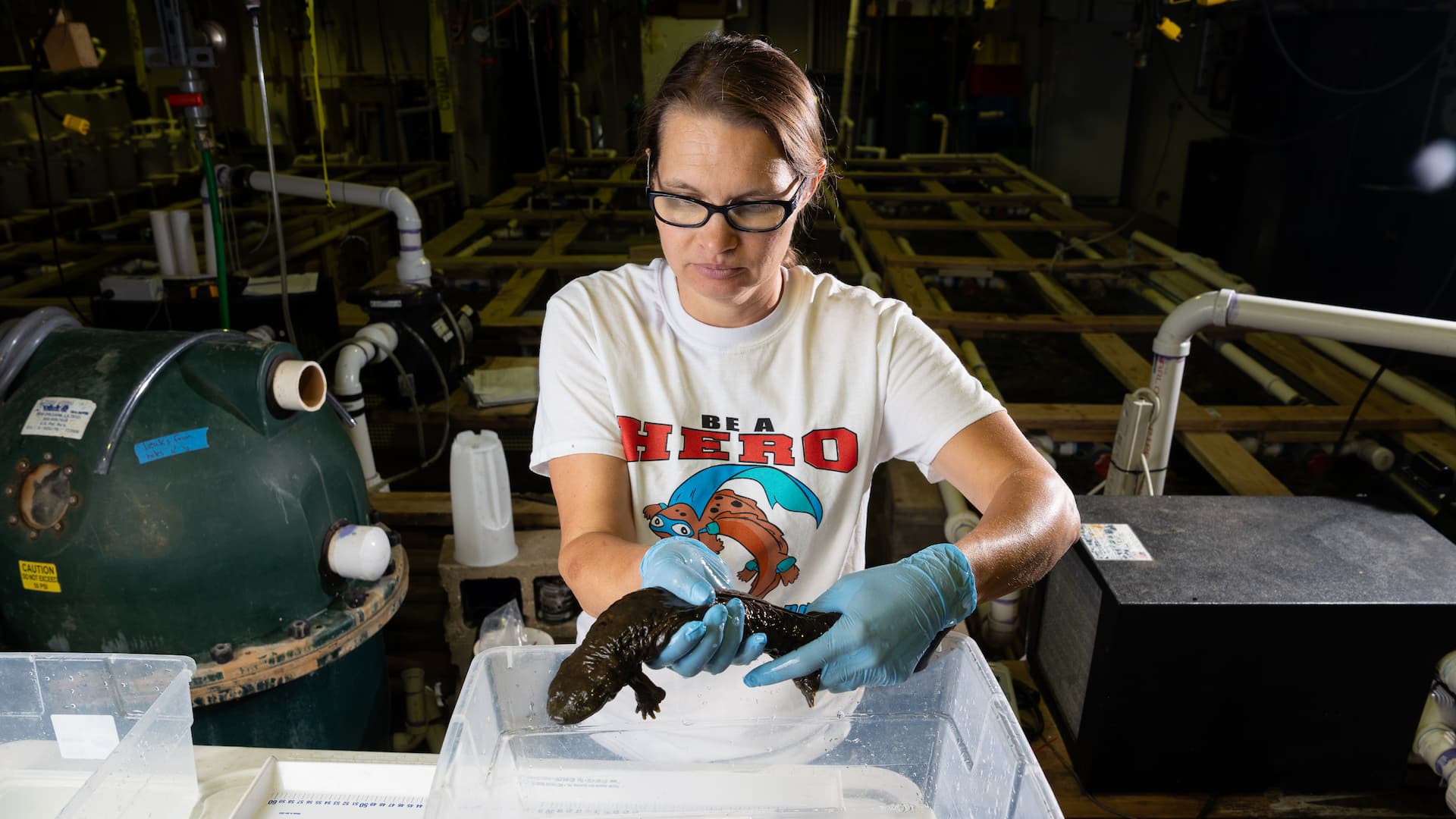
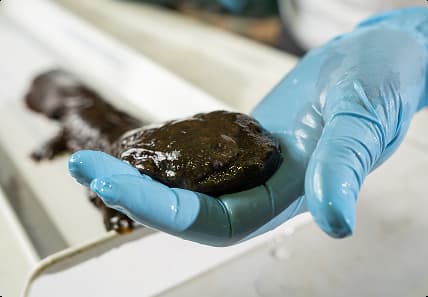
Sherri Reinsch, research associate and hellbender husbandry coordinator gently handles a hellbender in the lab. (Photo provided by Purdue Agricultural Communications/Joshua Clark)
This amphibious rock star gets its own educational video game with the help of Purdue research.
The eastern hellbender salamander will never win a wildlife beauty pageant. It’s believed that it got its name from settlers who said it looked like a creature from hell that was “hell-bent” on going back there. But it turns out that the hellbender could probably win the pageant’s talent contest because of all the good it does for the ecosystem.
Purdue research has revealed that the hellbender is one salamander that just might capture your heart.
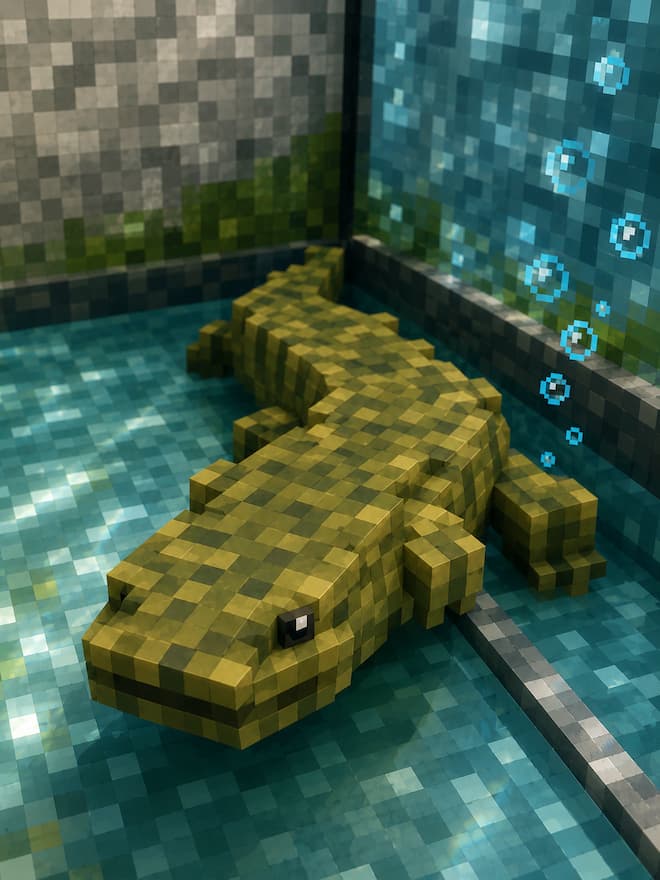
Once endangered in Indiana and at risk in other parts of America, the hellbender does so much good that it inspired its own custom-built Minecraft experience. Yes, Minecraft — the one with its own movie starring Jack Black and Jason Momoa, and millions of players from every single country worldwide.
Helped by Boilermaker researchers first organized by Rod Williams, a former Purdue professor now on the faculty at Texas Tech University, “Help the Hellbender — A Minecraft Conservation Quest” was created for the Minecraft Education realm.
This new game lets players traverse the hellbender’s underwater world, overcoming challenges and learning about why we all need to protect this superstar amphibian, whose health helps reveal the health of rivers and streams.
With millions of young Minecraft lovers around the world, the game is an ideal vehicle to reach middle schoolers and high schoolers — its target audiences.
It’s hoped that those students will discover not only a fascination with this lovable amphibian, but also a sense of environmental stewardship.
Roni Bullock, a senior Purdue Extension educator and forestry and natural resources graduate student, who has written lesson plans for teachers to use in combination with the game, says she sees the Minecraft game-based learning experience as a digital adventure that connects young minds to the living systems that sustain them.
“The hellbender might not look glamorous,” she says with a laugh, “but once you get to know it, you realize how much it tells us about the health of our rivers and streams. It’s a perfect species to show why protecting water matters.”
A living water-quality monitor
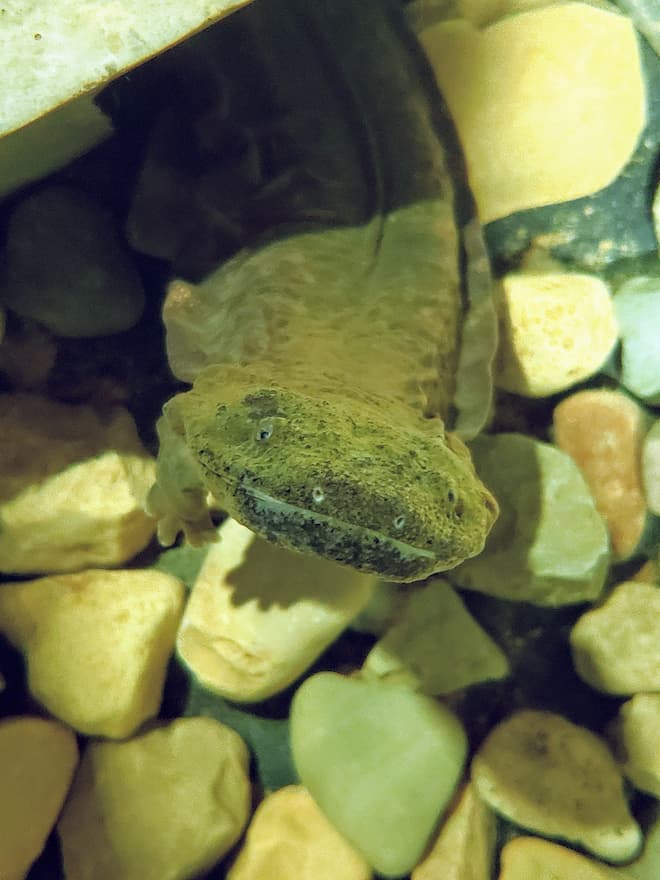
Looking like very slimy, super-overgrown tadpoles — their unique nicknames include “snot otter” and “water dog” — hellbenders can grow up to 2 feet long and weigh nearly 5 pounds.
You might notice that the hellbender’s wrinkly skin looks a bit like wet lasagna noodles. That’s because it lives underwater and breathes through its skin. This also is a main reason it’s so vital to humans. Because it absorbs oxygen through its skin, it’s a living water-quality monitor — a sentinel — for the health and purity of waterways.
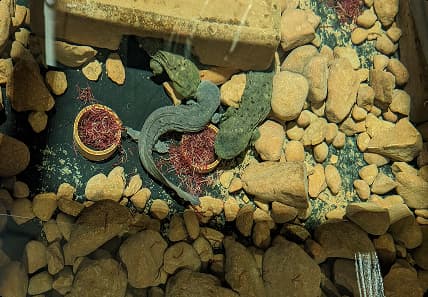
When hellbenders get sick or fail to reproduce, water conservationists know they need to figure out what’s wrong with their watery habitat and then work to fix it.
Jason Hoverman, professor of vertebrate ecology in the Department of Forestry and Natural Resources in Purdue’s College of Agriculture, says hellbenders are coming back in Indiana after their numbers were estimated at less than 1,000 before 2010. He says their comeback story is all about teamwork.
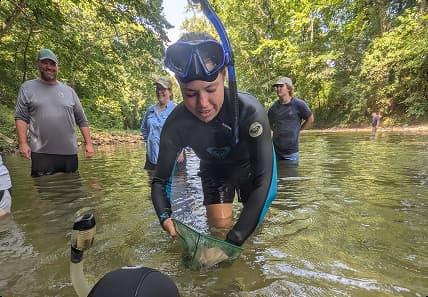
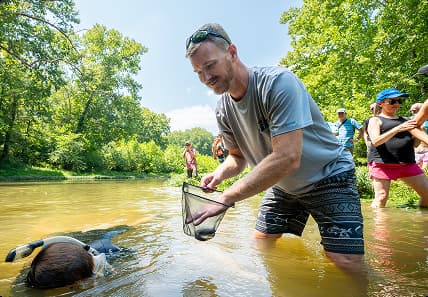
“We’ve released over 1,000 hellbenders into Indiana streams in the last decade and, just two summers ago, we found the first evidence that they’re reproducing again,” he says. “That was huge. It meant the population was not just surviving — it was recovering.”
The hellbender makes a comeback
The recovery is no accident. “It’s been a massive partnership,” Hoverman says. “We work with the Indiana Department of Natural Resources, several zoos and nonprofits. Everyone’s doing their part to make sure this species has a future.”
The collaboration even stretches beyond Indiana, linking scientists and conservationists across more than a dozen states in the hellbender’s range from New York to Georgia.
Hoverman and his team study the eastern hellbender, found mostly in the cold, rocky streams of southern Indiana near the Kentucky border. “They used to be found farther north,” he says, “but as water quality declined and habitats changed, their range shrank.”
Today, much of the work focuses on protecting and restoring those last strongholds — particularly the Blue River, where Purdue scientists monitor conditions closely. “It’s encouraging; overall, the water quality there has really improved,” Hoverman says.
But the battle isn’t over. Farming practices that strip soil from fields can send clouds of mud into streams, filling in the under-rock crevices where hellbenders stay hidden from predators and protect their eggs.
“If you have bare farm fields and heavy rain, that soil can just slide into the river,” Hoverman says. “It’s like a mudslide filling in all the spaces they need to live.” He says the solution can be surprisingly simple: planting cover crops and buffer strips of trees at the edges of farm fields to retain soil and nutrients. “Those practices help farmers, too — they conserve soil and nutrients, so everyone wins.”
Hoverman sees the hellbender as an essential messenger: “When hellbenders are thriving, it means our water is clean enough for us to thrive, too. If we take care of them, we’re really taking care of ourselves.”
Learning species conservation through play
When Minecraft’s virtual gaming platform enables players to dive into the world of the hellbender, Bullock wants to make sure those players resurface with a purpose.
“When they play, students get to experience three different roles,” Bullock says. “They’ll choose to be a wildlife biologist working in the field, a lab researcher helping raise hellbenders in captivity or a conservationist collaborating with local landowners. And at the end, they can actually become the hellbender itself, experiencing how human activities affect its world.”
By taking on those roles, players will experience the problems as well as the possibilities. “I want students to see that people really do have an impact on the environment around them,” Bullock says. “But I also want them to feel empowered — to realize that they can make a difference. Whether it’s through farming practices that prevent runoff or by pursuing careers in conservation biology, these are all ways to help protect wildlife and clean water.”
Bullock’s lesson plan will become part of Purdue Extension’s signature curriculum for teachers nationwide — and even internationally.
“It’s free for teachers everywhere, and anyone can download it,” Bullock says. “The lesson I’ve written is designed to pair with the game so that teachers can engage students and draw out the key concepts afterward.”
Her lesson plan will soon be available on Purdue Extension’s Nature of Teaching website as well as the Help the Hellbender homepage. “We want it to be easy; just click, play and learn,” Bullock says.
For the Purdue scientists behind the project, the goal extends far beyond the screen. Every student who plays and every teacher who shares the lesson helps build a generation that values clean water, resilient ecosystems, and the intriguing and mysterious creatures that depend on them.
As Bullock puts it, “If the hellbender can inspire even a few students to care about conservation, then that’s a win for everyone — including the rivers we all share.”
If the hellbender can inspire even a few students to care about conservation, then that’s a win for everyone — including the rivers we all share.
Roni Bullock
Senior Purdue Extension educator, Franklin County