Purdue and Kiewit are building the future of construction engineering and management
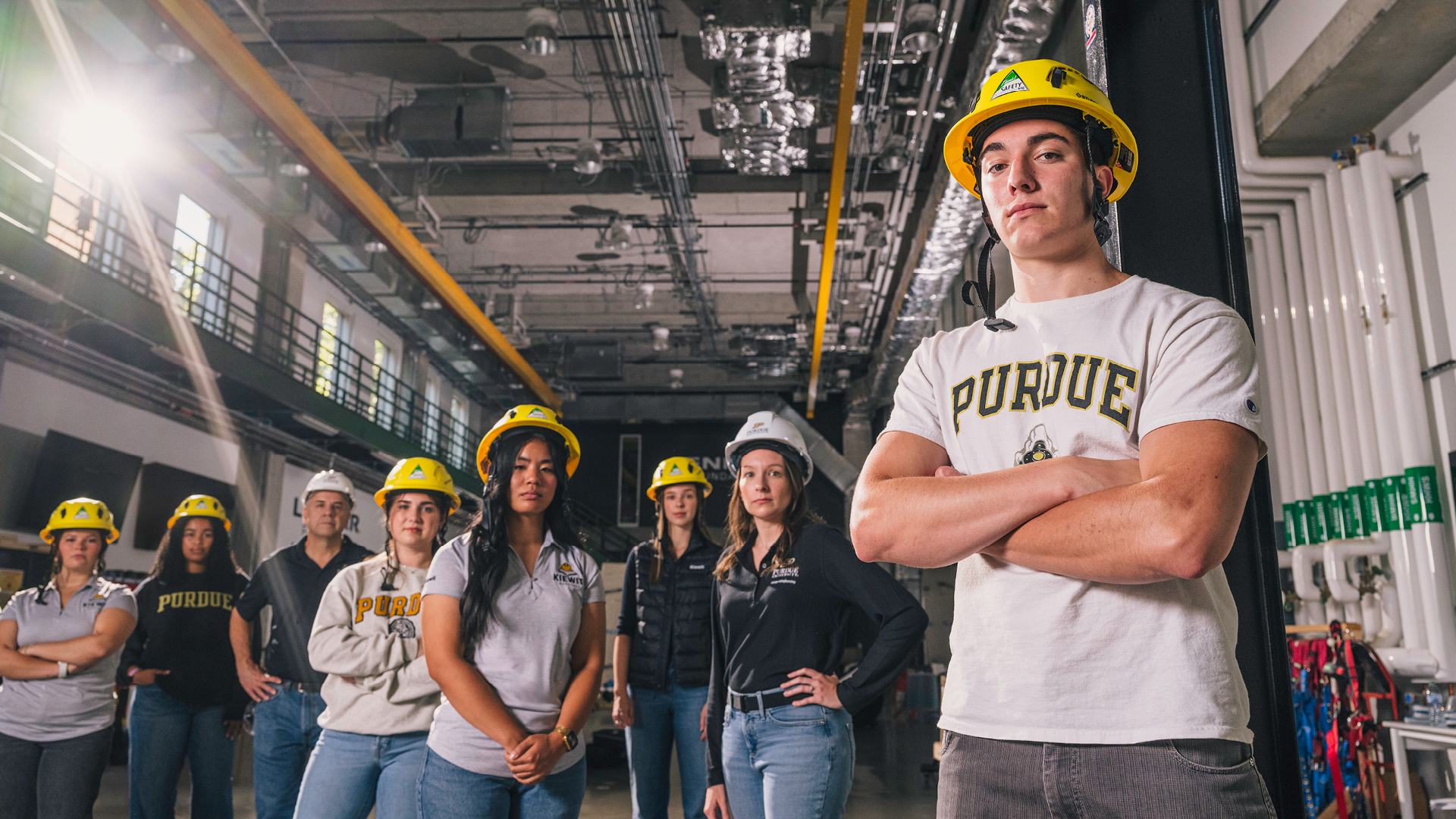
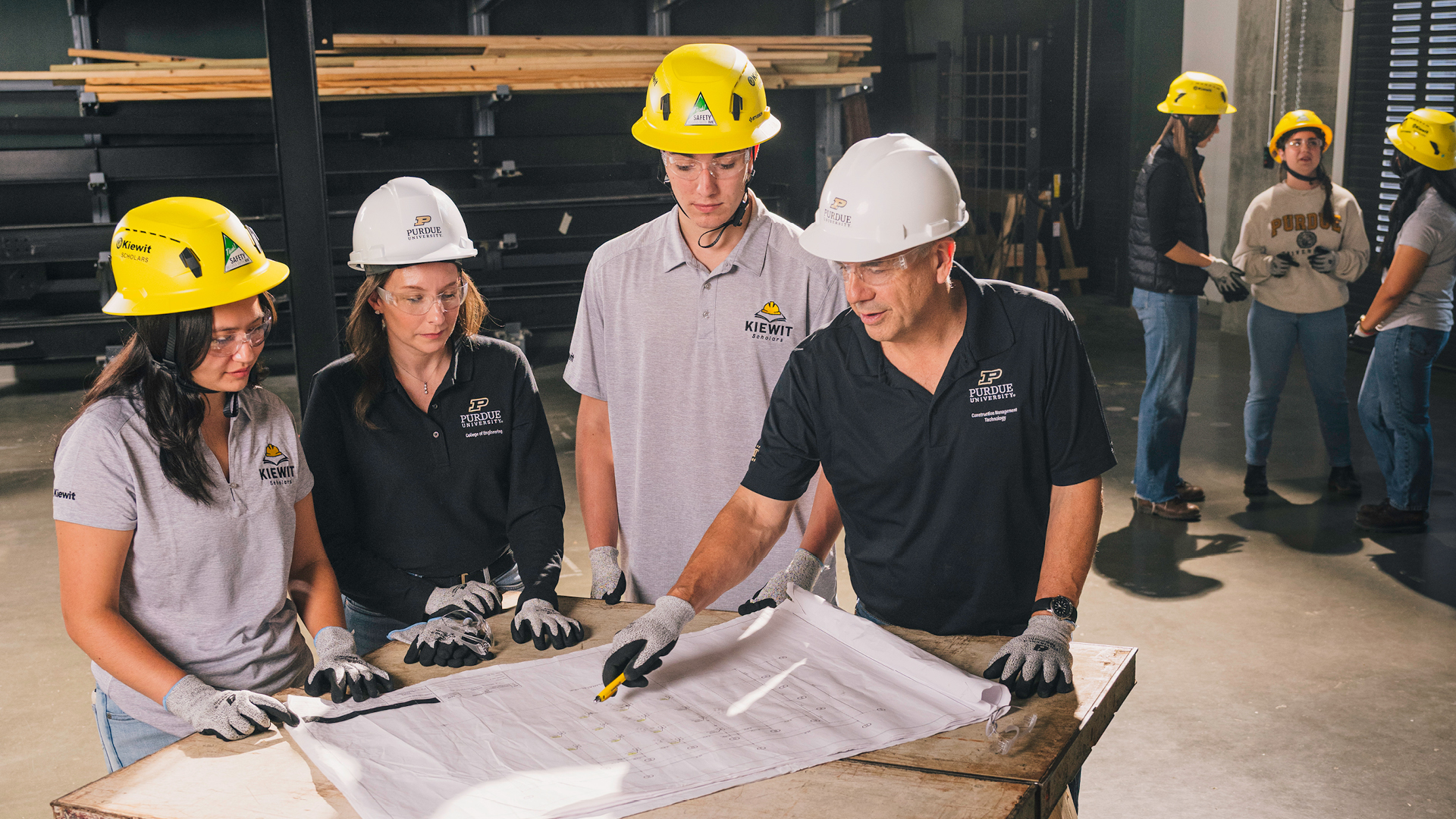
Bryan Hubbard, Tyson McFall-Wankat and Kiewit Scholars from the College of Engineering and Purdue Polytechnic Institute unite classroom knowledge with hands-on learning in the Lennar Foundation Construction Lab located in Dudley Hall. (Purdue University photo/Rebecca Robiños)
How do you keep an entire industry innovating? By educating the next generation of leaders
This story highlights one of the many ways Purdue teams up with corporate partners to create solutions for complex global challenges. Learn how your organization can collaborate with us.
Shared knowledge is the foundation on which the Purdue and Kiewit partnership is built.
The university and company have a deep history of joining forces on everything from coursework to advisory councils to conferences. A recent component of the collaboration, which has rapidly grown to become its centerpiece, is the Kiewit Scholars program.
Kiewit, one of North America’s largest construction and engineering companies, has a longstanding tradition of prioritizing workforce development. “Part of our culture, which started all the way back when Peter Kiewit founded the company, is that we grow our people,” says Jim Rowings (BSCE ’75, MSCE ’79, PhD ’82).
As chief learning officer and vice president of Kiewit University, Rowings oversaw the education, training and development programs of Kiewit’s 31,000-plus employees. In that role, he also worked with now-President Mung Chiang and others at Purdue to translate the ethos of Kiewit University into the Kiewit Scholars program — with an eye toward preparing a new generation to lead in a rapidly changing world. “To always be training and teaching is who we are,” he says.

Kiewit Scholars
Purdue is one of just five universities that Kiewit tapped to prepare the workforce talent that the entire construction trade will need.
Tyson McFall-Wankat (BS agricultural economics ’09) serves as project manager for undergraduate initiatives in the College of Engineering. She says, “Kiewit recognized that the industry, as a whole, is aging. They anticipated that there was going to be a time of large-scale retirement, and that they would need a younger generation prepared to jump into leadership positions without as many years under their belts as their predecessors had when they took on those senior roles.”
Kiewit Scholars, which is open to select majors in the Purdue Polytechnic Institute and the College of Engineering, is preparing students to fill those roles. Purdue’s first Kiewit Scholars cohort started in fall 2022. Students are eligible to participate in the program starting their sophomore year, and it provides generous scholarships that are renewable for up to six semesters.
“We intentionally cap the program at 21 students, seven per cohort year,” McFall-Wankat says. “The smaller size allows our students to get to know each other and to become comfortable working together.”
Special classes, internships, field trips and networking events are all part of the program, but its hallmark is the rare opportunity for Purdue students to be mentored by high-level Kiewit executives, such as Tom Shelby (BS building construction management ’81), an executive vice president at Kiewit and president of the Kiewit Energy Group.
“Leadership and the ability to communicate is so critical to our business,” Shelby says. “And I enjoy talking with the students. Sometimes we’re in an informal setting, sharing a meal, and sometimes we’re in the classroom talking about real-world, on-the-job scenarios.”
When you’re working with a place like Purdue, you’re going to get access to a lot of really smart people, and you’re going to see cutting-edge things that you can take back to your company.
Tom Shelby (BS building construction management ’81)
Executive vice president, Kiewit
President, Kiewit Energy Group
“It’s amazing for students to have the opportunity to get to know Tom,” McFall-Wankat says.
Alana DeVilbiss (BSCE ’25), a Purdue civil engineering graduate student, agrees: “Kiewit has helped me strengthen my technical, leadership and professional skills early in my career,” she says. “Working with a company like Kiewit as a student provides hands-on experience across multiple sectors of construction that develop my skills as a young professional.”
In addition to ongoing mentorship, students benefit from workshops on professional development, teamwork, conflict resolution and negotiations. These interactive workshops focus on helping students improve their confidence and strengthen their leadership skills.
“We bring in improv actors to work with students on training their brains to think quickly. It’s a skill that helps them remain calm so they can navigate challenging situations better,” McFall-Wankat says. “Something that’s been mentioned to me quite a bit is how much the workshops have helped our graduates on the job.”
Day in the life presentations are another key component of the program. “Purdue alumni, Kiewit employees and others discuss their career paths: what they’ve learned and advice that they have,” McFall-Wankat says. “We also do a field trip to a Kiewit job site to just get our feet on the ground and really see what it’s like to work in this industry.”
Connecting classroom and construction site
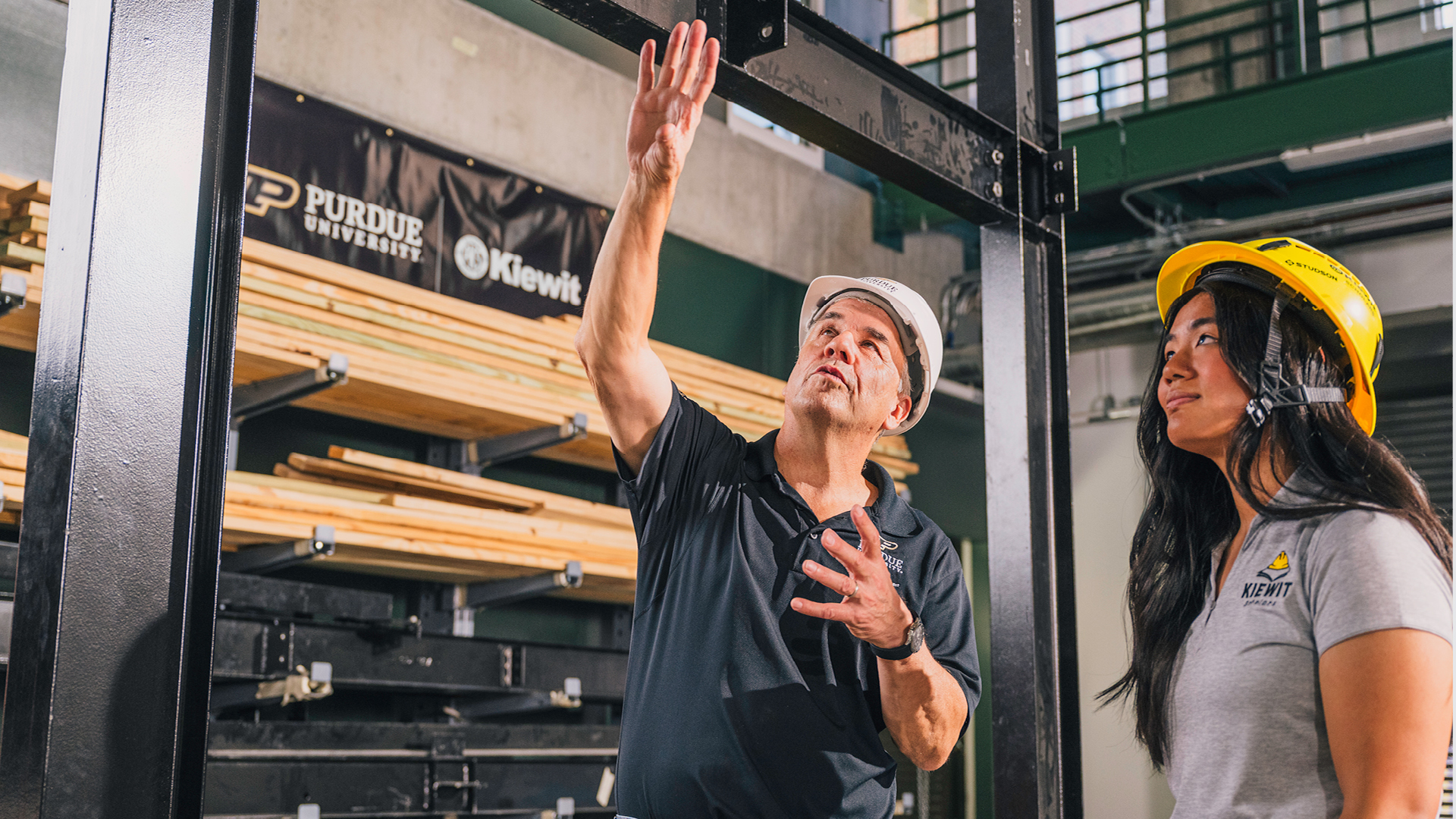
Bryan Hubbard (BSME ’88, MSE ’90), a Purdue professor in the School of Construction Management Technology, plays an important role in uniting classroom knowledge with hands-on learning. Hubbard has taught roughly 20 different courses since coming to Purdue in 2007. A current area of focus for him, and for Kiewit, is industrial construction.
“Industrial construction is unique to our program at Purdue, and it’s also a strong focus area for Kiewit,” he says. “It’s part of a concentration called infrastructure construction. So it combines both industrial construction — such as wind and solar energy, power plants, chemical plants, chip and fab manufacturing plants — with the other side of that concentration, which is what we call the heavy civil: bridge and road construction. When you combine bridge and road and industrial, that’s a big portion of Kiewit’s work.”
Hubbard adds that Purdue students love learning from industry people and benefit from having materials in the classroom that are from an actual project.
Louis Mariacher, a senior in the Purdue Polytechnic construction management program, says, “Working with an industry leader like Kiewit has been incredibly valuable, especially so early in my career. It gives me the chance to experience complex projects and learn the strategies and tools that make them successful.”
“It’s great to have real-world materials: plans, specs, quality control information,” Hubbard says. “We have someone from Kiewit who works in their solar fields walk our students through the process of setting up a construction site — the productivity issues, the cost issues, the quality control issues. We’re preparing them for all that happens on a job site while they’re still here in school.”
Benefiting an entire industry
Kiewit’s commitment to training future leaders for the construction industry isn’t simply a matter of preparing good workers for careers at Kiewit. It supports the larger goal of developing a quality workforce for the construction industry as a whole.
“If we train a lot of people and they go out and follow the way we like business to be done, it’s going to be good for us,” Shelby says, “and it’s going to be great for the industry.”
Rowings agrees. “The culture of Kiewit is to train and develop our people,” he says. “In a sense we are teaching them how to be professors in their own areas of expertise. But we want them to grow those skills of developing young people and staying engaged because as they advance in their careers, these are the people who will be coming behind them and moving up with them.”
Staying connected to innovation, particularly in areas such as AI and workplace safety, is another benefit to Kiewit in its partnership with Purdue.
“We need to keep our workers safe,” Shelby says. “So, we put a lot of effort into understanding safety and how we can support the industry that way.”
AI is going to play a key role in the future of the construction industry. It’s an innovation that Kiewit anticipated years ago and that informs its partnership with Purdue.
“When you’re working with a place like Purdue,” Shelby says, “you’re going to get access to a lot of really smart people, and you’re going to see cutting-edge things that you can take back to your company.”