Remembering an American hero: Purdue’s first astronaut, Gus Grissom
At a Glance:
- Purdue engineering alumnus Gus Grissom was one of NASA’s first seven astronauts — the legendary Mercury Seven — introduced April 9, 1959.
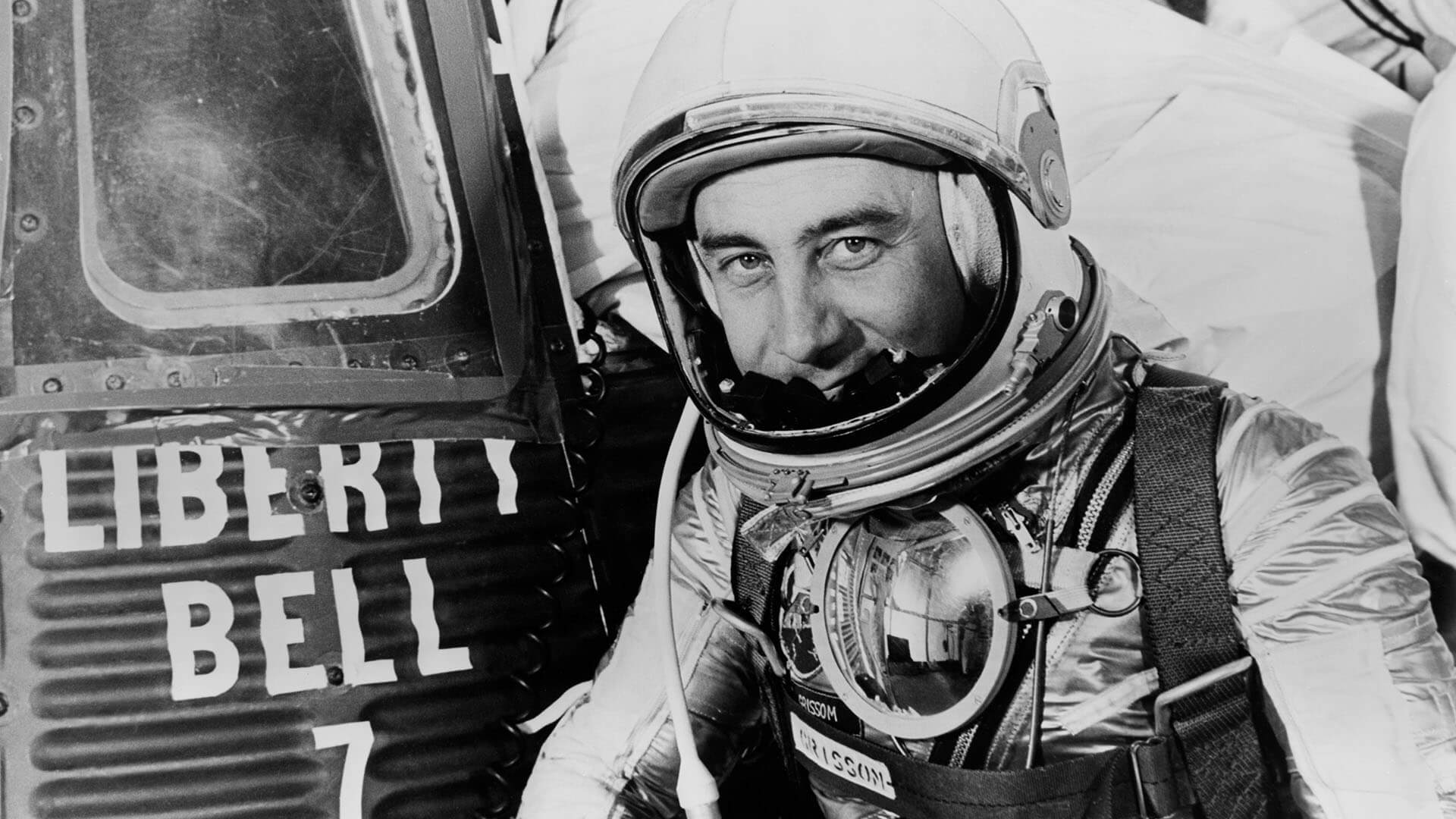
- On July 21, 1961, Grissom became the second American to fly in space during his Liberty Bell 7 flight as part of the Mercury program.
- In 1965, Grissom commanded the first manned Gemini mission, flying aboard a spacecraft — nicknamed the “Gusmobile” — that he helped design.
- Grissom and Apollo 1 crewmates Ed White and Roger Chaffee (also a Purdue alum) died Jan. 27, 1967, when a fire broke out in the cabin during a prelaunch test.
The Boilermaker engineer, who would have celebrated his 100th birthday on April 3, 2026, was the second American in space
If Gus Grissom had survived the Apollo 1 fire, “That’s one small step for a man, one giant leap for mankind” might never have become part of the cultural vernacular.
Neil Armstrong (BS aeronautical engineering ’55), who uttered those iconic words after stepping onto the lunar surface, still would have walked on the moon. But a different Purdue engineer would likely have become the first to do so — if not for the disaster during a prelaunch test that cost the lives of Apollo 1 astronauts Grissom (BS mechanical engineering ’50), Ed White and Roger Chaffee (BS aeronautical engineering ’57).
“One thing that would probably have been different if Gus had lived: The first guy to walk on the moon would have been Gus Grissom, not Neil Armstrong,” NASA’s Deke Slayton confirmed in his autobiography, “Deke!”
If anyone could have made that prediction with authority, it was Slayton, who as NASA’s director of flight crew operations was responsible for selecting crews for the Gemini and Apollo missions. Nothing against Armstrong, Slayton explained, but he and his fellow NASA decision-makers’ preference was for one of the first seven American astronauts — the Mercury Seven — to handle that illustrious assignment. “And at that time Gus was the one guy from the original seven who had the experience to press on through to the landing,” he wrote.
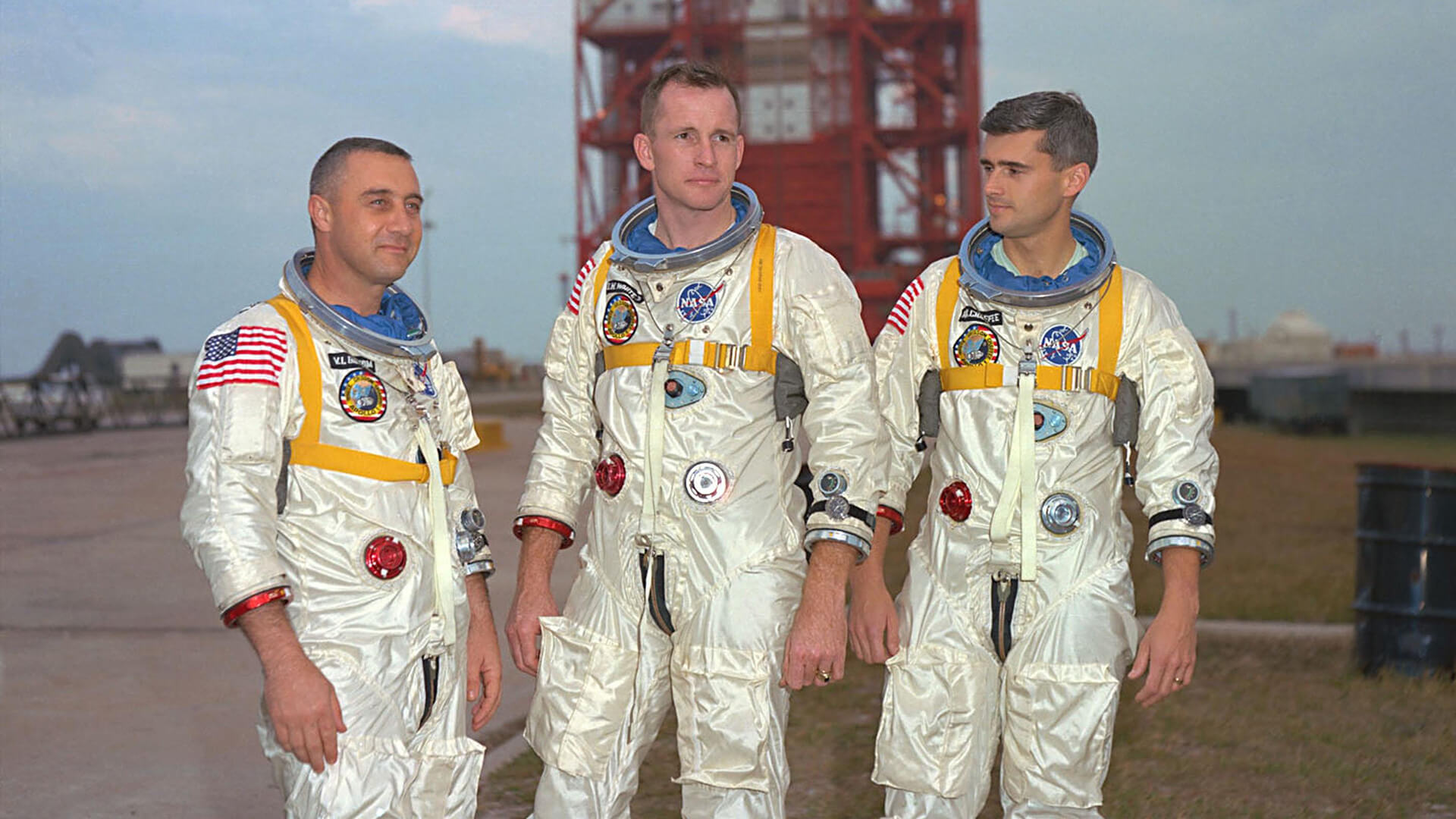
Grissom had flying experience aplenty. Before becoming an overnight celebrity upon NASA’s 1959 introduction of the Mercury astronauts, the Mitchell, Indiana, native flew 100 combat missions as a decorated Air Force fighter pilot in the Korean War and spent years after that as a flight instructor and test pilot. Then he became the second American to travel to space during Project Mercury and was selected to command the first manned missions for both the Gemini and Apollo programs.
He would have been well-qualified to execute the lunar landing, with a list of accomplishments that no other candidate could have matched during the nation’s high-stakes race to beat the Soviet Union to the moon.
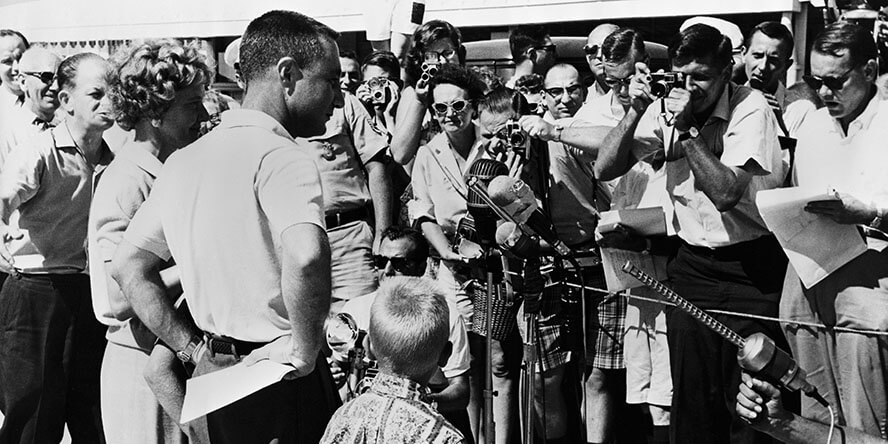
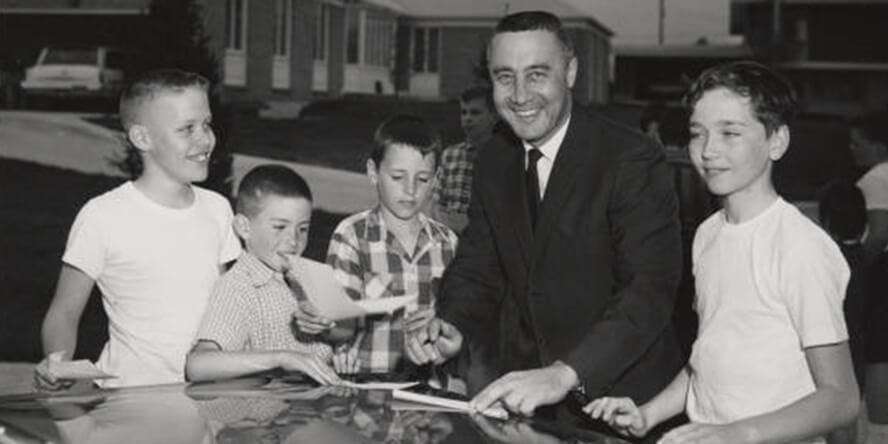
“He was an American hero,” Grissom’s youngest sibling, Lowell Grissom, says in an interview with Purdue weeks before what would have been Gus’ 100th birthday, April 3, 2026. “I guess that’s the main thing people should remember: that he did his job.”
Alas, the catastrophic fire at Cape Canaveral on Jan. 27, 1967, robbed Grissom of the opportunity to fulfill Slayton’s grand expectations. But the reckoning that followed the space agency’s first major disaster allowed Grissom to make yet another contribution to its success.
Afterward, many NASA veterans admitted that the fire forced everyone to slow down and focus on quality control. They believed this pause likely prevented a similar disaster from occurring in space, helping the Apollo program ultimately reach its goal of sending astronauts to the moon and returning them home safely by the end of the 1960s.
“I think the Apollo 1 fire and the deaths are one more example of how too often in the world in which we human beings live and have made for ourselves, it takes the loss of life to sharply focus, to focus enough, on a problem for real change to then happen. Sadly so,” says Purdue astronaut Charles Walker (BS aeronautical and astronautical engineering ’71), who was a first-year Purdue engineering student at the time of the fire.
“Their attitude became, ‘We are not going to let these guys die in vain. We’re going to fix this thing. If we have to work 24 hours a day, we’re going to fix this thing to make sure that these guys didn’t die in vain,’” says George Leopold, author of “Calculated Risk: The Supersonic Life and Times of Gus Grissom.” “That was the attitude, and in 18 months they launched again. You’d be hard-pressed to find people today who would make a commitment like that.”
‘This was not a game’
Perhaps it should not come as a surprise that the American engineers of that era would display such seriousness.
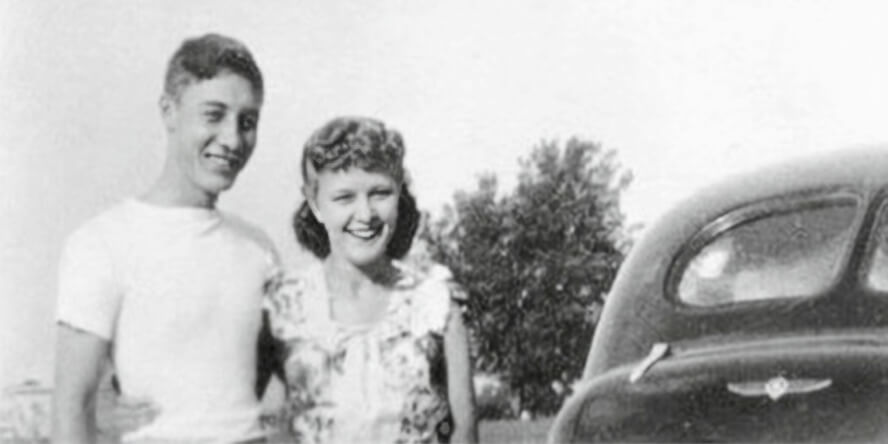
Like Grissom, who enrolled at Purdue in 1946 after a one-year stint in the U.S. Army Air Forces toward the end of World War II, many of them had used GI Bill benefits to attend college. As was also the case with Grissom, who married his high school sweetheart, Betty Moore, in 1945, these veterans were laser-focused as they completed college educations that would launch their careers and support their future families.
“He’s surrounded by a lot of guys who have seen war,” Leopold says. “This was not a game. They’re not there to drink beer. They’re there to study, get a degree and get a job, but jobs were pretty tight back then.”
Purdue’s campus was bursting at the seams because of the influx of veterans in the years after the war, with enrollment hitting record numbers and housing in short supply. In fact, the Grissoms had such difficulty finding somewhere to live that Betty had to stay behind in Mitchell and live with her parents during Gus’ first semester at Purdue.
Once they finally found their own living quarters, they didn’t exactly enjoy carefree college years. Betty became the breadwinner of the family by working as a long-distance operator for Indiana Bell Telephone Company while Gus was a full-time engineering student and part-time burger flipper at a local diner. He also helped make ends meet with part-time jobs as a cornfield laborer and worker in the Lafayette roundhouse of the Chicago, Indianapolis, and Louisville Railroad during his time at Purdue.
Although these obligations left little time for social activity, the Grissoms did enjoy some traditional campus favorites, like attending Boilermaker football games.
“He was as crazy about Purdue as most (Boilermakers) are,” Lowell Grissom recalls with a chuckle. “Of course, I went to IU (Indiana University), so we had a little fun over that.”
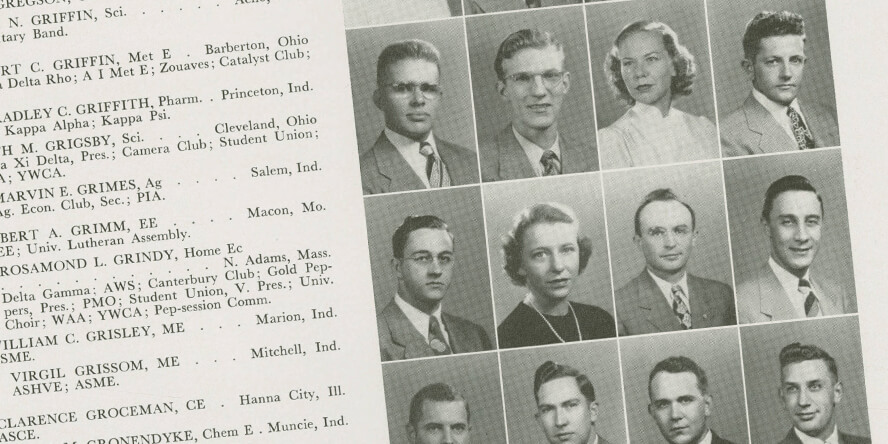
Grissom was not a star student, but he completed the mechanical engineering curriculum in just 3 1/2 years, building an advanced skill set that would serve him well in the years to come.
“He had a no-nonsense, hands-on approach to engineering,” says Purdue history professor Michael G. Smith, who has written and taught extensively about the history of the space age. “This was a calling card for Purdue at the time, which still demanded that all its engineers learn how to weld and fabricate things, inspect the power plant (where the Wilmeth Active Learning Center is now), and conduct experiments in general engineering. As an ME, mechanical, Grissom had a comprehensive, demanding education here.”
‘He must be reliable’
As Leopold mentioned, however, jobs were tight in the post-war years. And Grissom still held on to the dream of becoming a pilot that first inspired him to enlist after graduating from high school.
When Grissom and childhood friend Bill Head encountered an Air Force recruiter on the steps of the Purdue Memorial Union just ahead of Grissom’s graduation, he jumped at the second chance to fly. Unlike his first military stint, this time he would indeed become a combat aviator.
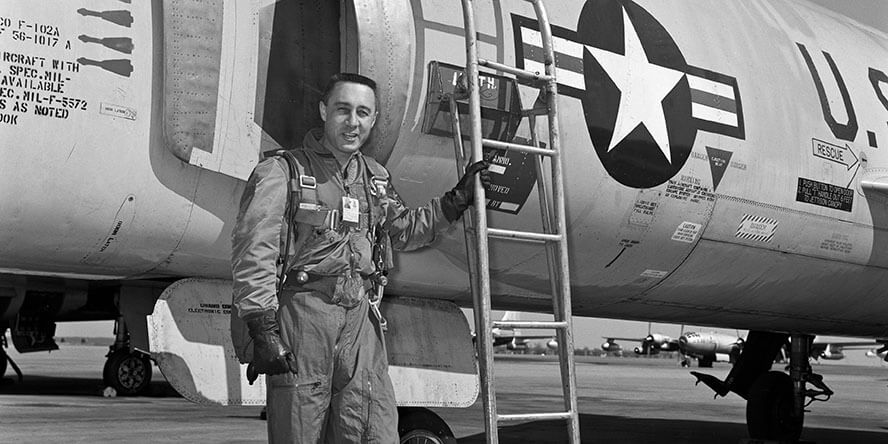
Grissom earned his pilot wings a year after graduating from Purdue and soon shipped out to Korea with the 334th Fighter Interceptor Squadron. He named his F-86 Sabre jet “Scotty” after his infant son, flying the aircraft on 100 successful escort missions where he had to fight off air raids from North Korean MiGs on occasion.
“The requirement of a wingman is that he must be reliable,” Leopold says. “And that’s one of the perfect words to describe Gus Grissom: reliable. And competent. And while he did not have much to say, when he said something, people listened.”
‘He was the best engineer’
Grissom’s greatest opportunity to flex his engineering muscle came during the buildup to his Gemini 3 mission that would make him the first person to travel to space twice.
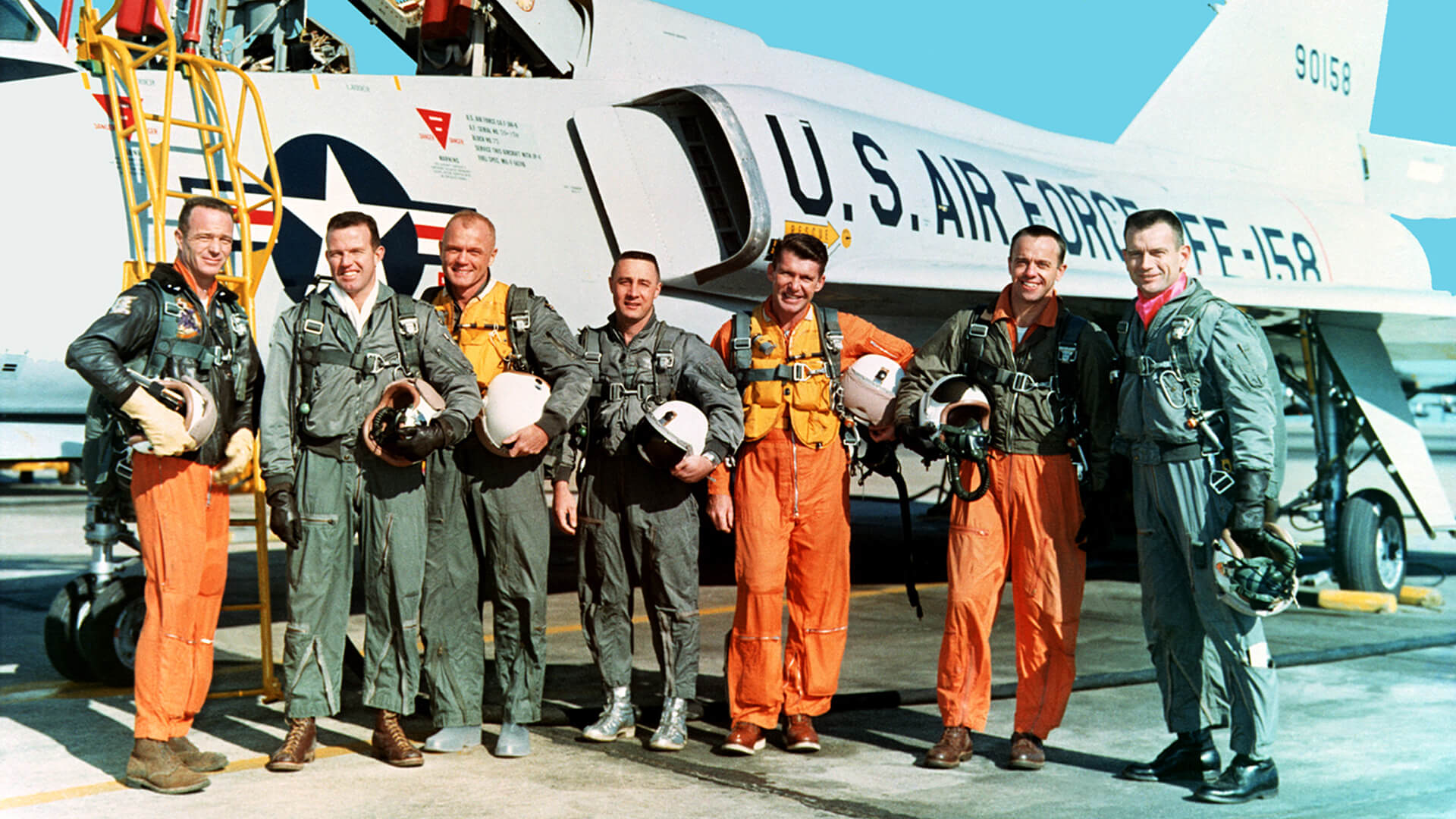
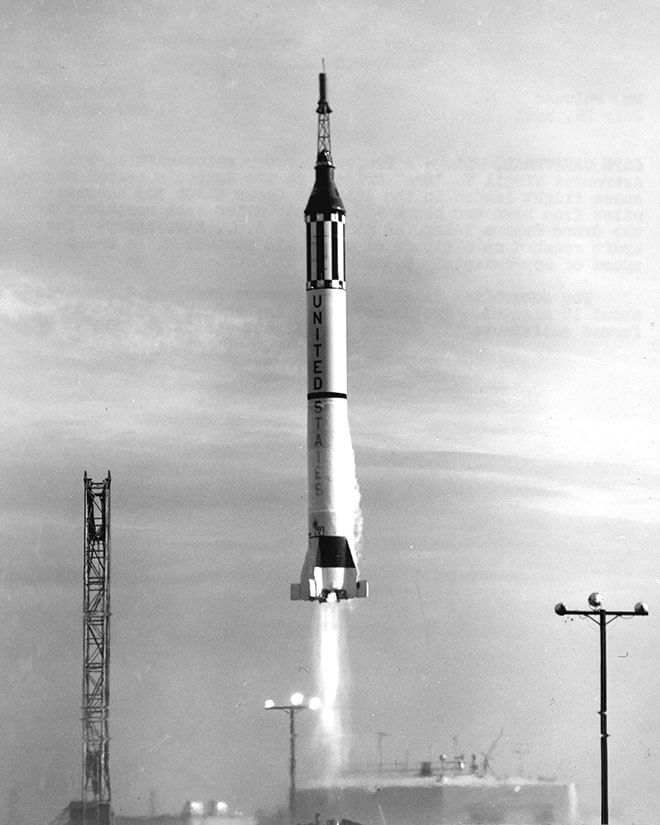
After initially inviting hundreds of military pilots to top-secret interviews in Washington, D.C., to gauge their interest in Project Mercury, NASA put the candidates through a series of rigorous physical and psychological tests before ultimately selecting Grissom and six others as the nation’s first astronauts. Grissom’s first mission came on July 21, 1961, when he made a 15-minute suborbital flight aboard Liberty Bell 7, the second Project Mercury flight following Alan Shepard’s maiden voyage two months earlier. When a bout of Meniere’s disease grounded Shepard in 1964, Grissom jumped to the front of the line to command the first crewed mission for Gemini — the intermediate-phase project with missions to test orbital maneuvering, rendezvous and docking, and extravehicular activity techniques that would be needed for the moon missions ahead.
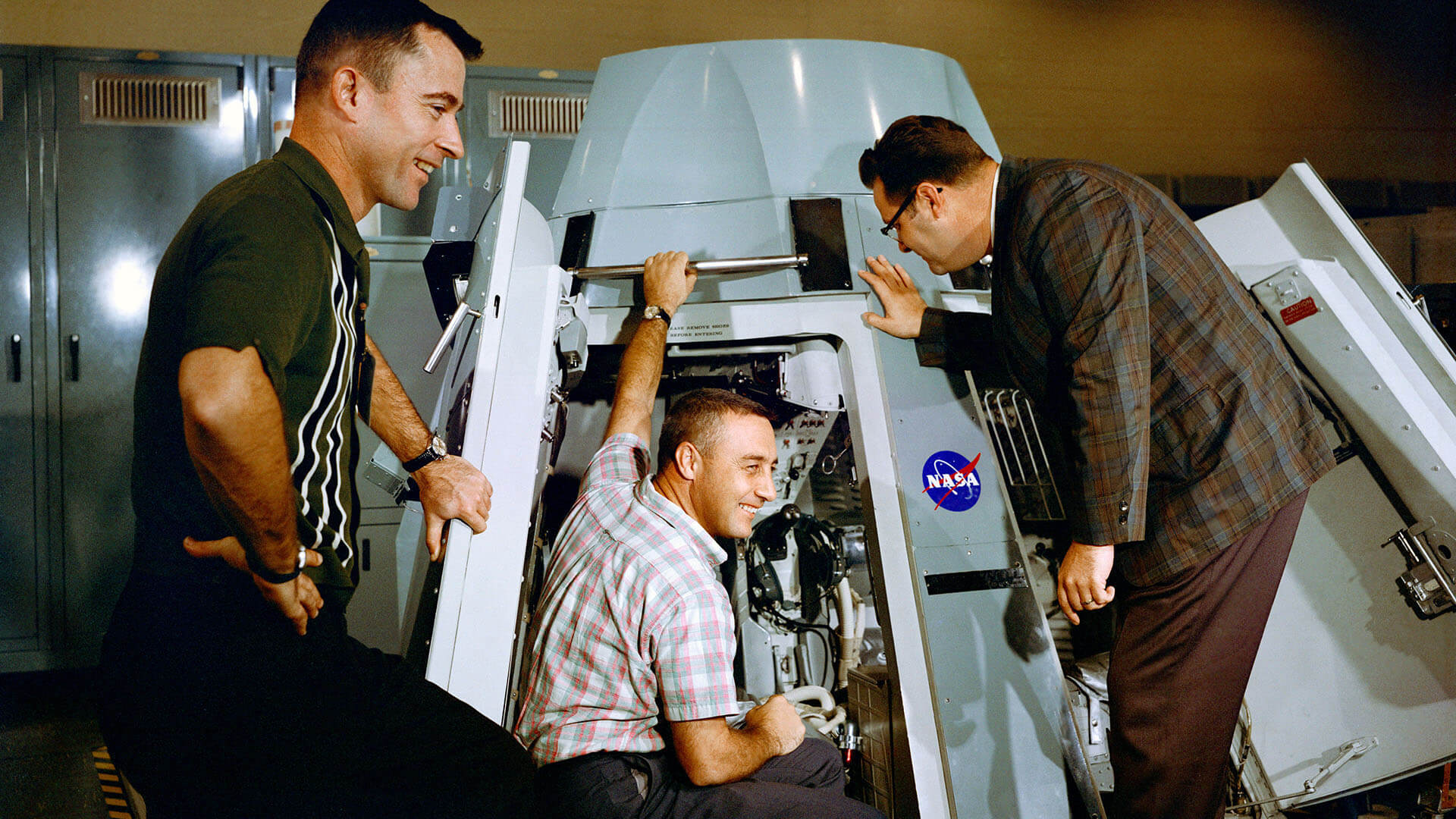
Grissom brought to the table the thousands of hours he had spent in cockpits — plus the extensive technical knowledge he built at Purdue — to help the engineers at McDonnell Aircraft create a Gemini spacecraft whose control and display layouts met a pilot’s preferences.
“He had a lot to do with it,” says Lowell Grissom, who was working at McDonnell in 1964, when his oldest brother spent the entire summer at the company’s St. Louis plant while helping to develop the Gemini spacecraft. “He was working 12 hours on and 12 hours off when he was here. I think that’s what a lot of people forget: He was an engineer. He was very much into that.”
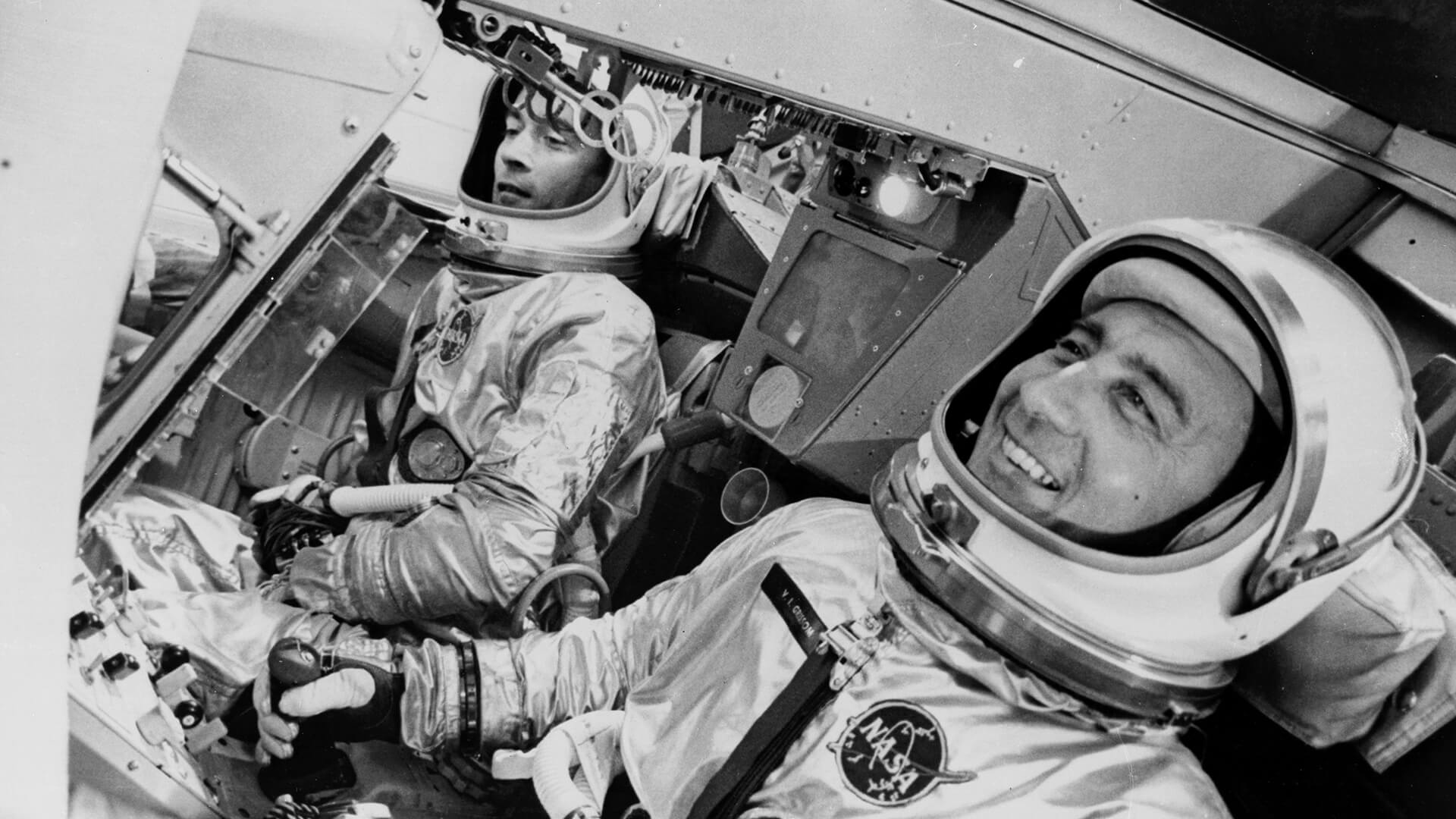
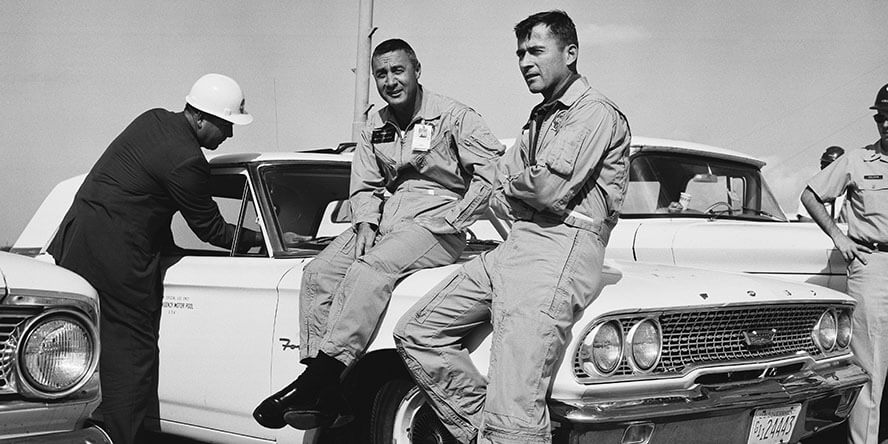
So involved was Grissom in the development of the vehicle that his fellow astronauts began jokingly referring to it as the “Gusmobile.” But its performance was no laughing matter. During Grissom and pilot John Young’s five-hour Gemini 3 flight, they successfully fired the spacecraft’s thrusters to change its orbit during flight.
“I think he was unmatched in terms of his engineering abilities,” Leopold says. “I think that’s one of the key reasons why he was selected for Project Mercury as one of the first seven astronauts because as the astronaut Mike Collins from Apollo 11 said, ‘Gus had a love of machines.’
“He had to know how they worked, and he would spend hours on the factory floor — whether it was in St. Louis during Mercury and Gemini, or whether it was in Downey, California, at North American Aviation during Apollo — to understand these systems, how they were put together, how they functioned, how they could malfunction,” Leopold continues. “Amongst the seven original astronauts, he was the best engineer. And I think they all acknowledged that.”
‘The hatch crap’
Grissom’s first NASA mission did not go as smoothly as his Gemini flight.
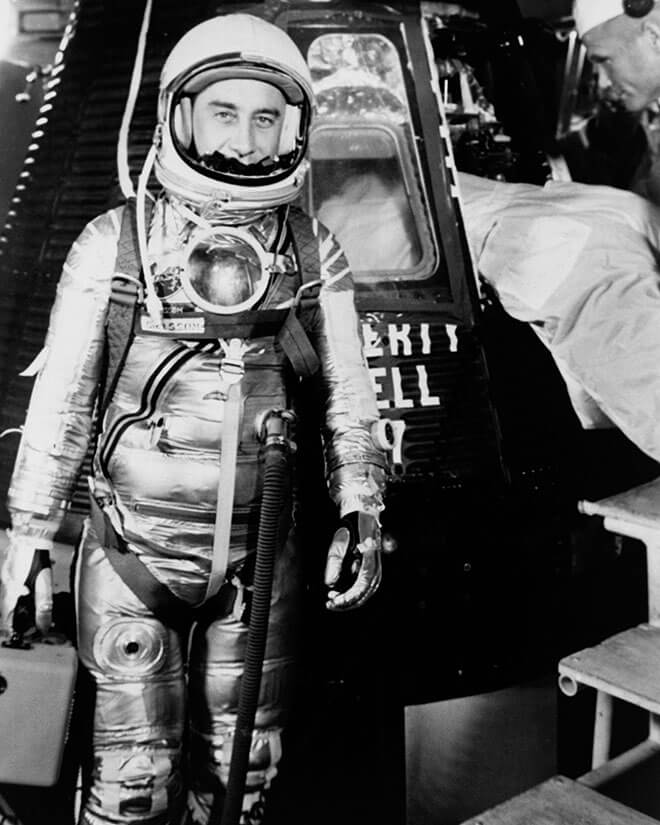
The Liberty Bell 7 flight itself went as planned. It was what happened after the capsule splashed down in the Atlantic Ocean that hung over Grissom’s head.
While waiting for a recovery helicopter to lift the Liberty Bell out of the water and carry it to the nearby USS Randolph, the capsule’s explosive hatch accidentally blew, allowing water to rush inside. Grissom escaped the capsule but nearly drowned while waiting to be rescued. An open oxygen inlet valve on his spacesuit caused the suit to begin losing buoyancy, making it increasingly difficult to remain afloat amid the helicopter prop wash.
Grissom was saved, but Liberty Bell 7 was not. The flooded capsule was too heavy for the rescue helicopter to hoist out of the ocean, so eventually the crew was forced to cut it loose and allow it to sink to the ocean floor. And there it remained until 1999, when it was located and lifted onto the deck of a recovery ship.
It was the only aircraft Grissom had ever lost, and he took some public lumps over the mishap. Although Grissom insisted that he did not blow the hatch, some critics believed he either did so inadvertently or out of panic.
After reviewing evidence from the mission, however, Leopold is confident that Grissom was not to blame.
“He was just going down his checklist,” Leopold says. “He said, ‘Give me a few minutes. I have to check all of my instrument settings to make sure I record them properly. Then I’ll give you a call, and then I’ll blow the hatch.’”
But then the hatch blew prematurely, creating the impression among detractors that he made a huge mistake.
“I know it bothered him,” Lowell Grissom says. “He called it ‘the hatch crap.’”
What actually caused the hatch to blow may never be known with certainty. But Leopold, digital imaging expert Andy Saunders and Liberty Bell recovery specialist Curt Newport have developed a theory.
The collaborators point to an interview given by a Marine aboard the recovery helicopter whose job was to use a cutting mechanism to snip a communications antenna so that the helicopter could hook on to the Liberty Bell. The Marine, John Reinhard, observed an electrostatic arc when the cutter made contact with the antenna and noted that the hatch blew shortly thereafter.
“We think that electrostatic discharge blew the hatch,” Leopold says. “Gus didn’t screw up.”
An independent post-flight review did not blame Grissom for the loss of the spacecraft, nor did the incident hold back his career. But when the time came to name his Gemini 3 spacecraft that lifted off four years after the Liberty Bell flight, Grissom was still as salty as the seawater he was spitting up that day in the Atlantic.
The name he selected: Molly Brown, a nod to the hit Broadway musical, “The Unsinkable Molly Brown.” And when NASA officials balked at that name choice, he offered an alternative that they liked even less.
“‘Sure,’ he said. ‘How about the Titanic?’” Slayton recalled in his autobiography. “Well, compared to that, Molly Brown sounded great.”
‘He knew it was a bad deal’
As a child in southern Indiana, Boilermaker astronaut Walker grew up idolizing the likes of Shepard, John Glenn and especially Grissom. After all, Grissom’s hometown of Mitchell was 12 miles down the road from Bedford, where Walker’s family lived.
“He was a local hero,” Walker says. “Having been selected in 1959 to be one of the first astronauts and Mercury Seven, he was big news.”
Walker’s family knew the Grissoms. He wanted to follow his fellow Purdue alum into space someday — and he ultimately succeeded, flying on three NASA space shuttle missions as an employee of the McDonnell Douglas Corp. But that local connection made the events of Jan. 27, 1967, feel even more devastating when an ABC newscaster interrupted the TV show Walker’s family was watching that Friday night to share the breaking news.
“I remember it vividly. When they said, ‘There’s been a fire on the pad at the Cape,’ I knew what was going on,” Walker says. “I was read up on all available information about Apollo. I knew what was happening in that testing on the launch pad in preparation for their February 1967 first flight of the Apollo capsule with a crew. So, the words hit me hard. I turned and said to my folks, ‘Gus is in that test.’”
Walker’s assessment was correct.
Preparations for the first Apollo mission had been a logistical disaster, filled with frustrating delays, technical issues and miscommunications between NASA workers and those at North American Aviation, the aircraft maker that had won the contract to build the new Apollo command and service modules.
Already a workaholic, Grissom barely returned home to see his family in 1966 as he prepared to lead the three-man crew on the planned voyage that would serve as Apollo’s first low Earth orbital test.
“He was all-in on this stuff, and there were so many demands on his time and his expertise and constant meetings and going to Downey to keep track of the spacecraft,” Leopold says. “If you’re a commander, you have a lot of responsibilities. He’s got the lives of two other crewmates in his hands, so he’s got to balance all of that, and slowly, by the middle and end of 1966, he realizes he has a pretty bad spacecraft on his hands.”
It wasn’t that Grissom ignored the many issues with the spacecraft as much as he kept soldiering ahead in spite of them. Like everyone else at NASA at the time, he was wholeheartedly committed to beating the Soviets to the moon and fulfilling late President John F. Kennedy’s goal of getting there and back by the end of the decade.
After the Apollo 1 disaster, this organizational hubris — overlooking obviously sloppy work because they were rushing to get the job done — would come to be known as “Go fever.”
“Gus knew there was a poor design and a lot of problems with all of that wiring that was bad. So he knew it was a bad deal,” Lowell Grissom says. “Mom and Dad were down there two weeks before the accident, and he said it was supposed to be an open-ended mission, but he didn’t see that it could go more than three orbits at that point.”
Sure enough, an electrical issue ignited a fire in the cabin during a standard, “plugs-out” launch rehearsal a couple weeks before the scheduled liftoff. Because of the risky high-pressure, pure-oxygen environment within the capsule and wealth of combustible materials, the fire blazed out of control within a matter of seconds. Choking on toxic, blinding smoke, the astronauts were unable to pry open the hatch that could have allowed them to escape.
They died of asphyxiation within moments. Their burns likely would have been survivable.
‘He earned everything’
Fifty years after the Apollo 1 disaster, Leopold was attending a series of observances at Cape Canaveral when Apollo 11 astronaut Michael Collins asked for notes on what to say about Grissom in his keynote remarks.
“I said, ‘Tell them that he earned everything. Nothing was given to him. And he and Betty were examples of ordinary people doing extraordinary things,’” Leopold says.
Indeed they were, these children of the Great Depression who grew up in small-town Indiana and rose to international fame as a result of Grissom’s courage and elite flying ability. By the time Apollo ended in 1972, with Purdue astronaut Gene Cernan taking humankind’s most recent steps on the lunar surface, only two astronauts had participated in each of the Mercury, Gemini and Apollo programs: Grissom and Wally Schirra.
“These three programs and three spacecraft and his association with them spotlight Grissom’s very unique place in spaceflight history,” says Smith, the Purdue history professor. “One nearly killed him, one he helped improve, and the last killed him and Chaffee and White, well beyond their control.”
Grissom was aware that such a risk existed when he signed up for the astronaut program. He wanted the job all the same, viewing it as both a professional honor and a patriotic duty.
“I couldn’t have asked for a bigger hero,” says Lowell Grissom, although Leopold notes the original astronauts thought of their role in a different way.
“None of these guys thought they were heroes. They thought, ‘This is what we signed up for,’” Leopold says. “He really considered himself to be a pioneer, like, ‘What’s over the next hill?’ Let’s keep pushing the technology and do it as safely as we can, but there are certain risks, which obviously was the theme of my book. You have to accept certain risks, but you work as hard as you can to minimize those risks. That’s what a test pilot was supposed to do.”