Purdue and Beck’s are reimagining the future of farming
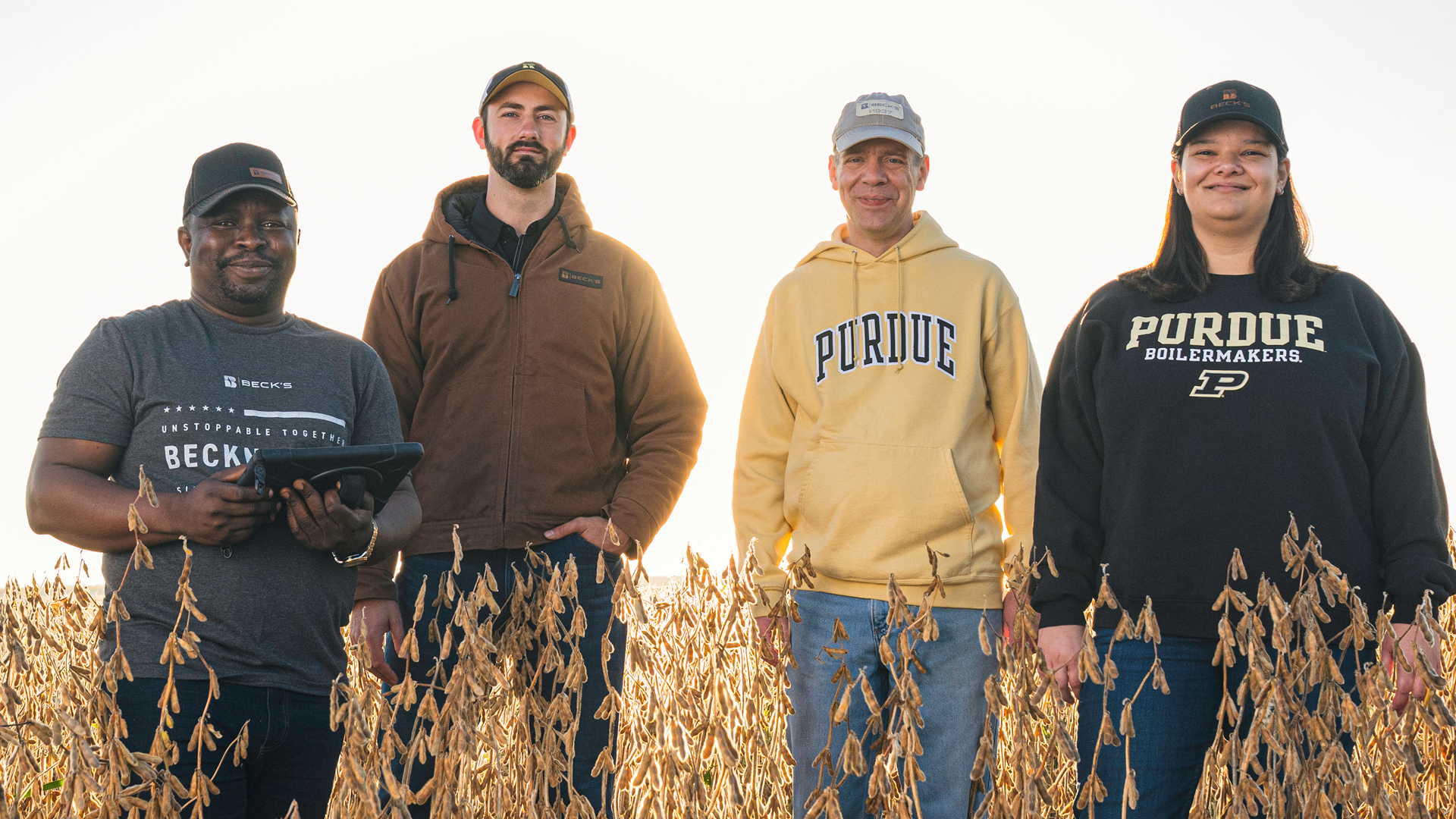
Seyi Ogunmodede, Mark Gee, Mark Ward and Lorena Ferreira Benfica are part of the innovative collaboration between Purdue and Beck’s. (Purdue University photo/Rebecca Robiños)
Advanced agricultural research and a pipeline of highly skilled workforce talent drive innovative partnership
This story highlights one of the many ways Purdue teams up with corporate partners to create solutions for complex global challenges. Learn how your organization can collaborate with us.
Say the word “agriculture” and most people think fields and farmers, crops and plows. Most people don’t associate farming with machine learning, computational analysis and AI. But Beck’s does.
Beck’s is the largest family-owned retail seed company in the United States. Based in Atlanta, Indiana, Beck’s has always been on the leading edge of what’s next in their industry. The Beck family has invested 90 years in the seed business, and its connection to Purdue dates back even further.
The company places a strong emphasis on innovation and education. Through its partnership with Purdue, Beck’s has access to advanced agricultural research and a pipeline of highly skilled workforce talent.
Building ‘unicorns’
About six years ago, Brad Fruth (ASCT ’01) was tasked with creating the Beck’s innovation group. Early on, he saw the value of partnering with land-grant universities. As the director of innovation, his initial focus was on building a resilient talent pipeline.
“We wanted the best of the best,” he says. “And so we derisked recruitment for our company by building a bridge between Beck’s and Purdue. We brought the university projects, and we received access to top talent.”
Beck’s has strengthened its workforce development ecosystem even more by bringing an industry-transforming research project to Purdue.
“We were able to match a cutting-edge project with Purdue students who have skill sets that are not readily available out in the wild,” Fruth says. “And then we were able to say, ‘OK, now why don’t you join our organization?’ It allowed us to build our own unicorns rather than blanket hiring a disparate group of people and hoping that we got the right ones for our team.”
Venkata Limmada, a Purdue PhD student in agronomy, agrees. “Through this collaboration, Beck’s gains access to multidisciplinary student teams who are highly skilled in their respective fields. At the same time, the partnership helps build a pipeline of future talent who already have experience working with Beck’s data, tools, and organizational needs.”
Computational breeding
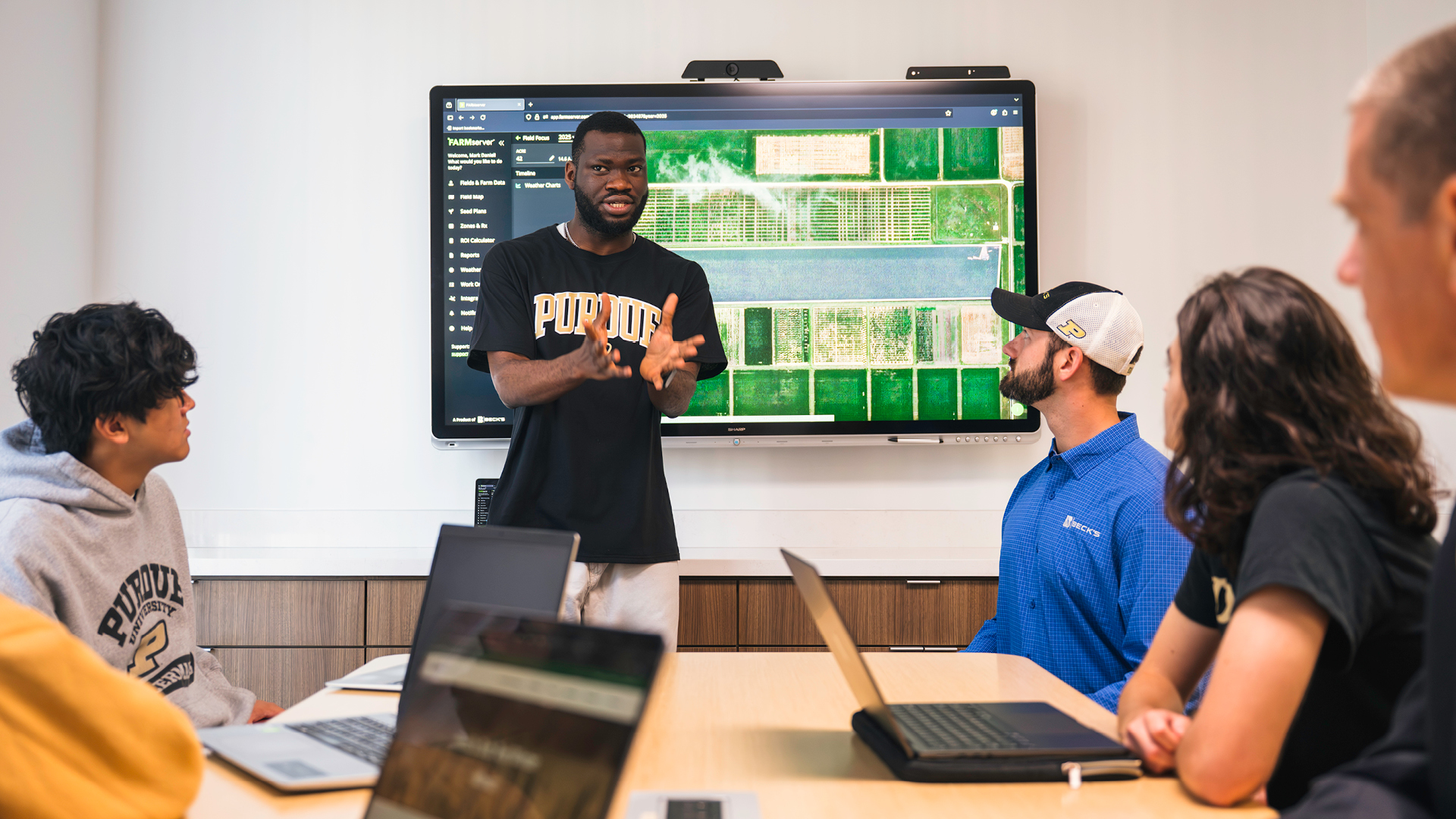
Beck’s high-impact research project with Purdue is a computational breeding platform. For decades, Beck’s has collected detailed information about corn crop varieties — their traits and the DNA sequences they hold. They have partnered with Purdue to translate these large datasets into smarter plant breeding and stronger crops.
One of the things that Fruth discovered in this collaboration is the value of having access to a cross-disciplinary team.
“Management students, ag students, computer science students, math students, data science students — having all of them coalesce on one project has been very meaningful for us,” he says. “There was not one single source we could go to from a consultancy standpoint to tackle this project.”
The computational breeding platform is no ordinary project either. It’s a high-stakes undertaking with the power to transform an entire industry. “We knew that the decisions we were going to make on this project are going to shape the next generation of our R&D pipeline,” Fruth says.
Seyi Ogunmodede, a PhD candidate in the School of Applied and Creative Computing, leads one of the interdisciplinary teams working on the Beck’s project. Ogunmodede and his Purdue colleagues created multiple predictive analytics models for plant breeding.
“Utilizing advanced analytics and machine learning tools like deep learning, time series clustering, embedding, transformer, genomics best linear unbiased prediction, convolutional neural networks and XGBoost, we are able to create models that help predict the strongest crop hybrids and which varieties will best suit the regions in which they are grown,” he says.
“The whole team works together in a way whereby we’ve been able to predict what will happen in the following season, in the following year and how farmers can gain a better yield.”
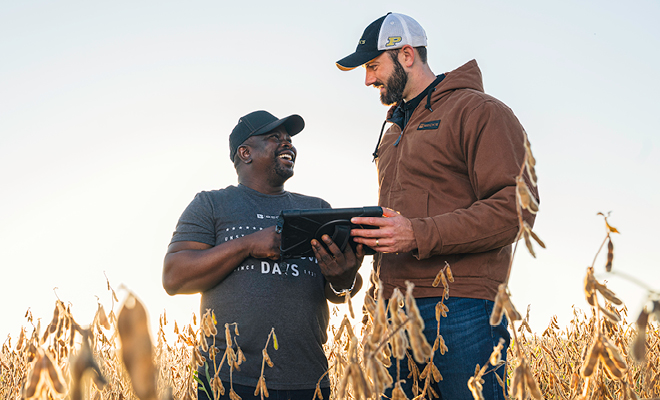
We are able to provide corporate partners with high-impact results backed by teams of trained researchers and student analysts.
Seyi Ogunmodede
PhD candidate, School of Applied and Creative Computing
The Data Mine
Ogunmodede’s work with Beck’s is facilitated through The Data Mine, an interdisciplinary living-learning community of Purdue students who work alongside corporate partners and Purdue faculty to provide solutions to today’s toughest challenges.
Ogunmodede points to the opportunity to collaborate across disciplines, handle large datasets and cocreate solutions with industry professionals as what makes partnering with The Data Mine transformative.
“As a team leader and graduate research assistant with The Data Mine, I have witnessed firsthand the significant benefits organizations gain from partnering with Purdue,” Ogunmodede says. “We are able to provide corporate partners with high-impact results backed by teams of trained researchers and student analysts.”
Fruth agrees. “The Data Mine was able to bring five different disciplines together on our project,” he says. “Working together to build something brand new helped us achieve our goals. We have other businesses asking us how we are being so successful.”
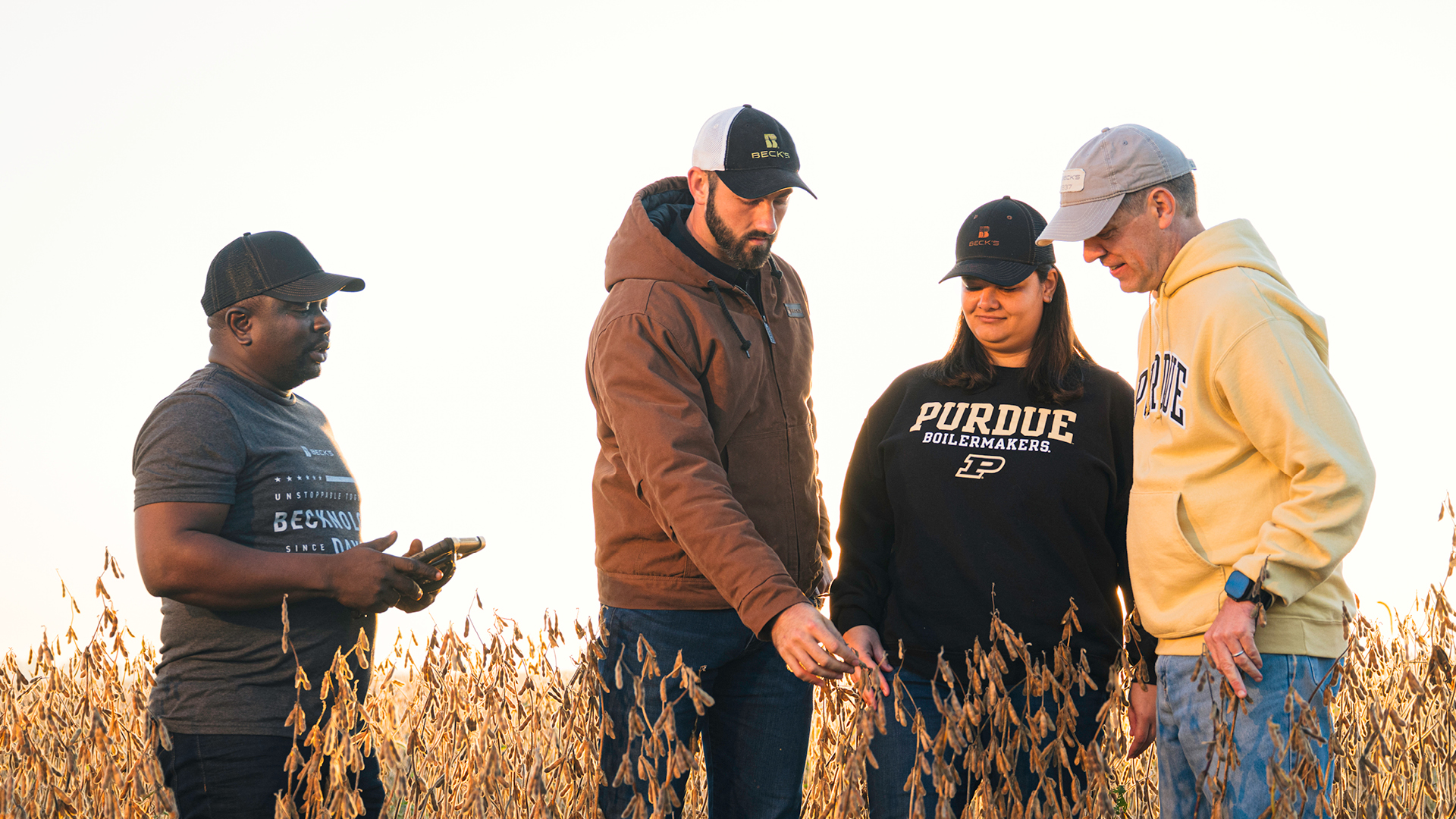
The best corn for next year’s crops
Lorena Ferreira Benfica, a postdoctoral researcher at Purdue who specializes in genomics, plays a key role in the university’s partnership with Beck’s. Among her responsibilities are receiving all raw genomic data, organizing and formatting these datasets, and performing quality control so the team can use them in the genomic prediction models.
“Beck’s has thousands upon thousands of options,” she says. “We help them transform large amounts of information into genomic predictions that guide breeding decisions and drive impact in the field.”
Access to innovative, data-driven solutions is only part of the Purdue x Beck’s equation. Fresh perspectives and cost-effective collaboration are others.
“The creativity, the innovation, that’s a key piece of what Purdue brings to the partnership with Beck’s,” Ogunmodede says. “And the students who work on this project, they are really energetic. They want to develop new things. They know about the latest technology, and they want to see it in action.”
Beck’s willingness to try new things is also a key component of the partnership. “They have such an open point of view and an eagerness to embrace new ideas and technology,” Ferreira Benfica says. “It’s been amazing to work with them.”
Industry, knock here
Partnerships like the one Purdue has with Beck’s create distinctive opportunities for companies to innovate. “When we were at a crossroad of not knowing how to technically solve a problem,” Fruth says, “that’s when we said, ‘I think we have a university that can help us with this.’”