Personal experiences with cancer drive Purdue’s research strides

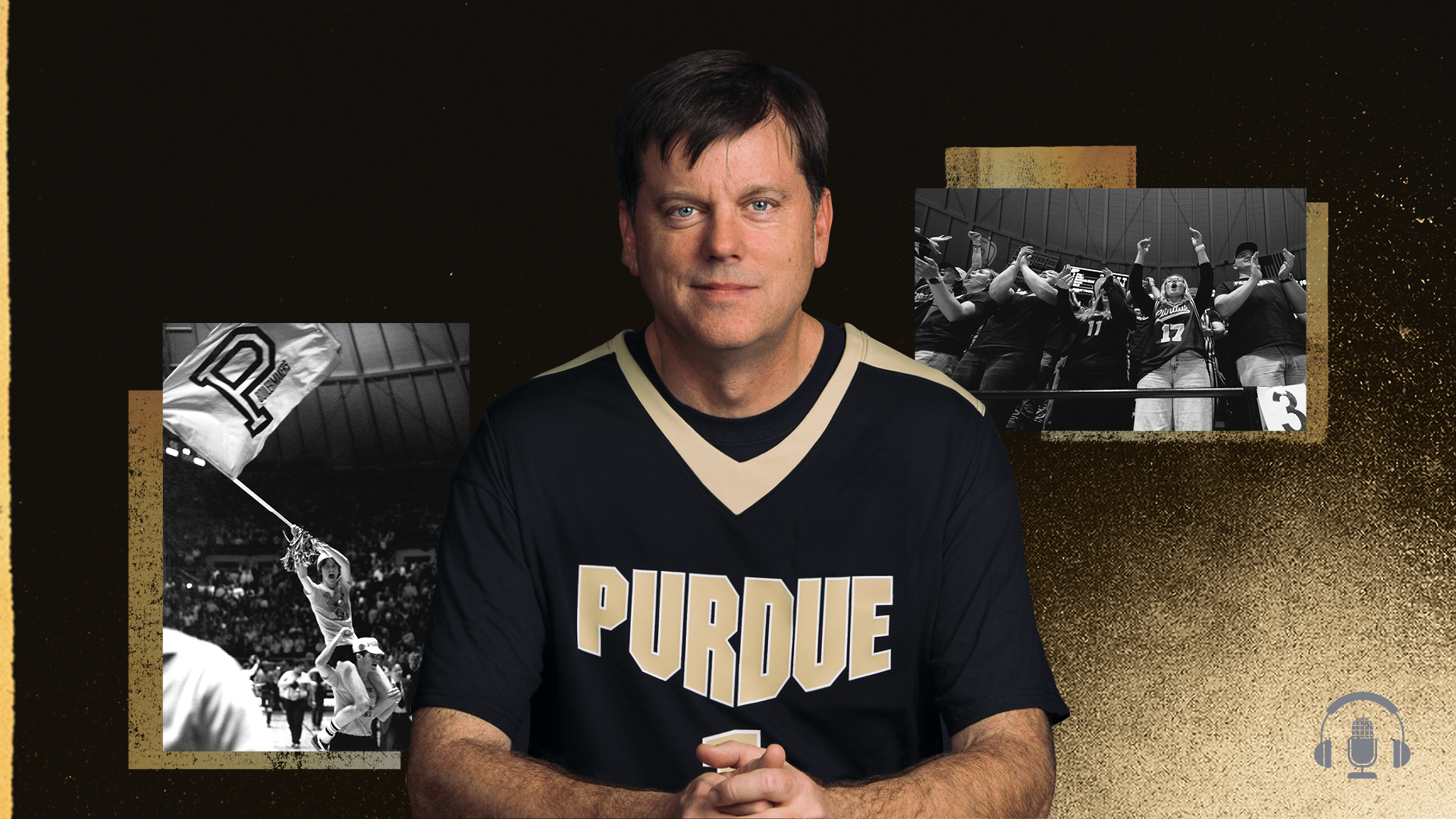
Andrew Kinder, a Purdue business student, cheers in the crowd at Mackey Arena. As a leukemia survivor and proud Boilermaker, his story motivates those behind Purdue’s game-changing strides in cancer research.
More than six years after Tyler Trent showed campus and the world what it means to stand up to cancer, his story still touches the lives of so many.
People like Purdue senior Andrew Kinder and cancer researcher Nathaniel Mabe, and everyone at the Purdue research center that bears his name: the Tyler Trent Pediatric Cancer Research Center. It’s part of the Purdue Institute for Cancer Research (PICR), one of the university’s leading research centers.
Kinder, who is on track to graduate this year from the Mitch Daniels School of Business, and Mabe, a PICR member and an assistant professor of medicinal chemistry and molecular pharmacology in Purdue’s College of Pharmacy, are also connected by something else: They are both survivors.
Though these two individuals have never met, their paths have both been inspired by Trent’s resilience and passion for Boilermaker athletics and philanthropy.
For Mabe, the lightning bolt to commit his life’s work to cancer research came in 2018: As a football fan and Ohio native, he happened to watch the ESPN “College GameDay” episode highlighting Purdue superfan Trent’s story, about two months before the 20-year-old Boilermaker student passed away following a five-year battle with osteosarcoma.
“I didn’t know Tyler and didn’t have connection to Purdue, but his story really spoke to me and was a motivating factor for why I wanted to go into pediatric cancer research,” he says.
That spark –– that unexpected connection to Tyler that so many shared –– was also a major reason he joined Purdue.
Kinder too felt kinship with Trent, as a Purdue freshman undergoing oral chemotherapy in 2021. “Tyler was exactly what a Boilermaker is. His mindset really is also something I look at as motivation. Like you’ve always got to keep going,” he says.
The senior comes from a family of proud Boilermakers, including his parents and two older sisters, and he attended the now-famous Boilermakers’ 2018 upset win over Ohio State where Trent made his last appearance at Ross-Ade Stadium. “I think a lot of what I modeled after him is, I just wanted to be the most normal that I could be,” Kinder says.
Mabe’s commitment to patients
Mabe is one of many individuals at the PICR and the Tyler Trent Pediatric Cancer Research Center working to make a difference in the lives of students like Kinder and Trent.
“Our role in this is to be the scientist to help to make new therapies, not just to help treat cancer but to make them safer and better tolerated,” Mabe says.
He’s motivated by the struggles of young patients and their families — and by his own story, too. In 2014, while he was a PhD student and just 24 years old, he was diagnosed with testicular seminoma. Although treatable, the cancer diagnosis changed his academic trajectory.
Prior to his diagnosis, he wanted to study cardiovascular disease. But, Mabe says, “I decided that I wanted to be part of the scientists that were finding new treatments that could make cancers curable for everyone and not just for people like me.”
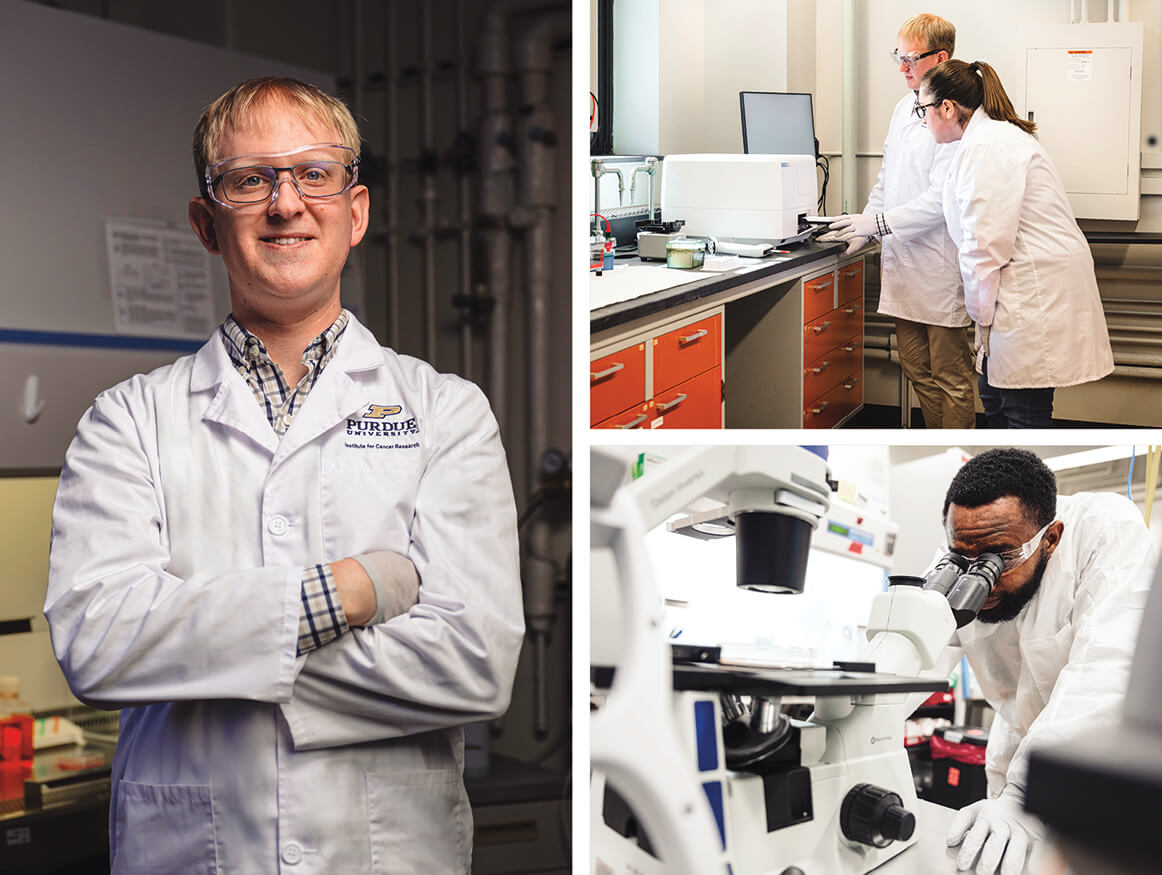
Our role in this is to be the scientist to help to make new therapies, not just to help treat cancers but to make them safer and better tolerated.
Nathaniel Mabe
Assistant professor of medicinal chemistry and molecular pharmacology, Purdue Institute for Cancer Research
He studies neuroblastoma, a malignant cancer that originates in a child’s nerve tissue. He says, “One of the challenges that we want to tackle is helping to increase the therapies available for these really young kids.”
As a part of this effort, he studies the possible drivers behind this type of cancer, including epigenetics. “Every cell in the body has the same DNA –– whether it’s a heart or a brain or skin cell, they all have the same DNA, but the cookbook for making a human, all the different kinds of organs, is what’s called epigenetics,” Mabe explains. “That is, it tells a cell, ‘You’re to become a heart cell; you’re to become a brain cell; you’re to become a skin cell.’”
It’s during this process that childhood cancer commonly develops in the tissue. By digging deeper, Mabe and his collaborators seek to target cancer cells that aren’t developing properly as tissues and use drug therapies to manipulate the cancer cells to resemble healthy tissues. He says, “That doesn’t turn them into healthy tissue, but it prevents them from continuing to grow.”
This research, which he hopes to take to the clinical-trial phase, is part of a larger nationwide effort, including at Mabe’s previous institution, the Dana-Farber Cancer Institute in Boston. The collaborators are currently in talks with pharmaceutical companies, clinicians and scientists, all with the aim of developing a new drug that could help kids with neuroblastoma.
Mabe strives to innovate in this area, and it’s his interactions with patients –– like Kinder –– and their families that keep him going. “We’re in the lab most days,” he says, “but certainly seeing their energy and commitment to the cause energizes us to work harder and to work smarter so that we can make as many differences as fast as we can.”
Kinder finds his purpose
Kinder chose Purdue with his parents’ help, because he knew the campus well and trusted that it would provide him with the sense of comfort and normalcy that he craved during his treatment for leukemia.
He benefited from a few stabilizing forces. One of his older sisters, Claire, was a senior at the time and living on campus in West Lafayette, which was a big relief in case he ever needed help.
Also, the Riley Hospital for Children, where Kinder received regular chemotherapy treatments, was roughly an hour’s drive from where he lived. And Purdue’s Disability Resource Center helped coordinate with his doctor at Riley, eliminating some of the stress when he needed to miss classes.
Like Trent, Kinder was highly motivated to contribute something meaningful to Purdue –– a place they valued so much –– and be unrelenting in those pursuits.
One of the ways Kinder worked toward this goal was by joining the Beta Theta Pi fraternity. During his sophomore and junior years, he became heavily involved in the organization’s philanthropic efforts in connection with the PICR and Tyler Trent Cancer Research Endowment.
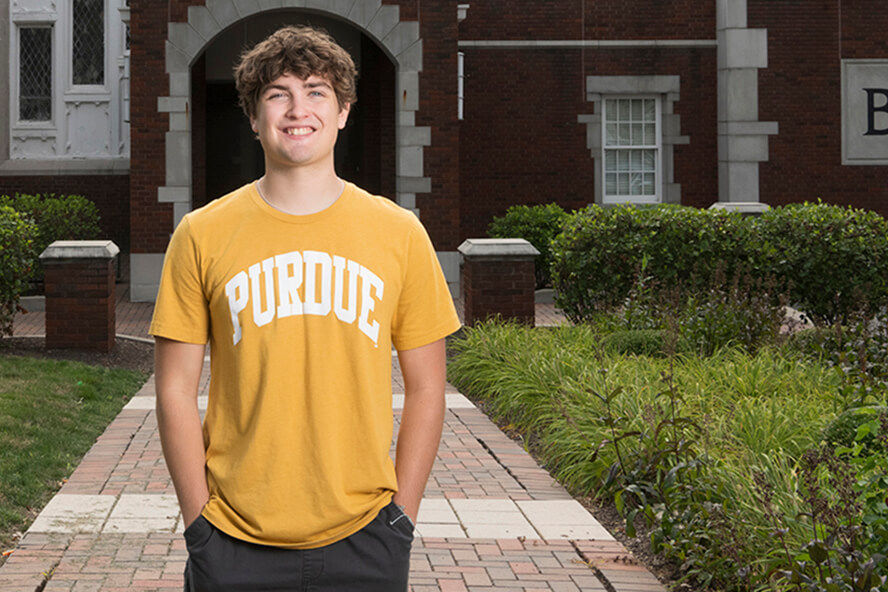
Tyler was exactly what a Boilermaker is. His mindset really is also something I look at as motivation. Like you’ve always got to keep going.
Andrew Kinder
Purdue senior in business
Each fall around the Hammer Down Cancer football game, members from Beta Theta Pi shave their heads and donate the sponsorship proceeds to cancer research at Purdue during an event called “Buzz-A-Beta.” Kinder estimates that he raised around $15,000 through this.
For him, this philanthropy is incredibly fulfilling. “As a Boilermaker, you always keep pushing. You can’t let anything really stop you,” he says.”
The mission behind cancer research at Purdue
The Purdue Institute for Cancer Research was established in 1976 and became a National Cancer Institute-designated cancer center in 1978. It’s one of only 73 NCI-designated cancer institutes, which are found in 37 states and the District of Columbia.
“NCI designation is the gold standard of quality in cancer care and in cancer research,” says Andrew Mesecar, the Robert W. Miller Director of the PICR.
He explains that Purdue’s, and particularly the PICR’s, biggest strengths are its interdisciplinary nature and renewed focus on pediatric cancer research with the Tyler Trent Pediatric Cancer Research Center, which was established in 2023 with support from the Tyler Trent Cancer Research Endowment.
Mesecar says, “I wanted to create a model where we were not just a cancer research center, but an institute, where we can create centers focused on specific areas like pediatric cancer, and fulfill our academic mission of training students and training postdocs as the next generation of cancer researchers.”
This model draws on Purdue’s unique scientific expertise and technological capabilities. It also brings together biologists, pharmacists –– like Mabe –– biochemists and engineers, for example, to analyze and better understand what’s driving a specific cancer and develop effective therapeutics and delivery methods.
The institute has a proven track record of excellence in these areas for adult cancers, including three FDA-approved drugs and agents, and patents and licensed technologies. And now, Mesecar hopes to translate these strengths into advancements in pediatric cancer, an area that requires more funding and research.
The Tyler Trent Pediatric Cancer Research Center and the recruitment of new faculty like Mabe are essential leaps toward this objective.
Mesecar wants patients and their families to know that they’re not alone. “Purdue exists and it’s doing something about cancer,” he says.
At Purdue, we tackle the world’s toughest challenges through timely research and innovation. Andrew’s story is just one of many incredible examples of how this pursuit continues to enhance the lives of those in our community and beyond.
Learn more https://www.purdue.edu/campaigns/next-giant-leap/