Purdue alums waiting to help Artemis astronauts return home safely
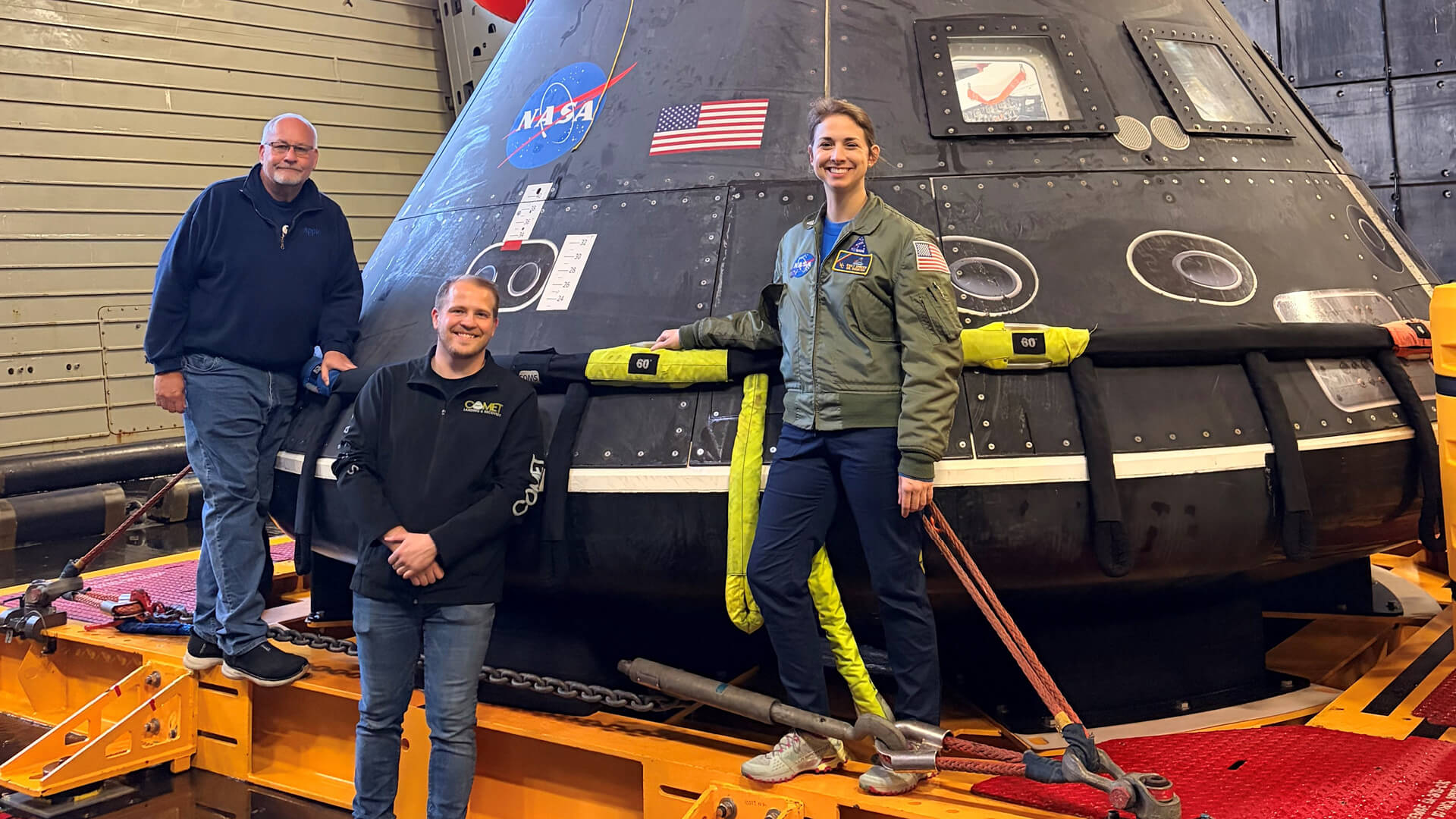
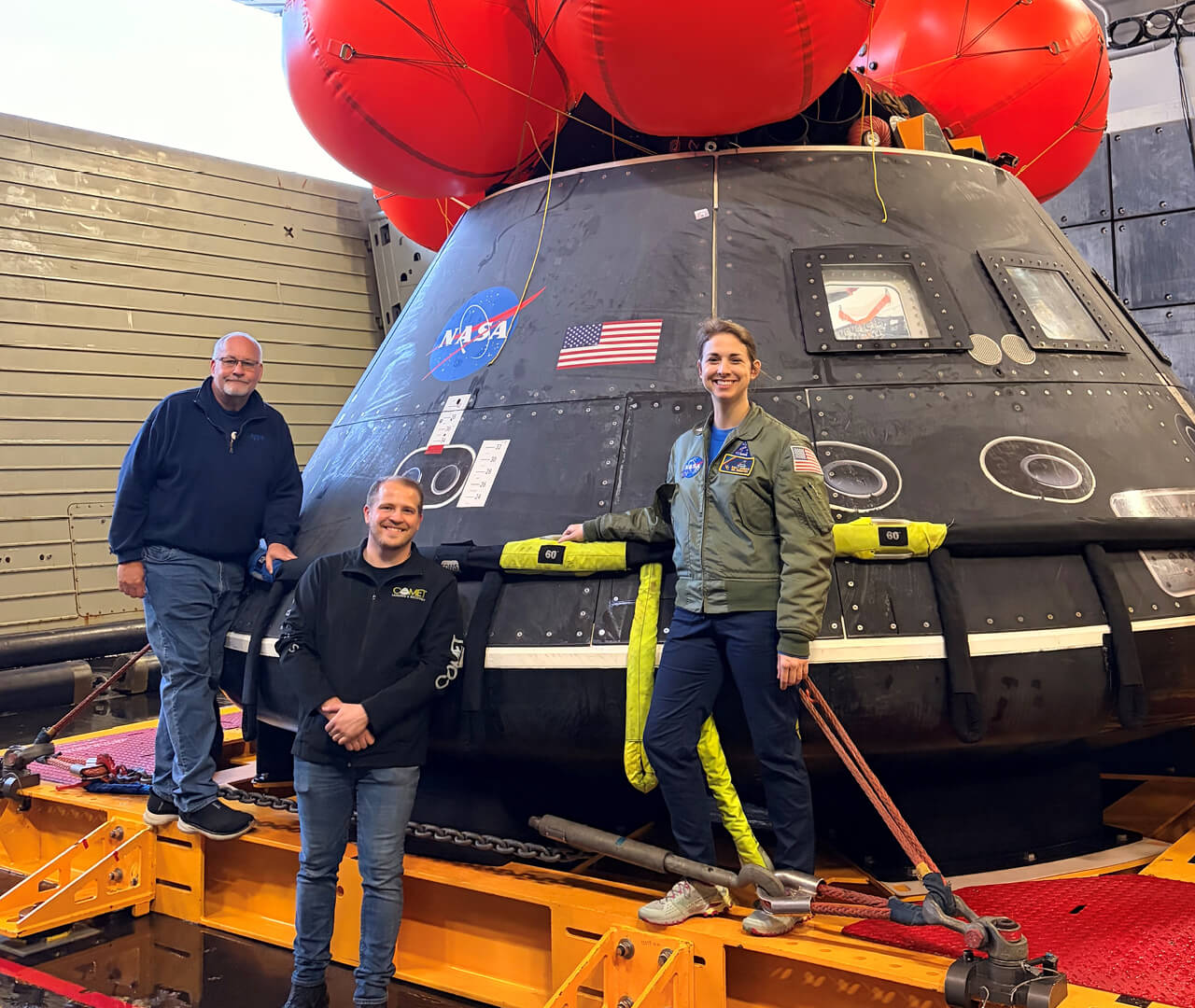
Purdue alumni Rob Lantz, Jason Endsley and Emily Spreen are members of the Landing and Recovery Operations team responsible for retrieving the Artemis II astronauts and crew module from the Pacific Ocean after splashdown. (Photo courtesy of Jason Endsley)
NASA’s recovery team includes three alums aboard the Navy ship that will retrieve the space voyagers from the Pacific Ocean
When the crew of Artemis II splashes down in the Pacific Ocean just after 8 p.m. ET on Friday, April 10, it will be the end of a 10-day journey where they traveled farther away from Earth than anyone in history.
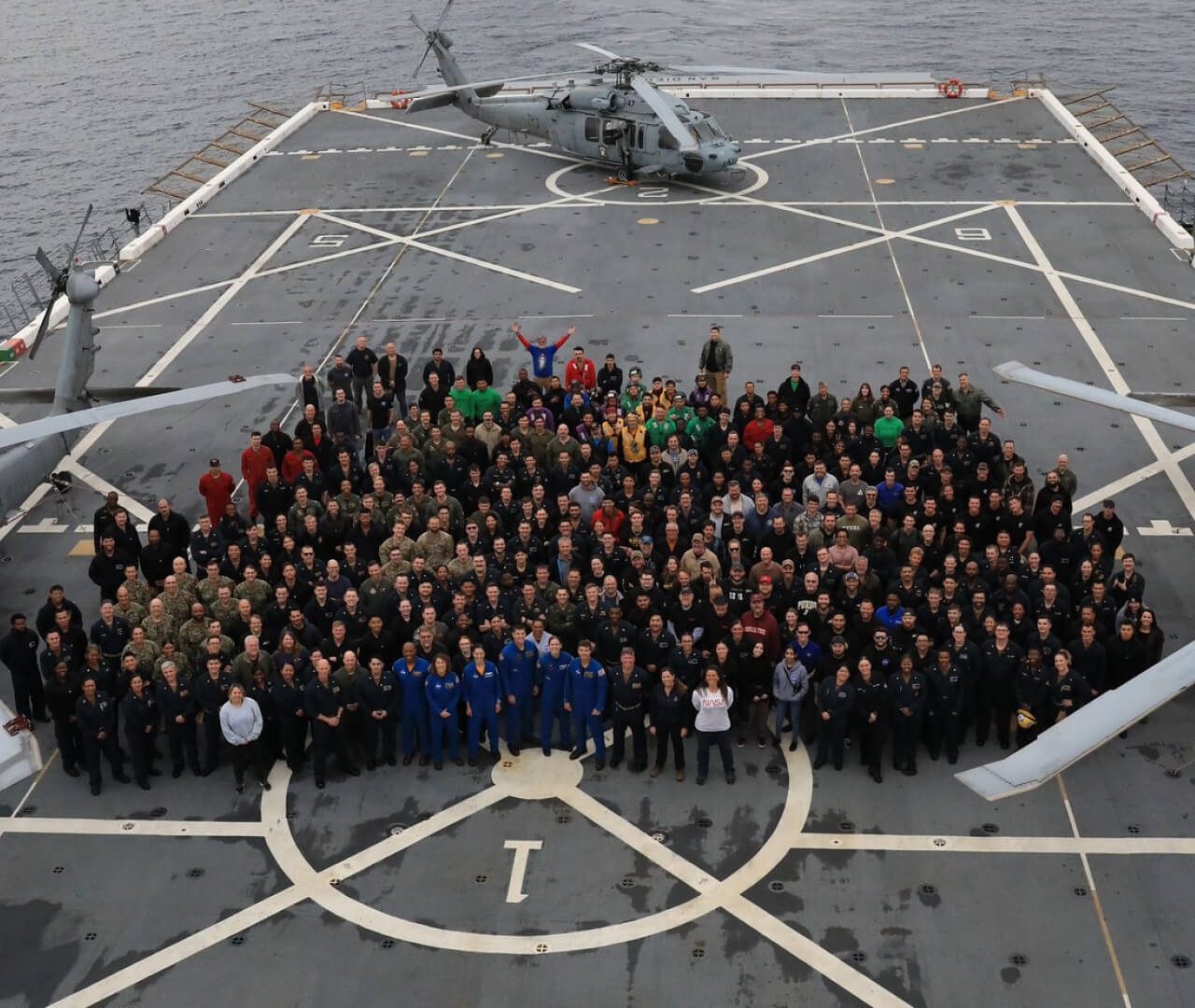
But the work will be far from complete for the members of the Landing and Recovery Operations team — a group that includes Purdue alumni Emily Spreen, Jason Endsley and Rob Lantz — who have spent years preparing for this moment. The team has been aboard the USS John P. Murtha all week, preparing to retrieve the four astronauts and spacecraft and safely transport them to the Navy ship.
“I’d describe the recovery process as a carefully coordinated ballet,” says Spreen (BS aeronautical and astronautical engineering ’15, MS astrodynamics and space applications ’17, PhD aeronautical and astronautical engineering ’21), a NASA aerospace engineer who leads a team that will pinpoint where the spacecraft and jettisoned hardware will land, ensuring the safety of the waiting recovery crews. “There are a lot of moving parts and interfaces between NASA and the DOD (Department of Defense) that all must work smoothly together. We practice each piece of the recovery process many times in order to be prepared for anything on game day.”
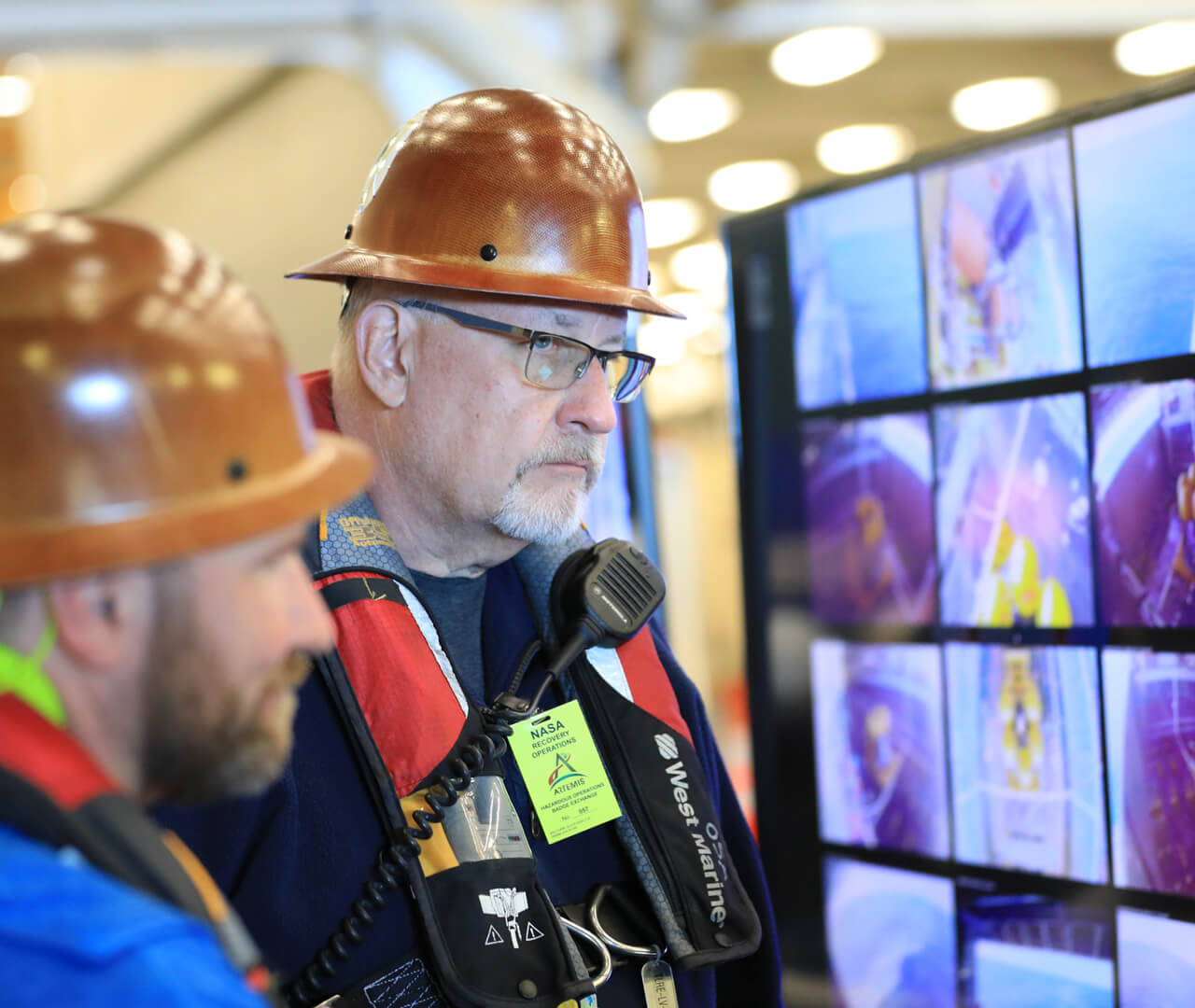
Purdue Polytechnic alum Endsley (BS aeronautical engineering technology ’19, MS aerospace and aviation management ’20) will share real-time data that can help the team account for weather and water conditions and make decisions on how to proceed with recovery. As the lead instrumentation engineer for the Landing and Recovery team, Endsley has installed sensors on the recovery equipment and naval vessel that will provide critical information about factors such as wave heights; water depth; line speed and tension; and the ship’s pitch, roll and yaw.
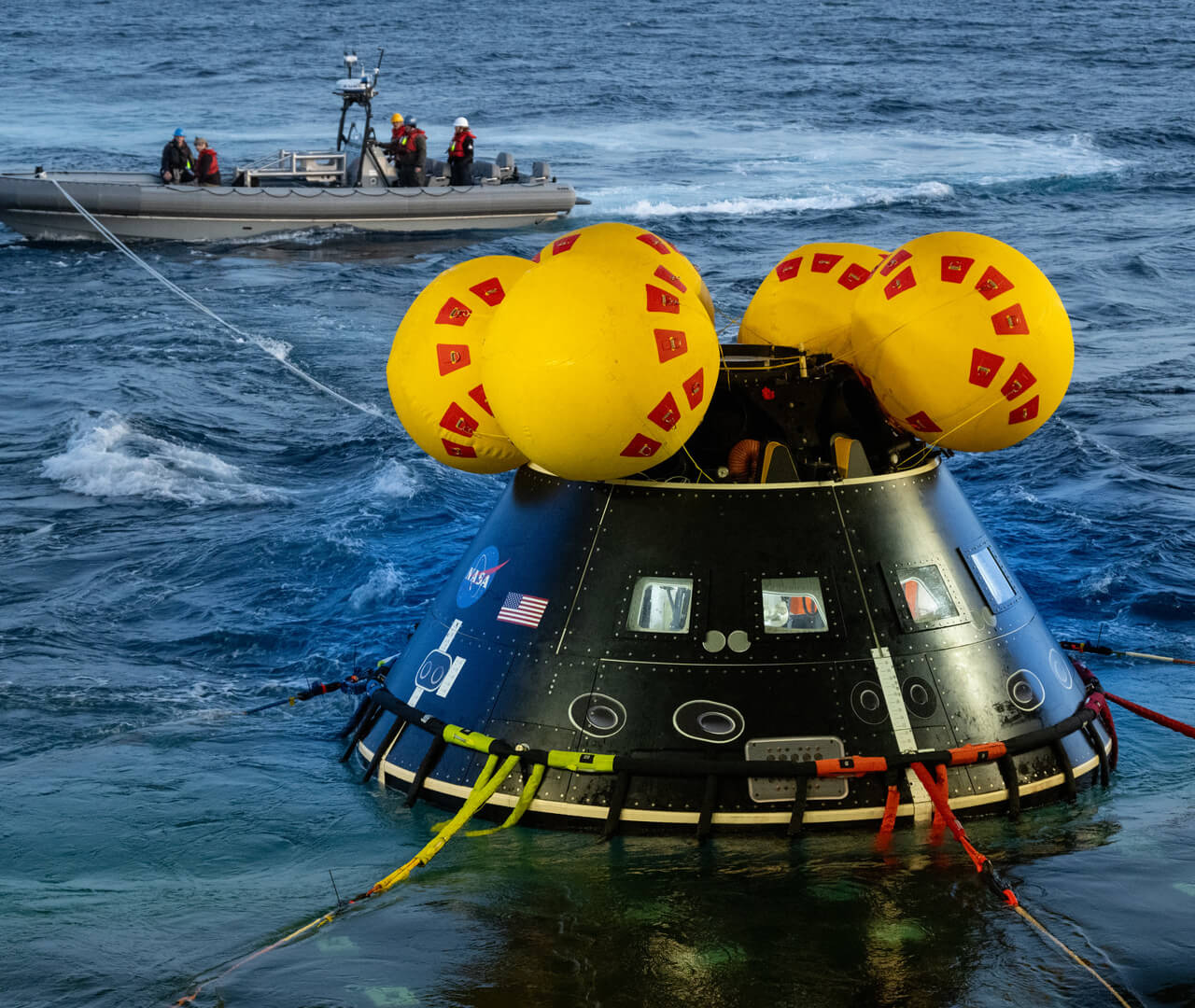
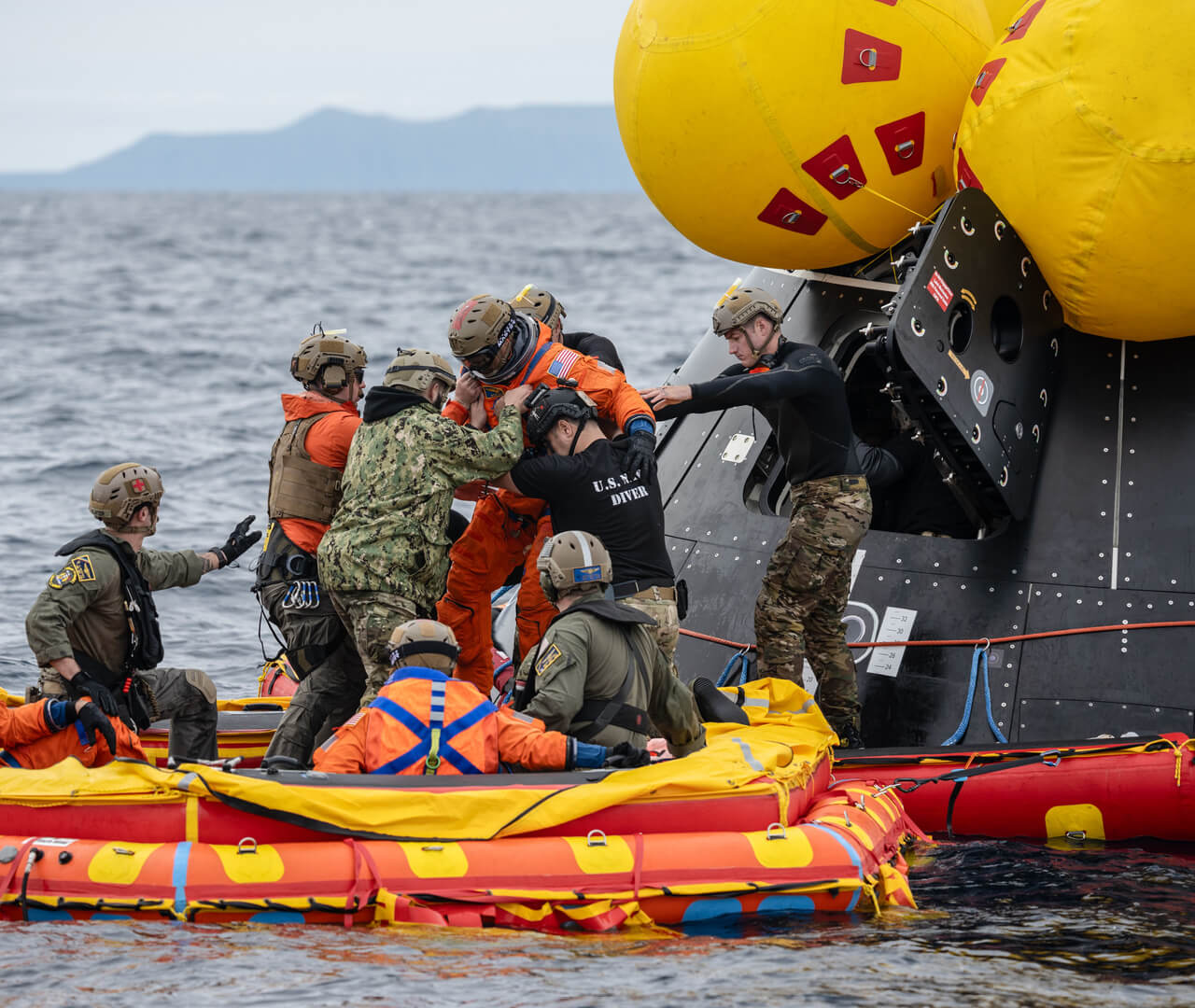
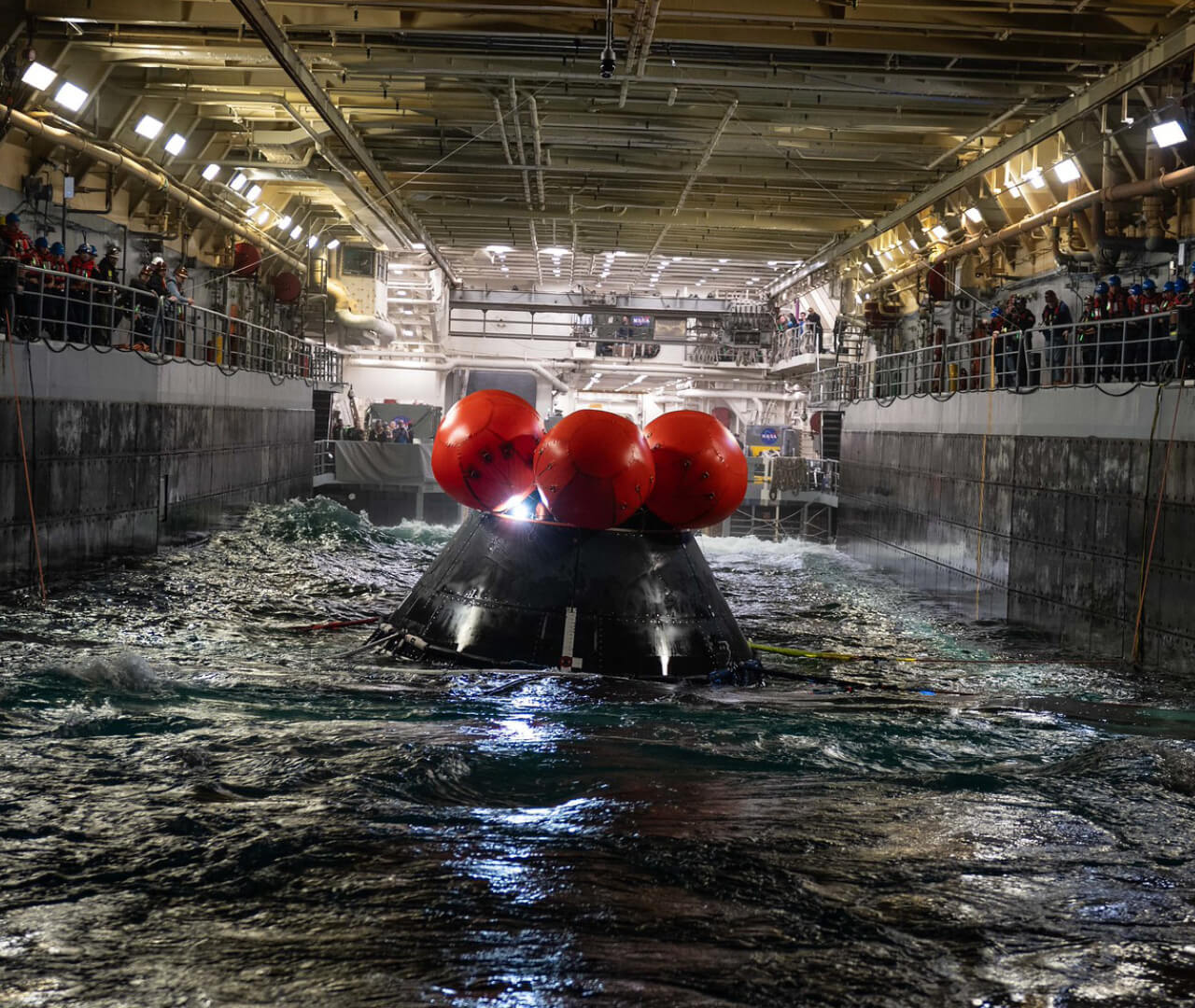
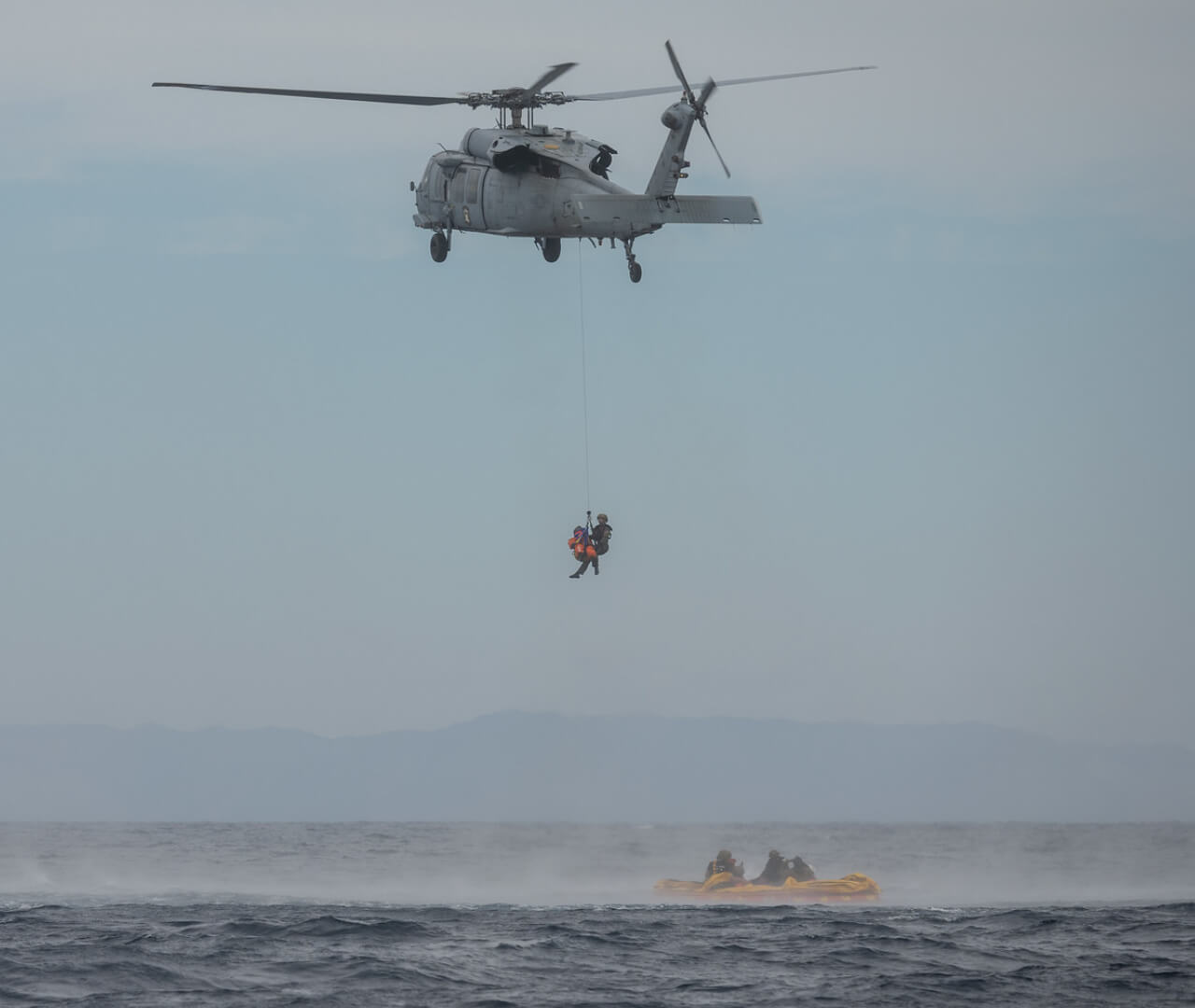
“Prior to splashdown, the recovery team will already be working hard to prepare for our operations and will jump into action right away,” Endsley says. “The first objective will be to swiftly and safely get the astronauts on board the ship to be medically evaluated, and the second objective will be to recover the crew module.”
After splashdown, projected to occur between San Clemente Island and Catalina Island off the coast of San Diego, the Department of Defense and NASA’s Johnson Space Center will share the responsibility of getting the astronauts out of the water. Four helicopters will be waiting — two for recovery, two for imaging — with the recovery helicopters alternately retrieving astronauts one at a time and carrying them to the John P. Murtha.
“The most incredible part to me is how well prepared the recovery team is to handle this part of the mission,” Spreen says. “We practice and rehearse till the real thing feels like another simulation, albeit with much more excitement and electricity in the air.”
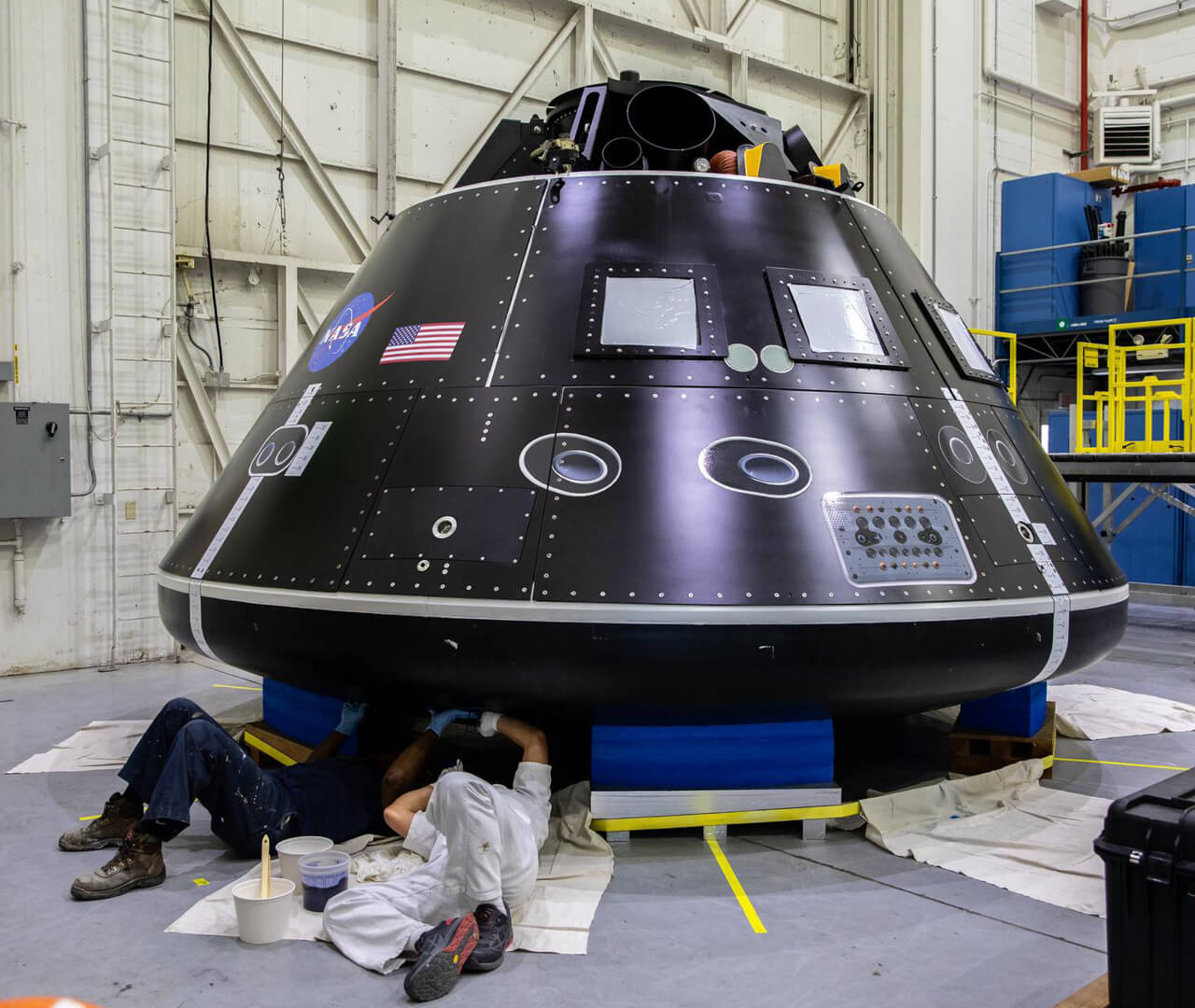
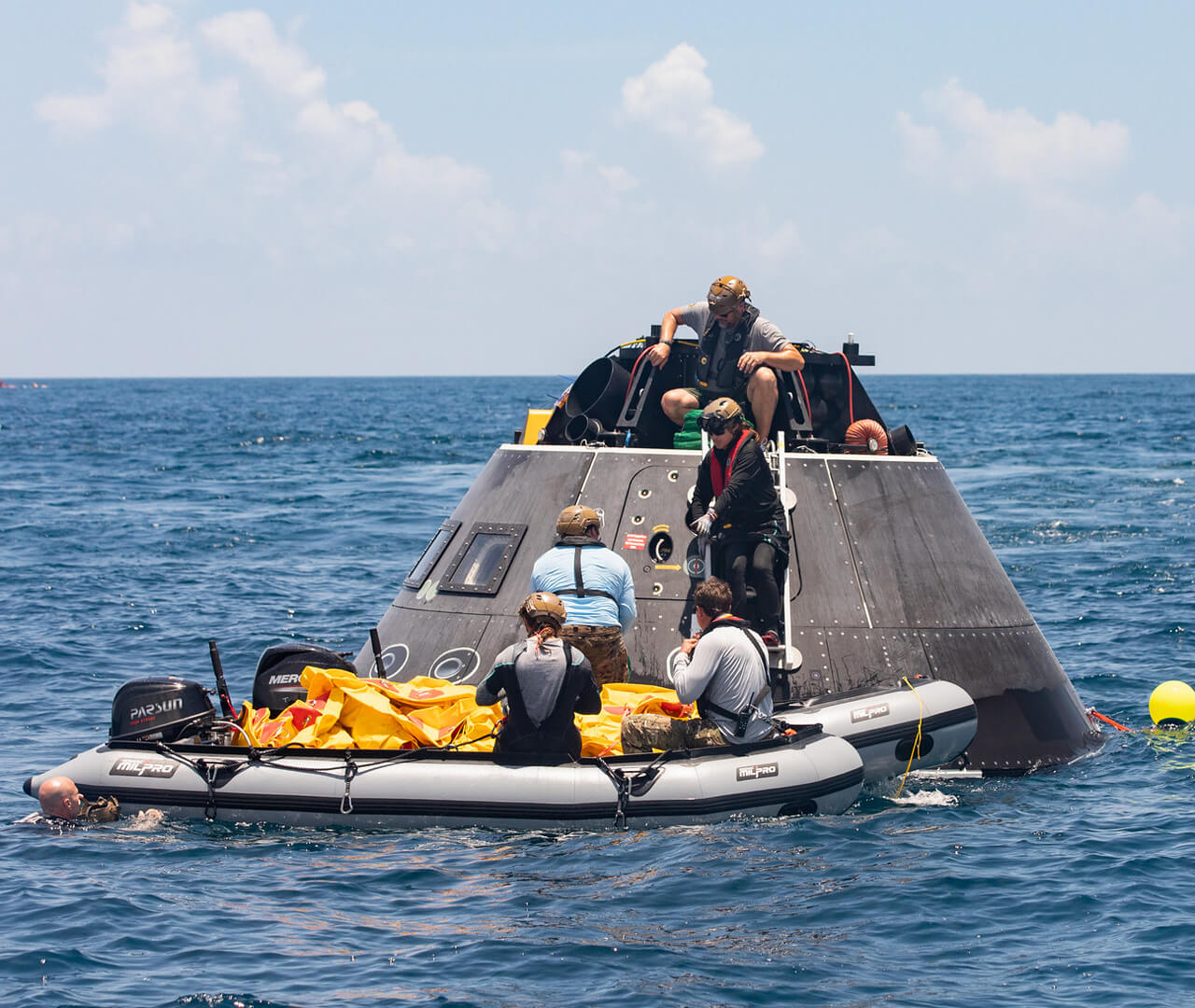
Once the astronauts have been retrieved, the recovery team will turn its attention to the Integrity crew module. Endsley and Lantz (BS aeronautical and astronautical engineering ’88) are part of the team responsible for recovering it and floating it into the well deck of the Navy ship. Then they will prepare it for truck transport back to Kennedy Space Center in Florida.
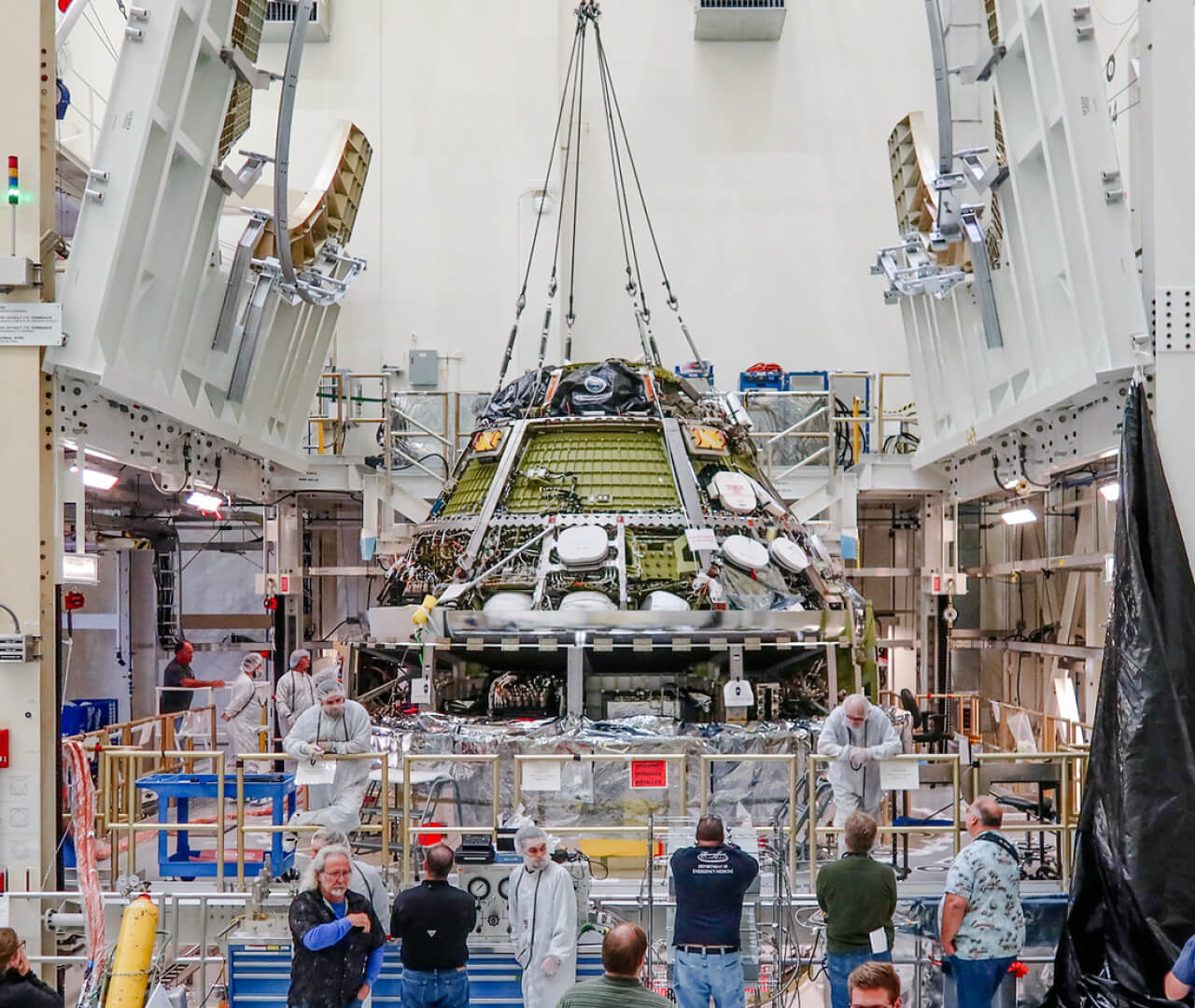
“It will be a great pleasure to see the years of practice and coordination between NASA, contractors and the military come together to safely recover the Artemis II crew and flight hardware, while also making history,” Endsley says. “While there will still be more work to do after recovery operations are complete, I think we will all breathe a sigh of relief once the astronauts are safely on board and the crew module is secured in the well deck of the naval vessel.”
‘The vibe for this one is off-scale high’
The Artemis II mission has been historic for many reasons. On Monday, April 6, crewmates Reid Wiseman, Victor Glover, Christina Koch and Jeremy Hansen eclipsed the Apollo 13 crew’s record for the farthest distance of a human spaceflight. The Orion spacecraft eventually reached 252,756 miles from Earth, beating the Apollo 13 record by approximately 4,000 miles.
The Artemis II lunar voyage also marked the first time humans traveled to the moon since December 1972, when Boilermaker astronaut and Apollo 17 commander Eugene Cernan (BS electrical engineering ’56) took the most recent steps on the lunar surface. The significance of this trip was obviously not lost on those who dedicated years to ensuring that NASA could successfully send a new collection of astronauts to the moon and back.
“I can tell you that the vibe for this one is off-scale high,” says Lantz, who has supported 108 launches since 1989 while working for NASA or government contractors with the space shuttle program. “Low earth orbit is cool, but going to the moon is awesome. Especially since I was only 8 years old in 1972 when we had the last moon mission, and I honestly do not remember it at all. I am nearing the end of my career, and I can honestly say this is one of the greatest highlights of it.”
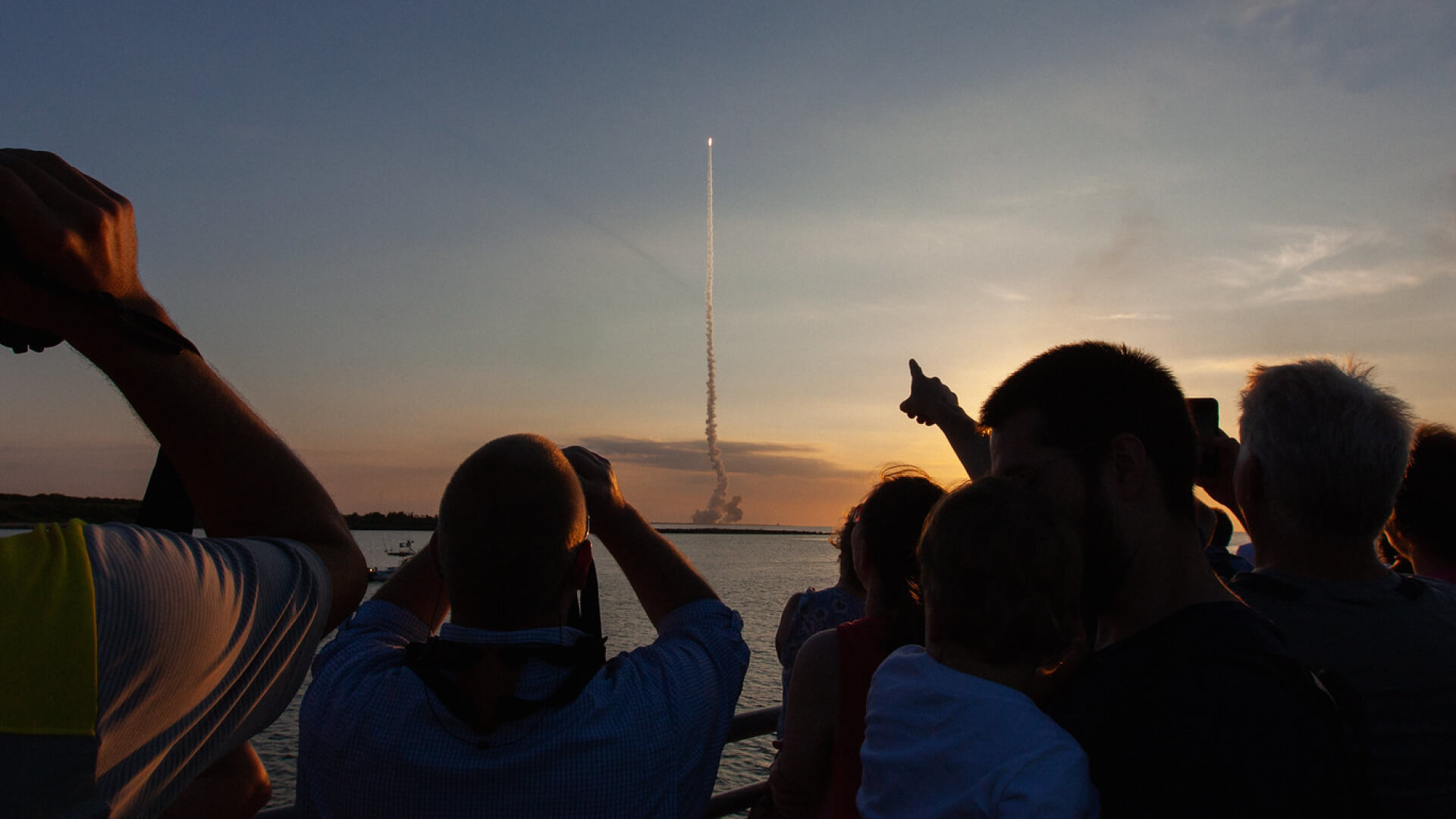
That is a common sentiment among his colleagues who, like many Americans, watched the April 1 liftoff with a combination of excitement, awe and sentimentality.
“Honestly, it was an emotional experience for me,” says Spreen, who watched the event at Kennedy Space Center. “My journey to NASA started when I saw a space shuttle launch in high school with my family — I wanted to be a part of human spaceflight. Now it feels like my journey is coming full circle. I am a part of it!”
As members of the Expedited Recovery Team (ERT), Endsley and Lantz were already in San Diego at liftoff. If the crew experienced any complications that forced them to abort the mission and splash down prematurely in the Pacific, the ERT was on standby to mobilize and quickly rescue the astronauts.
Fortunately no such issues arose, so the ERT members were able to enjoy the occasion together at a high-spirited watch party.
“To be completely honest, we were all literally amazed that we launched on the first attempt,” Lantz says. “There was a lot of hooting and hollering, high-fives and quite a few tears shed. You work on a vehicle for years assembling and testing it, and it launches on the first attempt. It was magical for sure.”
During the mission, the Artemis crew has tested life-support and other critical systems and capabilities of the Integrity spacecraft, such as its ability to execute docking maneuvers for future flights.
Their work has helped set the stage for a new era of space exploration, advancing NASA’s plans for new moon landings, lunar settlements and voyages deeper into space in the coming decades. And when they return to Earth from this historic mission, the Boilermaker alums will be there to welcome them home.
“I am most excited to see the crew module come down under parachutes and splash down,” Endsley says. “That is a sight not many people get to see with their own eyes, and I feel very fortunate to get to do that.”
‘It feels like the first time, still’
The Boilermakers on the Landing and Recovery team have already participated in numerous training exercises in preparation for Friday’s splashdown, including many Underway Recovery Tests as well as the recovery of the uncrewed Artemis I capsule in 2022.
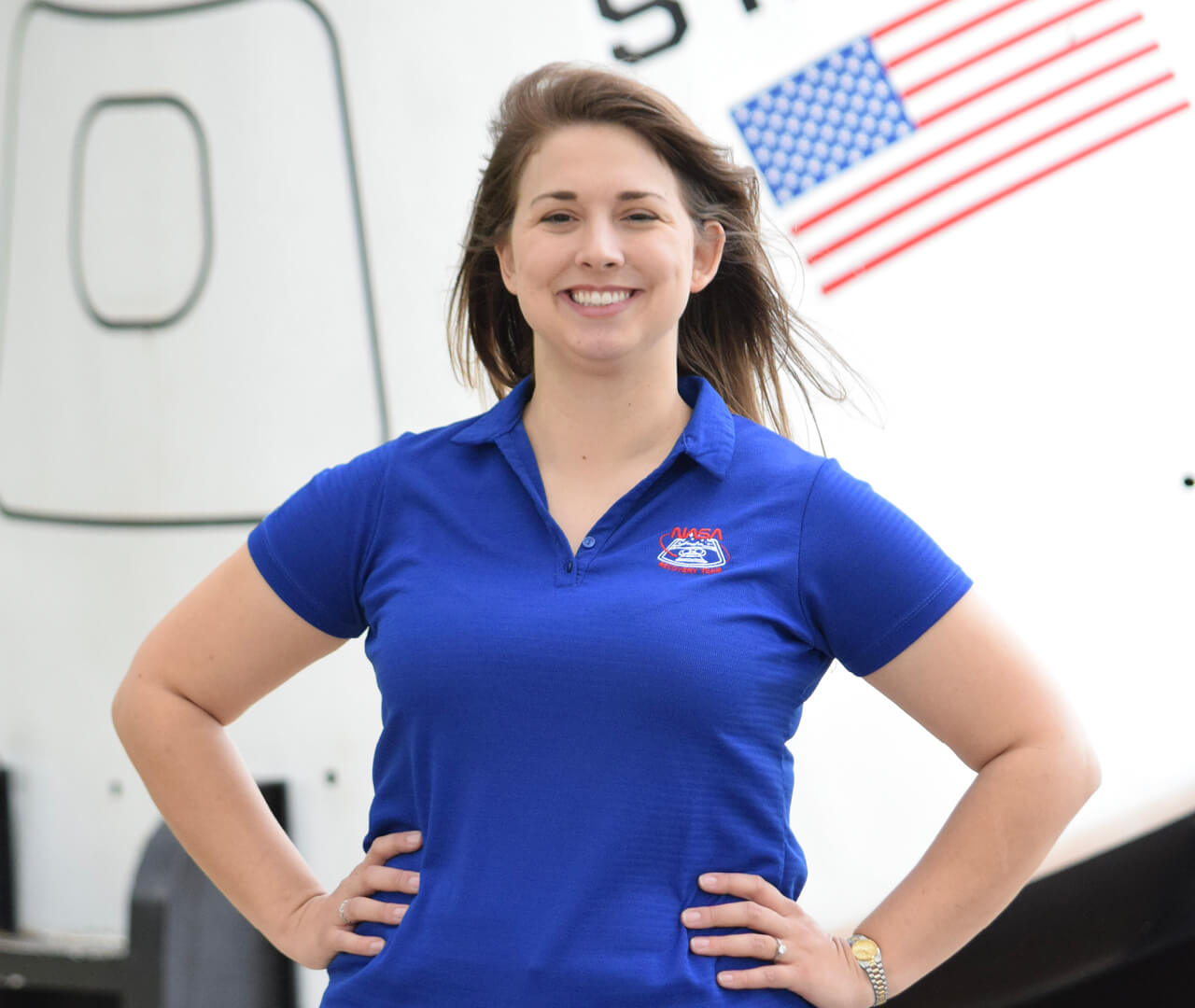
Spreen leads the “Sasquatch” recovery team, which projects the capsule location and helps to safely position the NASA and naval recovery crews to avoid the descending capsule and items that are jettisoned off during the parachute sequence.
If you’re wondering what the recovery process has to do with Bigfoot, allow Spreen to explain the tracking process.
“The positioning of those (jettisoned) items is predicted as ‘footprints,’ hence the team name, ‘Sasquatch,’” she says.
Perhaps it’s a silly name, but the software’s accuracy during the Artemis I landing was no joke.
“The performance of the ‘Sasquatch’ team was incredible, and our predictions on Artemis I were very accurate. I was thrilled,” Spreen says. “I expect similar accuracy for Artemis II. My team works very hard to make sure that we can get recovery forces as close as safely possible to expedite crew and capsule recovery and obtain engineering imagery for flight test objectives.”
Lantz, NASA’s lead engineer for the handling and access subsystem, shares responsibility with the lead engineer of a contractor crew for recovering the crew capsule into the ship’s well deck. They have conducted training runs aboard Navy ships numerous times since the Artemis I splashdown.
Endsley worked in launch operations before, during and after the Artemis I launch — he is also lead ground instrumentation engineer for Artemis — but did not begin working in recovery until after watching its awe-inspiring return on video. The self-described lifelong space nerd noticed the similarity between the Artemis recovery process and that of the Apollo years and immediately lobbied to add recovery responsibilities to his job description.
“I worked hard to learn as much as I could, continually expressed my interest in joining the team, and really just did not give up until I got the chance,” he says. “Every time I have gone out to sea since then, it feels like the first time, still, and is easily my favorite part of my job.”
‘Purdue was setting me up for great things’
Those familiar with Purdue’s extensive space legacy will not be surprised to learn that the three alums are among many Boilermakers working on the Artemis program.
“It’s always enjoyable to hear ‘Boiler Up!’ while at work or see Purdue gear while walking out of the Vehicle Assembly Building,” Endsley says. “There are quite a few Purdue alumni that work on the Artemis program, and this is evident by the fact that on this small recovery team there are multiple of us on the Navy ship. Every time I see another Purdue alum, I am reassured that I made the right choice in attending Purdue, which started me on a path to arrive where I am today.”
Lantz agrees, noting that “it is quite special to share these special moments with fellow Boilermakers.”
Supporting NASA’s goal to return astronauts to the moon, with the next footprints potentially being left in the lunar dust by 2028, gives their work added purpose.
“I wanted to be a part of history in the making,” Spreen says. “I also really enjoy the adventure of getting to go underway on a U.S. Navy ship and interface across many different teams at NASA and the DOD. It is a lot of fun to be a part of, and I’ve met so many brilliant people along the way. I like feeling like my work makes a difference and is important, and I most definitely get that feeling from the work I do with Landing and Recovery at NASA.”
The work is indeed pivotal — and their Purdue training has uniquely prepared them to do it well.
“I still remember the day I got my acceptance letter; I knew then that I was on the right path to achieve my dreams,” Endsley says. “While I was very aware that Purdue was setting me up for great things in my future, I still would never have dreamed of being able to do the job I do.
“Purdue has a storied history with spaceflight, and I was keenly aware of that,” he continues. “I am honored to be a small part of continuing that legacy by not only helping to build the vehicle returning humans to the moon for the first time since 1972 but also being there to recover the astronauts out of the ocean. As I sit here preparing for recovery, it reminds me that every night studying at the Purdue University Airport, Hicks Library or in my dorm was worth every moment. Those long nights, homework and final exams laid the foundation of the path that led me to this moment.”